Tlingit Chilkat and Ravenstail Weaving Regalia Guide 2026
The Living Legacy of Northwest Coast Textiles in 2026
The Indigenous peoples of the Pacific Northwest Coast—most notably the Tlingit, Haida, and Tsimshian nations—possess one of the most complex and visually striking textile traditions in the world. As we navigate 2026, the creation and wearing of traditional regalia is not merely an act of historical preservation; it is a vibrant, living assertion of sovereignty, identity, and artistic brilliance. From the intricate, curved formlines of the Chilkat blanket to the stark, geometric precision of Ravenstail weaving, Northwest Coast garments are masterpieces of mathematics, mythology, and material science.
In recent years, a profound cultural revitalization has swept through Southeast Alaska and British Columbia. Master weavers are passing down knowledge that was nearly lost during the 20th century, and a new generation of Indigenous artists is innovating within these ancient frameworks. This guide explores the structural differences, material sourcing, and contemporary significance of Tlingit and regional Northwest Coast weaving traditions in 2026.
Chilkat Weaving: The Pinnacle of Formline Art
Known in the Tlingit language as naaxein, the Chilkat blanket is arguably the most technically demanding textile produced by any Indigenous culture in the Americas. Originating with the Tsimshian people and later perfected by the Tlingit (specifically the Chilkat Tlingit, from whom the English name derives), these robes are worn by clan leaders and dancers during potlatches and ceremonial gatherings.
Unlike European tapestry weaving, Chilkat weaving does not utilize a traditional loom with heddles. Instead, the warp threads are suspended from a horizontal crossbar, and the weaver works from the top down, using only their fingers to twist and interlock the weft threads. The designs are based on Northwest Coast formline art—featuring stylized animals, ancestral crests, and spiritual beings. Historically, the pattern boards were painted by men trained in formline design, while the weaving was executed by women. Today, in 2026, these gendered divisions are much more fluid, with many male weavers and female formline artists contributing to the art form.
A genuine Chilkat blanket can take over a year to complete. The bottom and side fringes, which can be up to two feet long, are meticulously hand-twisted, creating a dramatic, swaying motion when the robe is danced. According to the Smithsonian National Museum of the American Indian, historic Chilkat robes remain some of the most prized and carefully conserved items in global ethnographic collections, but the true heart of the art form beats in the communities where they are still actively woven and danced today.
Ravenstail Weaving: The Geometric Ancestor
Before the curvilinear formlines of Chilkat weaving dominated the coast, there was Ravenstail (yéil kootéeyaa). Characterized by stark, high-contrast geometric patterns—primarily black, white, and yellow—Ravenstail is an ancient technique that shares structural roots with basketry.
In 2026, Ravenstail is experiencing a massive renaissance. Many contemporary weavers are drawn to its bold, almost modernist aesthetic and its deep historical roots. The patterns feature sharp angles, zigzags, and concentric diamonds that represent the eyes, feathers, and spiritual power of the raven and other ancestors. Because Ravenstail relies on twining techniques rather than the complex interlocking weft of Chilkat, it is often the entry point for apprentice weavers, though mastering the tension and mathematical precision required for a full ceremonial robe remains a monumental task.
Chilkat vs. Ravenstail: A Structural Comparison
Understanding the technical distinctions between these two paramount weaving styles is essential for collectors, students, and enthusiasts of Indigenous dress. Below is a comparative breakdown of their core characteristics.
| Feature | Chilkat (Naaxein) | Ravenstail (Yéil Kootéeyaa) |
|---|---|---|
| Design Motif | Curvilinear formline (animals, crests) | Geometric (zigzags, diamonds, eyes) |
| Primary Colors | Yellow, black, blue-green, white | Black, white, yellow (high contrast) |
| Weaving Technique | Twining with interlocking weft (tapestry-like) | Twining (similar to basketry techniques) |
| Warp Material | Mountain goat wool spun with cedar bark core | Mountain goat wool (often without cedar core) |
| Fringe | Long, flowing, hand-twisted warp fringe | Shorter, often braided or twisted fringe |
Materials and Sourcing in 2026: Sustainability and Adaptation
The creation of authentic Northwest Coast regalia is deeply tied to the local environment. The two primary materials are mountain goat wool and the inner bark of the yellow cedar tree. However, as of 2026, environmental shifts and climate change in the Tongass National Forest and surrounding regions have necessitated adaptations in how weavers source their materials.
Mountain Goat Wool and Ethical Harvesting
Traditionally, wool was gathered from sheds or harvested from goats hunted for subsistence. Today, master weavers work closely with local hunters and wildlife management agencies to ensure ethical and sustainable harvesting. The wool must be meticulously cleaned, carded, and spun by hand. To achieve the unique structural integrity of Chilkat warp threads, the goat wool is spun around a core of shredded yellow cedar bark, giving the thread a stiff, durable quality that holds the heavy fringe.
Yellow Cedar Bark and Climate Impacts
The inner bark (bast) of the yellow cedar is harvested in the late spring or early summer when the sap is running. In 2026, shifting spring temperatures have required weavers to be highly observant of local microclimates to harvest at the exact right moment. The bark is stripped, boiled, and pounded to separate the pliable inner fibers from the rough exterior. For practice pieces and educational workshops, many weaving circles now utilize commercially sourced merino wool and raffia to preserve wild-harvested cedar and goat wool for sacred, ceremonial robes.
The Button Blanket: A Post-Contact Masterpiece
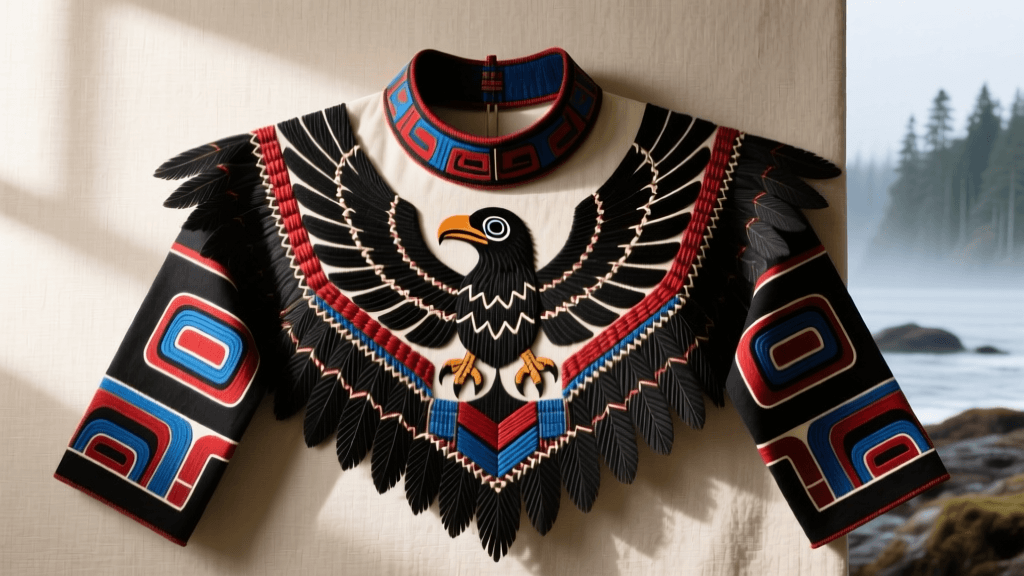
No discussion of Northwest Coast regalia is complete without the button blanket. Emerging in the late 19th century following contact with European and American traders, the button blanket is a brilliant example of Indigenous adaptation and innovation. Using heavy wool trade blankets (often from the Hudson's Bay Company) as a base, artists began appliquéing clan crests cut from broadcloth and outlining the designs with hundreds of pearl, abalone, and brass buttons.
In 2026, the button blanket remains a staple of the potlatch and the dance house. Contemporary artists are pushing the boundaries of the medium, incorporating LED lighting, laser-cut acrylics that mimic traditional abalone shell, and intricate beadwork. The buttons catch the firelight (and modern stage lighting), creating a dazzling, kinetic display of clan pride and ancestral continuity. Institutions like the Sealaska Heritage Institute actively support the creation of these garments, hosting workshops that teach the precise appliqué and button-sewing techniques required to make a blanket that can withstand the vigorous movements of traditional dancing.
Preservation, Protocols, and Purchasing Authentic Regalia
As global interest in Indigenous textile arts continues to grow, it is vital to approach the acquisition and study of these garments with respect for cultural protocols. Chilkat and Ravenstail robes are not merely decorative art; they are considered living entities that possess spiritual weight and belong to specific clans or houses.
If you are a collector, museum curator, or enthusiast looking to support this art form in 2026, the golden rule is to purchase directly from Indigenous artists or through verified, Native-owned galleries. Mass-produced replicas and cultural appropriations not only violate intellectual property rights but also undermine the economic sovereignty of Indigenous communities. The Burke Museum Ethnology Collection provides excellent resources for understanding the historical context of these pieces, but supporting living weavers ensures the tradition thrives for the next century.
Conclusion
The dress traditions of the Tlingit and neighboring Northwest Coast nations are a testament to the resilience and genius of Indigenous peoples. Whether it is the mathematical perfection of a Ravenstail tunic, the sweeping formlines of a Chilkat robe, or the shimmering crest of a button blanket, these garments are the physical embodiment of history, law, and spirituality. As we move through 2026, the loom remains a powerful site of resistance, education, and profound beauty, ensuring that the ancestors' voices continue to be heard in every twisted thread and sewn button.