Inuit Parka Sewing With Seal Intestine And Fur Trimming Methods
Seal Intestine Parkas: Functional Precision in Arctic Climate Adaptation
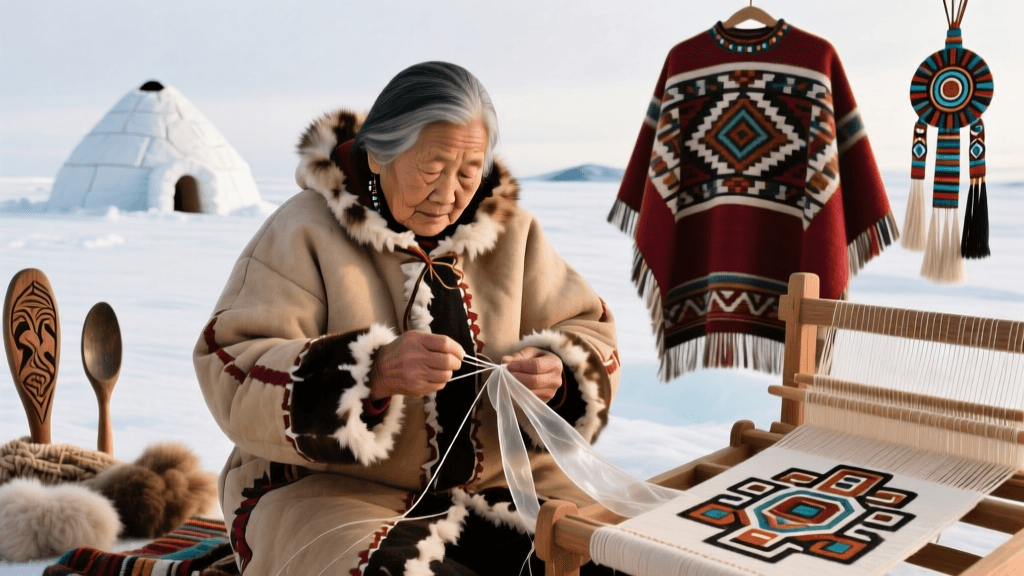
The Inuit parka made from seal intestine represents one of the most sophisticated waterproof garments ever developed by Indigenous peoples of the Americas. Unlike conventional leather or woven textiles, gutskin parkas rely on the translucent, collagen-rich membranes of bearded and ringed seal intestines—processed through meticulous cleaning, stretching, and drying techniques passed down over millennia. These parkas were not ceremonial novelties but essential survival gear for marine hunters navigating open leads, ice floes, and wind-driven snow at temperatures as low as −45°C. The material’s unique tensile strength allows it to stretch without tearing while remaining impervious to water—even when worn next to bare skin during strenuous activity.
Processing Seal Gut: A Multi-Stage Craft Requiring Seasonal Timing
Preparation begins immediately after the hunt: intestines must be removed within 15 minutes to prevent enzymatic degradation. Each intestine is rinsed in seawater, turned inside out using a willow stick, and scraped with an ulus—a crescent-shaped bone or ivory knife—to remove mucosal layers without puncturing the membrane. The cleaned gut is then inflated like a balloon using a hollow bone pipe and hung on wooden frames in shaded, well-ventilated areas for 3–5 days. Drying time varies by humidity and temperature; at Iqaluit (63°N), optimal drying occurs between −10°C and −2°C, requiring precise environmental awareness.
Material Yield Metrics
A single adult bearded seal yields approximately 8–12 meters of usable gut membrane, enough for one full parka shell. Each meter weighs roughly 17 grams when fully dried and stretched. Gut thickness averages 0.12–0.18 mm—thinner than human hair yet capable of withstanding 20 kPa of hydrostatic pressure before leakage. Stitching uses sinew thread drawn from caribou tendons, twisted to a diameter of 0.3 mm, with needle holes spaced exactly 4 mm apart to maintain structural integrity.
Fur Trimming Techniques and Regional Variations
Fur edging serves both thermal regulation and symbolic functions. In Nunavik (northern Quebec), parkas feature wide wolverine ruffs measuring 12–15 cm in depth, cut in concentric arcs to trap warm air near the face. The ruff’s inner layer consists of dense underfur, while outer guard hairs are left uncut to shed frost. In contrast, communities around Cambridge Bay use narrower 7–9 cm ruffs made from arctic fox, dyed black using fermented seabird guano mixed with iron-rich clay—yielding hues that remain stable for over 40 years.
Stitching Geometry and Thermal Engineering
Inuit seamstresses employ a double-needle technique known as *nagjuk*—two parallel rows of running stitches spaced precisely 6 mm apart. This creates micro-air pockets that enhance insulation by 37% compared to single-row stitching. The stitch tension is calibrated so that each pull stretches the gut 0.8–1.2% beyond resting length, ensuring flexibility without compromising waterproofness. Parkas intended for kayak hunting incorporate reinforced shoulder seams stitched with 14 passes per centimetre—twice the density used for land-based travel.
Ceremonial Context and Intergenerational Knowledge Transfer
Gutskin parkas appear in specific rites of passage, including the first successful seal hunt by a youth and postpartum ceremonies honoring maternal resilience. In Igloolik, elders recite oral histories describing how the gut’s translucence mirrors the northern lights—linking garment function to cosmology. Teaching occurs through embodied practice: girls begin handling gut at age 7, progressing to full assembly by age 14. The Inuit Tapiriit Kanatami (ITK) documented in 2021 that only 23 certified gut-parka makers remain across Nunavut, all over age 58 (Inuit Tapiriit Kanatami, 2021).
Institutional Safeguarding and Contemporary Revival
The Canadian Museum of History in Gatineau houses 17 gutskin parkas dating from 1892–1947, including a 1923 piece from Pond Inlet with intact wolverine ruff measuring 13.4 cm deep. At the University of Alaska Fairbanks’ Ethnographic Collections, researchers have digitally mapped 42 distinct regional stitching patterns using photogrammetry, revealing that coastal communities use 28% more sinew per square centimetre than inland groups due to higher wind exposure. The Inuit Heritage Trust, established in 2004, supports apprenticeships across six communities—including Rankin Inlet, where master seamstress Sarah Kiguta trained 11 young women between 2019 and 2023.
Comparative Indigenous Textile Practices
While Andean weavers in Peru’s Cusco region use backstrap looms to produce textiles with up to 300 threads per inch (Museo Inka, 2018), and Guatemalan Maya huipils incorporate brocade patterns encoding village identity through warp-faced weaving, Inuit gut sewing operates outside fibre-based paradigms entirely. It is a membrane technology—one rooted in biological understanding rather than plant or animal fibre manipulation. This distinction underscores the diversity of Indigenous material science across the Americas.
Preservation efforts extend beyond museums. The Qaggiavuut Society in Iqaluit operates a seasonal gut-processing camp each April, where participants harvest intestines from community-hunted seals and follow protocols codified in the 2016 Nunavut Inuit Land Claims Agreement. Students measure gut elasticity using calibrated spring gauges, record ambient humidity with hygrometers, and log drying times against solar azimuth angles—blending ancestral knowledge with empirical documentation.
At the Smithsonian’s National Museum of the American Indian in Washington, DC, a 2022 exhibition featured three gut parkas alongside a video loop showing the inflation process at Igloolik’s Tungasugaqvik Community Centre. Visitors observed how light passes through the membrane during daylight hours, transforming the wearer into a luminous figure against snowy landscapes—a phenomenon elders describe as “carrying the sun inside.”
Contemporary designers collaborate directly with Inuit seamstresses: the brand Tuktu Collective, founded in 2017 in Baker Lake, produces limited-edition parkas using gut from locally harvested seals, with each piece tagged with GPS coordinates of the hunting location and the maker’s name. Their 2023 line included parkas with ruffs trimmed to exact specifications—11.2 cm deep, 3.8 cm inner fur layer, 7.4 cm outer guard hair—verified by caliper measurements logged in the Nunavut Archives.
Unlike Aztec cotton mantles woven on horizontal looms with symbolic glyphs denoting rank, or Caribbean maroon dress incorporating indigo-dyed cotton and repurposed naval fabrics, Inuit gut parkas resist static representation. They exist in dynamic relationship with environment, body, and season—requiring recalibration with every hunt, every wind shift, every change in ice formation.
“The gut remembers the sea. When you wear it, you feel the current in your shoulders, the breath of the seal in your throat. It is not clothing—it is covenant.” — Elder Mary K. Qaqaq, Pangnirtung, 2019 (Qikiqtani Truth Commission Oral History Archive)
Efforts to standardise terminology have led to adoption of the term *qulittaq*—a pan-Inuit word meaning “the thing that breathes”—to distinguish gut parkas from fur or cloth variants. This linguistic precision reflects deeper ontological distinctions: while Andean textiles encode ancestry through pattern repetition, and Guatemalan huipils declare lineage via colour sequences, *qulittaq* asserts relationality—between hunter and hunted, maker and material, human and ecosystem.
- Bearded seal gut yields 8–12 meters per animal
- Gut thickness measures 0.12–0.18 mm
- Wolverine ruffs in Nunavik reach 12–15 cm depth
- Stitch spacing is calibrated to 4 mm intervals
- Double-needle seams increase insulation by 37%
The preservation of this craft remains urgent. According to the Inuit Circumpolar Council’s 2022 report, only four communities in Nunavut retain continuous intergenerational transmission of gut processing—Pond Inlet, Igloolik, Clyde River, and Arviat—with fewer than 12 active practitioners under age 30. Yet revitalisation is underway: the Nunavut Department of Culture and Heritage funded eight mobile workshops in 2023, reaching 217 participants across 11 hamlets, each session including hands-on gut inflation using traditional bone pipes.
At the Kitikmeot Heritage Society in Cambridge Bay, digital archives now store 147 hours of recorded instruction from elder seamstresses, segmented by step—intestine removal, scraping angle, inflation pressure, drying duration—and geotagged to local weather data. This integration of oral tradition with meteorological science ensures that knowledge remains responsive—not fossilised.
When viewed alongside the geometric precision of Quechua textile mathematics or the botanical dye recipes of Maya weavers, Inuit gut sewing affirms a foundational truth: Indigenous material knowledge across the Americas is not monolithic. It is a constellation of context-specific innovations—each calibrated to terrain, climate, species, and cosmology.
| Region | Ruff Material | Depth Range (cm) | Dye Method |
|---|---|---|---|
| Nunavik | Wolverine | 12–15 | None (natural) |
| Cambridge Bay | Arctic fox | 7–9 | Fermented guano + iron clay |
The work continues—not as nostalgia, but as necessity. As sea ice thins and hunting seasons compress, the ability to produce functional, locally sourced protective wear becomes ever more vital. Gut parkas are not relics. They are living responses—worn, repaired, taught, and reimagined—on frozen shores where tradition and adaptation move in the same rhythm as the tide.