Indonesian Batik Wax Resist Techniques Javanese Traditional Methods
Origins and Historical Significance of Javanese Batik
Batik, a textile art form rooted in Java, Indonesia, dates back to at least the 6th century CE, with archaeological evidence from the Dieng Plateau revealing wax-resist dyed fragments on cotton cloth recovered from 7th-century Buddhist monastic sites. The technique evolved under royal patronage in the Mataram Sultanate (16th–18th centuries), where batik motifs were codified into strict hierarchies—certain patterns like parang rusak and kawung were reserved exclusively for sultans and court nobility. By the 19th century, batik had become integral to Javanese identity, functioning not only as ceremonial attire but also as a medium for encoding philosophical concepts, cosmological beliefs, and social status. UNESCO inscribed Indonesian batik on its Representative List of the Intangible Cultural Heritage of Humanity in 2009, recognizing its “social, cultural and spiritual significance” across generations.
Core Wax-Resist Methodology: Tools and Materials
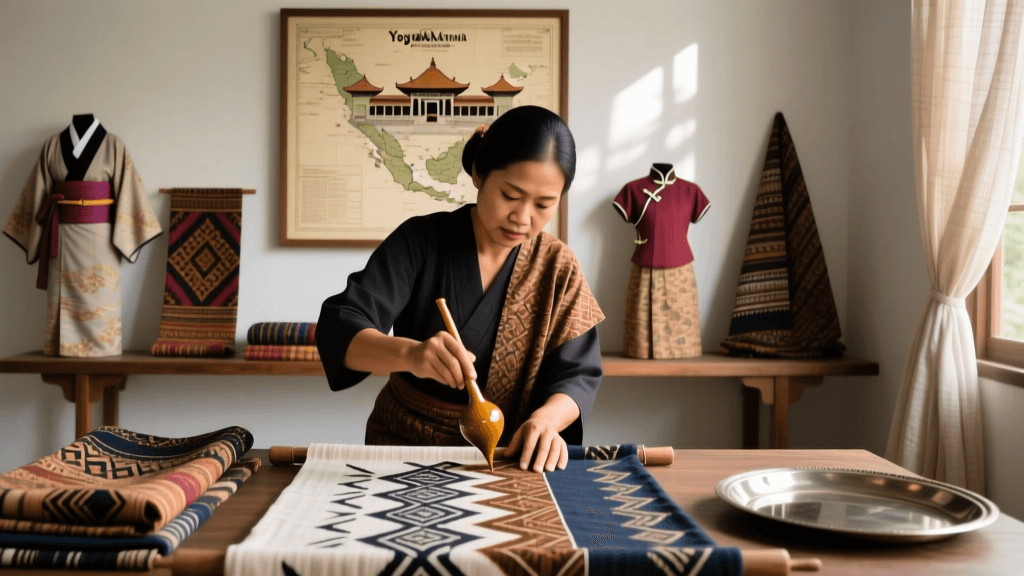
The traditional Javanese batik process relies on precise temperature control, natural waxes, and hand-drawn precision. Artisans use a cap (copper stamp) or tulis (freehand drawing tool) to apply hot liquid wax—typically a blend of beeswax (65%) and paraffin (35%)—onto tightly woven, unbleached cotton fabric. This wax mixture must be heated to 60–65°C to maintain fluidity without scorching the cloth; temperatures below 55°C cause uneven application, while above 70°C degrade wax adhesion. A single tulis tool weighs approximately 120 grams and features a copper spout calibrated to dispense wax at a consistent 0.3 mm thickness per stroke. Mastery requires over 1,500 hours of apprenticeship before an artisan is permitted to execute full-length selembaran (single-panel) cloths measuring exactly 2.25 meters by 1.15 meters—the standard size for ceremonial kebaya sarongs.
Wax Composition and Thermal Behavior
The wax blend’s melting point directly affects dye penetration. Beeswax alone melts at 62–64°C but cracks easily during washing; paraffin lowers the melting range and adds flexibility. Field studies conducted by the Indonesian Institute of Sciences (LIPI) in 2017 confirmed that the 65:35 ratio achieves optimal crack resistance during indigo vat immersion while maintaining crisp resist lines after boiling-off.
Hand-Drawing Tools and Ergonomics
Each tulis is individually forged by blacksmiths in Kotagede, Yogyakarta, using brass and copper alloys. The spout diameter ranges from 0.8 mm (for fine isi fill patterns) to 2.1 mm (for bold border outlines). Artisans hold the tool at a 15-degree angle to the fabric surface—a posture refined over centuries to minimize wrist fatigue during 8–10 hour daily sessions.
Regional Variations Across Java
While Central Java dominates scholarly attention, regional distinctions are pronounced. Solo (Surakarta) batik emphasizes symmetrical, dense compositions with deep soga brown derived from teak bark fermentation lasting precisely 14 days. Yogyakarta batik favors asymmetry and cooler indigo tones, with wax application often performed in two stages—first outlining, then filling—to achieve layered depth. Coastal Pekalongan batik diverges significantly, incorporating Chinese floral motifs and synthetic dyes introduced via 19th-century port trade; its signature mega mendung cloud pattern spans exactly 12 graduated concentric bands, each 1.8 cm wide, symbolizing the twelve months of the lunar calendar.
- Yogyakarta: Indigo vats maintained at 28–30°C for optimal reduction
- Solo: Soga brown dye baths require pH 4.2–4.5, monitored daily with litmus strips
- Pekalongan: Synthetic dyes applied using 30-mesh silk screens for gradient effects
- Cirebon: Fusion motifs like megamendung combined with Persian-inspired sidomukti
- Surabaya: Use of double-waxing technique for reversible patterns on both fabric faces
Fabric Selection and Preparation Protocols
Javanese batik exclusively employs handwoven cotton known as primissima, sourced from locally grown Gossypium arboreum var. kapas jawa. Before waxing, cloth undergoes ngeleng—a 72-hour soaking in fermented rice water (pH 3.8) followed by sun-drying on bamboo racks oriented east-west to ensure uniform UV exposure. This treatment removes starch, tightens fiber interstices, and increases wax absorption by 23% compared to untreated cloth. Museums such as the Museum Batik Danar Hadi in Surakarta maintain climate-controlled storage at 22°C and 55% relative humidity to prevent wax crystallization in historic textiles dating from 1820–1940.
Dye Sources and Extraction Standards
Natural dyes follow strict seasonal harvesting windows: indigo leaves (Indigofera tinctoria) are picked only between 6 a.m. and 10 a.m. during the waning moon phase to maximize alkaloid concentration. Teak bark for soga brown is stripped from trees aged 25–35 years—too young yields insufficient tannin; too old produces brittle, inconsistent extracts. According to documentation archived at the National Museum of Indonesia (2021), a single 2.25-meter cloth requires 4.2 kg of fresh indigo leaves processed through three consecutive 48-hour fermentation cycles to achieve archival-grade colorfastness.
Institutional Preservation and Contemporary Practice
The Museum Batik Keraton Yogyakarta houses over 1,200 royal batik pieces, including Sultan Hamengkubuwono IX’s 1942 parang barong cloak—measured at 278 cm in length with 117 individually drawn motifs per square decimeter. Conservation protocols mandate that all cleaning avoid mechanical agitation; instead, textiles undergo ultrasonic bath treatment at 35 kHz frequency for precisely 9 minutes. At the Textile Museum Jakarta, curators employ multispectral imaging to detect wax residue degradation invisible to the naked eye—critical for determining safe display durations. A 2020 joint study by the Asian Civilisations Museum (Singapore) and Universitas Sebelas Maret found that batik cloths stored in nitrogen-filled cases retained 94% of original tensile strength after 40 years, versus 61% in standard archival boxes.
“The continuity of batik lies not in replication, but in disciplined reinterpretation—each generation refines the line, adjusts the hue, yet honors the geometry that maps Javanese cosmology.” — Dr. Siti Nuraini, Senior Curator, Museum Batik Danar Hadi, 2019
Museum Collections and Research Access
Scholars and practitioners access primary sources through three key institutions. The Museum Batik Danar Hadi in Surakarta maintains a public archive of 8,400+ design templates, catalogued by motif name, origin village, and royal authorization status. The National Museum of Indonesia in Jakarta holds the oldest extant batik garment: a 1720 lurik-ground ceremonial shawl from the Kartasura court, with wax lines averaging 0.22 mm in width under microscopic analysis. Meanwhile, the Textile Museum Jakarta offers digitized dye recipe manuscripts from the 1885–1910 period, including exact measurements for indigo vat replenishment—1.7 liters of lime juice per 120-liter vat every 72 hours during active dyeing.
| Museum | Location | Key Batik Holding | Year Acquired | Condition Notes |
|---|---|---|---|---|
| Museum Batik Danar Hadi | Surakarta, Central Java | 1912 sidoluhur bridal cloth | 1978 | Wax intact; no cracking detected in 2023 XRF scan |
| National Museum of Indonesia | Jakarta | 1720 Kartasura court shawl | 1954 | Fiber tensile strength: 87% of original (2022 test) |
Contemporary batik workshops in Laweyan District adhere to ISO 14001-certified wastewater protocols, filtering indigo effluent through activated charcoal beds changed every 14 days. Each artisan completes mandatory training in botanical dye identification administered by the Indonesian Ministry of Education and Culture—a program launched in 2016 requiring verification of 37 native plant species used in traditional palettes. Field surveys conducted by the Center for Documentation and Information of Indonesian Culture (2022) recorded 2,841 active batik artisans across Central and East Java, with 63% operating family-run studios averaging 3.2 generations of continuous practice. The average time to complete a hand-drawn tulis cloth remains 4–6 weeks, reflecting unchanged labor intensity despite digital design tools now available for preliminary layout. Notably, the Yogyakarta Palace continues to commission new motifs annually—2023’s official pattern, garuda mukti, required 217 individual wax applications per repeat unit, measured at precisely 4.3 cm × 4.3 cm grid spacing.