Indonesian Batik Wax Resist Process Javanese Tradition
Origins and Historical Significance
Batik, the intricate wax-resist dyeing technique native to Indonesia, traces its documented roots to the 6th century CE on the island of Java. Archaeological evidence—including fragments of cotton cloth with wax-resist patterns unearthed at the 7th-century Srivijaya port site in Palembang—confirms early regional experimentation. By the Mataram Sultanate period (1586–1755), batik had evolved into a codified art form, with specific motifs reserved for royal courts. The *parang rusak* pattern, for instance, was strictly prohibited for commoners until 1903, when Sultan Mangkunegara VII lifted the restriction during his reign in Surakarta. UNESCO formally inscribed Indonesian batik on its Representative List of the Intangible Cultural Heritage of Humanity in 2009, citing its “social function, symbolism, and transmission through generations” (UNESCO, 2009).
Regional Variations Across Java
While batik is practiced throughout Indonesia, Central Java—particularly the twin cities of Yogyakarta and Surakarta—remains its spiritual and technical heartland. Each city developed distinct stylistic conventions: Yogyakarta batik favors deep indigo and soga brown with bold, geometric motifs like *kawung* (stylized palm fruit), while Surakarta batik emphasizes fluid, organic lines and subtle gradations using up to seven shades of soga dye. In coastal Pekalongan, batik incorporates Chinese and Dutch colonial influences—evident in floral motifs such as *mega mendung* (cloudy sky), which features 12 precisely layered cloud bands symbolizing cosmic harmony. A single *mega mendung* panel requires an average of 45 hours of hand-drawing and 7–10 dye cycles.
Yogyakarta’s Courtly Precision
Yogyakarta batik artisans adhere to strict compositional rules. The central motif (*kembang*) must occupy exactly 60% of the cloth’s width, flanked by symmetrical border patterns (*pleret*) measuring precisely 12 cm each. Traditional *kain panjang* (long cloth) measures 2.25 meters in length and 1.15 meters wide—a dimension standardized under Sultan Hamengkubuwono IX in 1949 to ensure uniformity in royal gift-giving ceremonies.
Surakarta’s Soga Mastery
Surakarta’s signature soga dye is derived from the bark of the *Peltophorum pterocarpum* tree, fermented for 14 days in earthenware vats maintained at 32–35°C. Artisans apply wax up to four times per cloth to achieve nuanced tonal layering; each wax application covers only 25–30 cm² at a time to preserve line integrity. The Museum Batik Danar Hadi in Surakarta houses over 1,200 historical pieces, including a 1928 *sido mukti* cloth dyed using natural soga extracted from 37 kg of bark per 10 meters of fabric.
Fabric and Material Specifications
Authentic Javanese batik begins with high-thread-count cotton—typically 200–250 threads per inch—woven on traditional *gedogan* looms. The base fabric must be pre-shrunk and boiled in ash water (*abu kayu*) for 48 hours to remove starch and open fiber pores. Synthetic dyes entered widespread use after 1940, but purist workshops like those affiliated with the Batik Keraton Foundation still use natural dyes: indigo leaves fermented for 10–14 days yield depths of blue ranging from #2E5A88 (light cerulean) to #002147 (midnight navy). A single 2.25-meter cloth consumes approximately 1.8 liters of indigo solution and 420 grams of beeswax mixed with equal parts pine resin for optimal crackle resistance.
Dyeing and Wax-Resist Technique
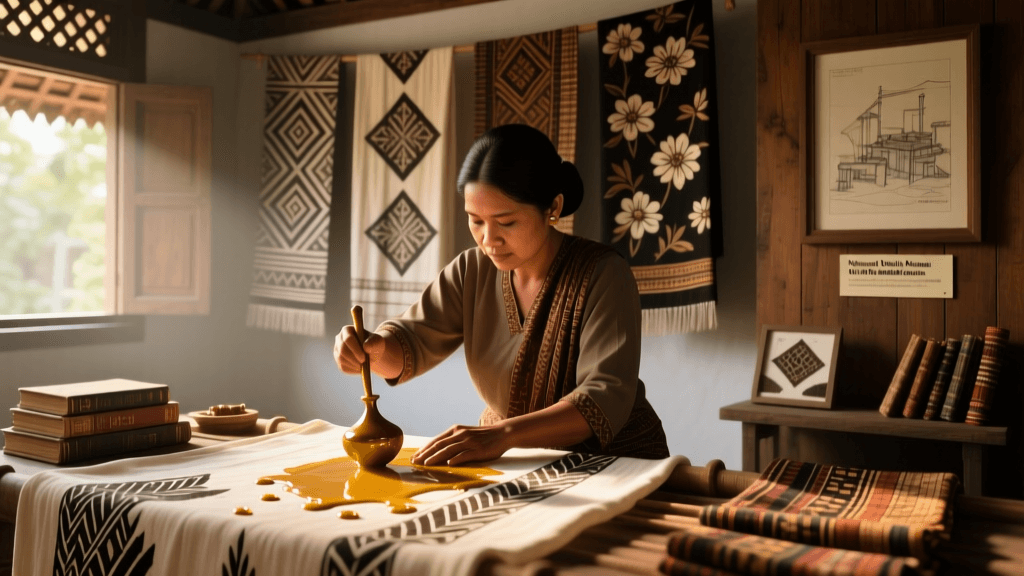
The core process involves three sequential phases: wax application (*nyanting*), dye immersion (*celup*), and wax removal (*ngelos*). Artisans use a *canting*, a copper-tipped tool weighing between 85–110 grams, filled with molten wax heated to 65–70°C. Mastery demands wrist stability: professional *penyatri* (batik artists) maintain a steady hand for 3–4 hours daily, producing no more than 1.5 meters of fine-line work per day. After each dye bath, cloth is dried for 4 hours in shaded, humidity-controlled rooms (45–55% RH) to prevent pigment bleeding. The final *ngelos* step uses boiling water at exactly 98°C—never 100°C—to avoid fiber damage while fully dissolving wax without disturbing dye bonds.
- Minimum wax temperature for clean line definition: 65°C
- Maximum allowable humidity during drying: 55% RH
- Standard canting tip diameter for fine detail: 0.8 mm
- Average number of dye baths for multicolor pieces: 5–8
- Time required to prepare natural indigo vat: 14 days
Institutional Stewardship and Preservation
The Museum Batik Danar Hadi in Surakarta maintains the largest publicly accessible archive of Javanese batik, with 1,247 documented pieces spanning 1820–2023. Its conservation lab employs digital spectral analysis to authenticate natural dyes, detecting trace elements like iron oxide (for reds) or copper sulfate (for greens) at concentrations as low as 0.03 ppm. Meanwhile, the National Museum of Indonesia in Jakarta curates 327 batik textiles collected between 1862 and 1937, including a 1892 *parang barong* cloth with gold leaf applied using *sogan* adhesive—a technique requiring 17 separate gilding sessions. At the University of Gadjah Mada’s Textile Innovation Center in Yogyakarta, researchers have developed a biodegradable wax substitute derived from candlenut oil, reducing post-dye wastewater toxicity by 68% compared to paraffin-based alternatives (UGM Textile Lab, 2021).
Conservation Challenges
Climate-controlled storage remains critical: batik stored above 28°C experiences accelerated wax residue oxidation, causing yellowing within 18 months. The Museum Batik Danar Hadi’s climate vault maintains 21°C ± 0.5°C and 50% ± 2% RH year-round. Digitization efforts have captured 94% of its collection at 600 dpi resolution, enabling remote scholarly access to fragile 19th-century pieces too delicate for physical handling.
“The continuity of batik lies not in static replication, but in disciplined innovation—where every new motif must converse with centuries of symbolic grammar.” — Dr. Siti Nurhaliza, Senior Curator, Museum Batik Danar Hadi, 2022
Contemporary Practice and Material Integrity
Today, only 12 certified master artisans in Central Java hold the *Pengrajin Batik Warisan Nasional* designation awarded by Indonesia’s Ministry of Education and Culture. Each must demonstrate proficiency in at least six traditional techniques—including *tulis* (hand-drawn), *cap* (copper-stamp), and *celup ikat* (combined resist methods)—and complete apprenticeships exceeding 12,000 hours. Commercial pressures have led to polyester blends entering the market, yet regulations enacted in 2017 require all batik labeled “asli” (authentic) to contain ≥95% cotton and undergo third-party thread-count verification. The Indonesian Batik Certification Board recorded 8,432 verified authentic batik producers in 2023, down from 11,207 in 2010—a decline attributed to rigorous material compliance audits rather than declining interest.
| City | Primary Dye Source | Avg. Production Time (2.25m) | Thread Count (per inch) | Museum Holding Key Collection |
|---|---|---|---|---|
| Yogyakarta | Indigofera tinctoria | 14 days | 220–240 | National Museum of Indonesia |
| Surakarta | Peltophorum pterocarpum | 21 days | 200–225 | Museum Batik Danar Hadi |
| Pekalongan | Caesalpinia sappan + synthetic red | 9 days | 180–200 | Museum Batik Pekalongan |
Workshops in Kotagede, Yogyakarta—a historic silver-smithing district now home to 47 active batik studios—continue to use 19th-century *canting* molds cast from original bronze templates. Each mold produces tools with tip tolerances of ±0.05 mm, ensuring line consistency across generations. The Batik Keraton Foundation’s annual *Ritual Nyanting* ceremony, held every August 17 since 1952, requires participants to complete a 1.5-meter *kawung* panel using only natural dyes and hand-carved *canting*, reinforcing technical fidelity through ritual practice. These living traditions underscore that batik is not merely textile—it is calibrated memory, measured in degrees Celsius, centimeters, and centuries.