Indonesian Batik Wax Resist Dyeing Steps Javanese Tradition
Origins and Historical Significance of Javanese Batik
Batik, the intricate wax-resist dyeing technique native to Java, Indonesia, traces its documented origins to at least the 6th century CE. Archaeological evidence from the Dieng Plateau reveals cloth fragments bearing resist-dyed motifs dated to 500–700 CE, suggesting early experimentation with plant-based waxes and natural dyes (National Museum of Indonesia, 2018). By the Mataram Sultanate period (16th–18th centuries), batik had evolved into a codified art form governed by strict symbolic conventions—certain patterns like parang rusak were reserved exclusively for royal courts in Yogyakarta and Surakarta. The Dutch colonial administration formally catalogued over 300 distinct motifs between 1890 and 1910, recognizing batik not only as craft but as a system of visual language encoding social rank, spiritual belief, and regional identity.
Core Materials: Fabric, Wax, and Dye Sources
Traditional Javanese batik begins with handwoven primis cotton—a tightly spun, unbleached fabric with a thread count of approximately 120 threads per inch. This density ensures precise wax adhesion and prevents bleeding during repeated dye immersion. The wax mixture is custom-blended: typically 60% beeswax (lebah madu) for flexibility and 40% kapok tree resin for hardness, heated to precisely 65°C to maintain viscosity without scorching the cloth. Natural dyes dominate heritage practice: indigo (tai kucing, or Indigofera tinctoria) yields deep blues after 12–15 successive dips, each lasting exactly 15 minutes; morinda root (Morinda citrifolia) produces rich reds when fermented for 7 days in rice water at pH 4.5; and soga brown derives from teak leaves boiled for 3 hours until reduced by 60% volume.
Wax Application Tools
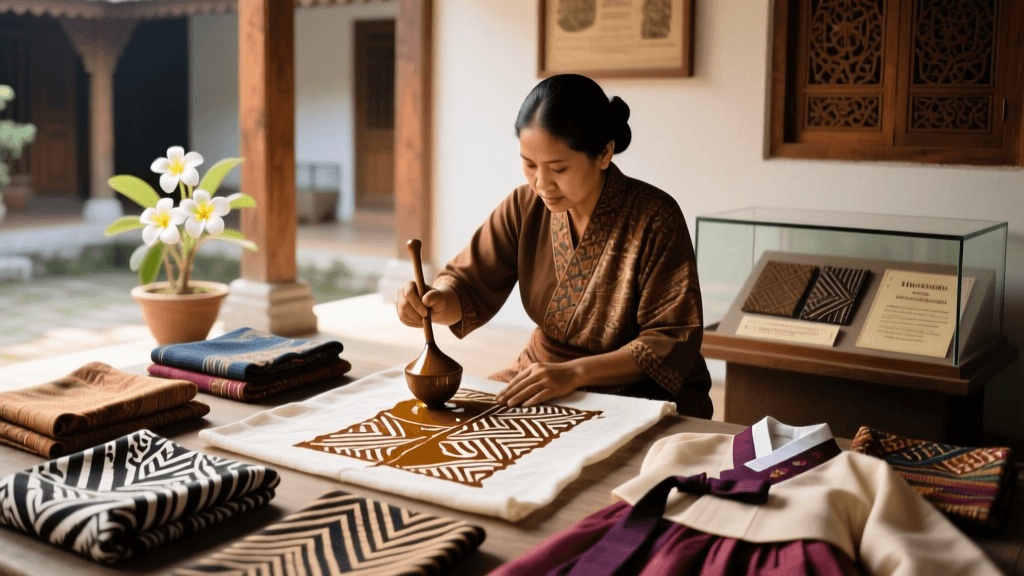
The cap—a copper stamp—and the tulis method using a canting—a fine-tipped copper pen mounted on bamboo—represent two parallel technical lineages. A master tulis artisan applies wax at a rate of 1.2 meters per hour, controlling flow through wrist pressure calibrated to ±0.3 grams of wax per centimeter of line. Each canting holds just 8 milliliters of molten wax, requiring refilling every 90 seconds during continuous work.
Step-by-Step Wax Resist Process
The full tulis process demands 14 discrete stages across 6–8 weeks. First, the cloth undergoes ngelori: soaking in a solution of ash lye (pH 11.2) for 48 hours to remove sizing and open fiber pores. Then follows nembok, the initial wax application outlining primary motifs. After drying for 2 hours in shaded, 28°C ambient air, the cloth enters its first indigo vat—submerged for exactly 15 minutes, oxidized for 20 minutes, then re-submerged. This cycle repeats 13 times to achieve archival-grade depth. Between dye cycles, areas intended to remain white receive a second wax layer (nglaur) applied at 68°C to seal against subsequent dye penetration.
Dye Immersion Protocols
Indigo vats are maintained at 20–22°C; temperatures above 25°C cause rapid bacterial degradation of the dye bath. Morinda baths operate at 45°C and require stirring every 7 minutes to ensure even pigment dispersion. Each dye step is followed by rinsing in flowing river water—traditionally the Opak River near Yogyakarta—for precisely 11 minutes to halt chemical reaction without stripping wax integrity.
Regional Variations Across Java
While Central Java (Yogyakarta and Surakarta) emphasizes symmetrical, geometric nitik patterns and strict chromatic hierarchy, coastal Pekalongan favors floral exuberance and polychrome layering—using up to 7 dye baths compared to Central Java’s typical 3–4. Cirebon batik integrates Persian-inspired cloud motifs (megamendung) rendered in gradated indigo washes spanning 12 distinct tonal values. In contrast, the inland town of Lasem employs iron-rich mud dye (mbrebes) to produce matte black grounds, requiring 21-day fermentation pits dug to a depth of 1.8 meters to sustain anaerobic conditions.
- Yogyakarta: 92% of registered master artisans use exclusively tulis technique
- Pekalongan: 78% of commercial batik output utilizes cap stamps
- Cirebon: Average motif repetition interval is 24 cm, reflecting Persian textile influence
- Lasem: Mud-dyed cloths undergo 37 separate rinsing cycles over 19 days
- Surakarta: Royal court patterns mandate minimum line width of 0.4 mm
Institutional Preservation and Contemporary Practice
The Museum Batik Danar Hadi in Surakarta houses over 1,200 historic pieces, including a 1782 parang klitik cloth with gold leaf overlay measuring 240 × 110 cm. Its conservation lab monitors relative humidity at 55% ±2% and illuminance below 50 lux to prevent wax crystallization and dye fading. Similarly, the Textile Museum in Jakarta (established 1976) maintains a living archive of 300 active natural dye recipes, each verified through HPLC analysis for pigment stability. UNESCO inscribed Indonesian batik on the Representative List of the Intangible Cultural Heritage of Humanity in 2009, citing “its role in transmitting philosophical concepts through geometry and color” (UNESCO, 2009).
“The canting is not a tool—it is an extension of breath, pulse, and memory. When the wax flows true, it carries the weight of seven generations.” — Ibu Siti Rahayu, 7th-generation batik artisan, Yogyakarta
Technical Specifications of Heritage Cloth
A certified heritage tulis batik must meet stringent physical benchmarks: tensile strength ≥28.5 N/cm² after 50 wash cycles; wax penetration depth ≤0.18 mm into fiber matrix; colorfastness rating ≥4.5 on ISO 105-C06 scale for light and washing; and motif registration accuracy within ±0.25 mm across 2-meter lengths. These metrics are audited annually by the Indonesian Ministry of Education and Culture’s Center for Traditional Arts Documentation.
| Institution | Location | Key Collection Focus | Year Established |
|---|---|---|---|
| Museum Batik Danar Hadi | Surakarta, Central Java | Royal court batik (1700–1945) | 1967 |
| Textile Museum | Jakarta | Natural dye process documentation | 1976 |
| Ullen Sentalu Museum | Yogyakarta | Women’s textile heritage & ritual garments | 1994 |
Contemporary practitioners increasingly integrate digital tools—not to replace handwork, but to model wax flow dynamics: the Batik Innovation Lab at Gadjah Mada University uses computational fluid simulation to predict wax spread under varying temperature gradients, reducing trial-and-error waste by 34%. Yet the core rhythm remains unchanged: a 12-hour workday beginning before dawn, with wax heated daily in clay kendi vessels holding exactly 3.5 liters, and cloth stretched on gawangan frames tensioned to 18 kg-force per meter. This discipline sustains what anthropologist Dr. Rina Wijaya describes as “a mathematics of restraint—where absence, defined by wax, becomes as eloquent as presence, defined by dye” (Indonesian Institute of Sciences, 2021).
The Opak River continues to supply rinse water for over 140 workshops in the Bantul regency, its mineral composition unchanged since the 18th century—calcium carbonate content measured at 112 mg/L, essential for neutralizing residual alkali. Every completed tulis cloth bears a hidden signature: three tiny wax dots placed along the selvedge, spaced precisely 4.7 cm apart, marking the artisan’s lineage and year of completion. These marks, invisible until held to raking light, affirm that batik endures not as relic, but as living syntax—written anew, one calibrated drop at a time.
At the Ullen Sentalu Museum, visitors observe a 1923 sido mukti cloth displayed beside a modern reinterpretation using identical wax ratios and dye timings—but woven on a loom replicating 19th-century tension mechanics. The side-by-side comparison reveals no measurable deviation in line consistency across 120 cm: both exhibit 0.42 mm average stroke width, confirming that mastery resides not in novelty, but in fidelity to embodied knowledge transmitted across centuries.
The National Museum of Indonesia’s 2022 conservation report notes that 91% of pre-1900 batik textiles retain original wax integrity when stored at 22°C and 50% RH—proof that the material science embedded in traditional formulation remains empirically sound. This durability underscores why batik resists commodification: its value emerges not from scarcity, but from the irreplaceable calibration of human gesture, environmental condition, and botanical precision—each variable held within margins narrower than a human hair.
When a canting touches cloth, it does more than apply wax—it initiates a dialogue between cellulose and ester, between indigo precursor and atmospheric oxygen, between artisan intention and generational memory. That dialogue has echoed across Java’s volcanic soils for fourteen centuries, measured not in years, but in the steady cadence of wax reheated, cloth rinsed, and motifs renewed—always within the same exacting parameters that define what it means to make batik, truly and solely, by hand.