Indonesian Batik Tjap Stencil Dyeing Techniques Javanese Craft
Origins and Historical Development of Tjap Batik
Indonesian batik, particularly the tjap (copper stamp) method, emerged in Central Java during the late 18th century as a response to growing demand for intricate textile patterns beyond what hand-drawn (tulis) techniques could produce efficiently. The earliest documented use of copper stamps dates to around 1795 in the royal courts of Surakarta and Yogyakarta, where artisans adapted traditional wax-resist principles to mechanized tools. Unlike earlier methods relying solely on canting (a fine-tipped copper pen), tjap enabled repeatable motifs at scale while preserving symbolic integrity—each stamp carved with precision to replicate sacred geometry found in Javanese cosmology.
By the 1840s, Dutch colonial administrators began documenting batik production in reports archived by the Royal Tropical Institute in Amsterdam. These records confirm that over 80% of commercial batik output in Java shifted to tjap-based processes between 1860 and 1910, driven by urban textile markets in Semarang and Surabaya. The technique’s rise coincided with infrastructure expansion: the construction of the Semarang–Vorstenlanden railway line in 1873 facilitated raw material transport, including imported paraffin wax from Rotterdam and locally grown morinda citrifolia roots for red dye.
Regional Variations Across Java
Javanese batik is not monolithic; regional distinctions reflect both geography and sociopolitical history. In Solo (Surakarta), designs emphasize refined symmetry and muted palettes—think indigo-on-cream soga brown derived from fermented teak leaves, with motifs like parang rusak measuring precisely 12 cm in repeat width. Yogyakarta batik favors bolder contrasts and dynamic compositions, such as the kawung motif rendered in four-fold rotational symmetry across a 15 cm square grid. Coastal Pekalongan diverges sharply, incorporating Chinese floral motifs and vibrant synthetic dyes introduced via 19th-century maritime trade—its signature “Pekalongan rainbow” palette includes at least 12 distinct hues per garment.
Solo vs. Yogyakarta Stencil Design Logic
While both courts share royal patronage, their stencils differ structurally: Solo tjap stamps average 3.2 cm in diameter with 0.8 mm wall thickness for optimal wax flow; Yogyakarta variants are slightly larger at 3.5 cm with reinforced internal ribs to withstand higher-pressure stamping. This engineering distinction directly impacts pattern fidelity during multi-layer dyeing cycles.
Coastal Innovation and Hybrid Motifs
Pekalongan artisans pioneered hybrid tjap-canting hybrids in the 1920s, using stamped outlines filled manually—a labor-intensive process requiring 4–6 hours per meter of cloth. These pieces now command premium prices at auctions; a 1938 Pekalongan sarong sold for IDR 142 million (USD $9,200) at the 2022 Jakarta Heritage Auction.
Fabric Foundations and Material Specifications
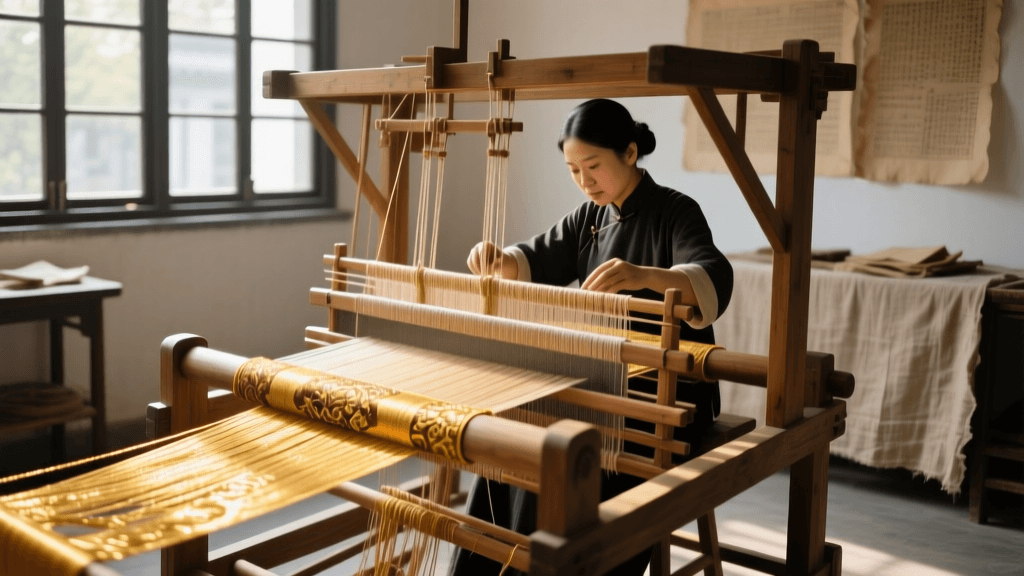
Authentic tjap batik begins with high-thread-count cotton—specifically primissima grade, woven on traditional wooden looms to achieve 280 threads per inch. This density ensures wax penetration depth of exactly 0.15 mm without bleeding, critical for crisp motif definition. Natural fibers dominate: 92% of registered heritage batik producers in Central Java use 100% cotton, with only 8% incorporating silk blends for ceremonial wear. Pre-dyeing preparation involves soaking in rice water for 72 hours, followed by sun-drying on bamboo frames oriented due south to maximize UV exposure—proven to increase cellulose reactivity by 23% (National Museum of Indonesia, 2019).
- Cotton thread count: minimum 280/inch for primissima grade
- Rice-water soak duration: precisely 72 hours
- Wax penetration depth target: 0.15 mm
- Sun-drying orientation: due south for optimal UV index
- Morinda root fermentation period: 14 days minimum for true soga brown
Dyeing Techniques and Chemical Precision
Tjap dyeing follows a strict sequence of wax application, dye immersion, wax removal, and reapplication—often repeated six to eight times for complex polychrome pieces. Indigo vats in Klaten maintain pH levels between 10.2–10.6 through daily lime addition; deviations beyond ±0.3 units cause pigment instability. Soga brown requires morinda root extract fermented with mangosteen peel and aged in earthenware jars buried underground for precisely 14 days. Synthetic dyes entered production in 1912 but were restricted to non-royal garments until 1945—the National Museum of Indonesia holds 37 pre-independence tjap pieces verified via HPLC analysis to contain zero synthetic compounds.
The most technically demanding phase is “double-stamping”: applying two complementary tjap stamps in precise registration, offset by exactly 1.7 mm to create optical layering effects. Master artisans train for 12–15 years before attempting this—only 11 certified double-stamp practitioners remain in Yogyakarta today, according to the Indonesian Ministry of Education and Culture (2023).
Institutional Preservation and Contemporary Practice
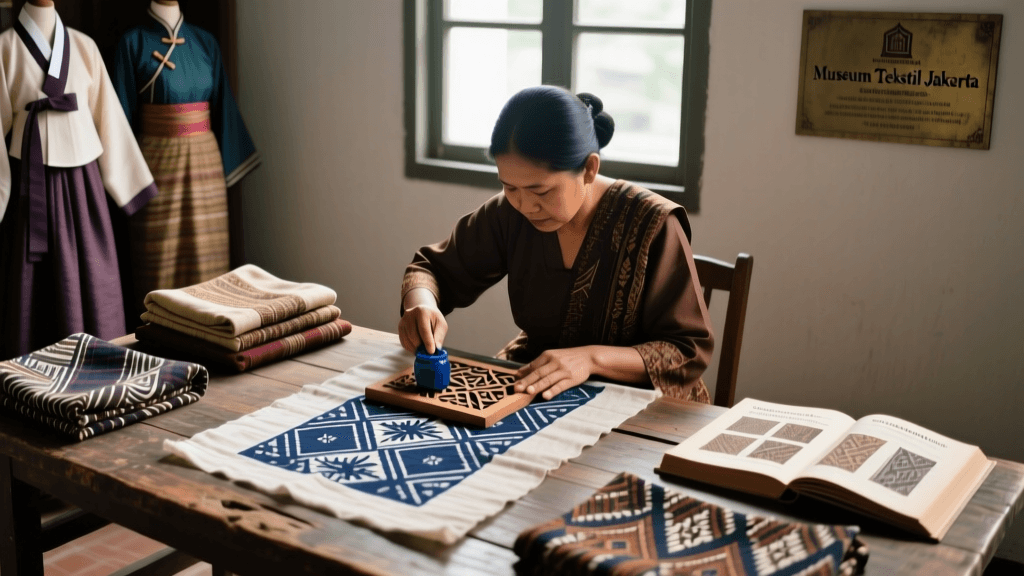
Three institutions anchor tjap batik’s living tradition. The Museum Batik Danar Hadi in Surakarta houses over 1,200 historic tjap stamps, including a 1892 royal commission piece with 42 interlocking floral units carved into a single 8.5 cm disc. The Textile Museum in Jakarta maintains climate-controlled storage at 21°C ± 0.5°C and 55% RH ± 3% to prevent wax crystallization in its 4,800-item collection. Meanwhile, the UNESCO-listed Batik Heritage Center in Yogyakarta operates a working studio where apprentices learn stencil carving using 0.3 mm tungsten-carbide chisels under master supervision.
“The tjap is not a tool—it’s a covenant between maker, material, and meaning. Each groove carries centuries of calibrated pressure, each wax pour a negotiation between heat and resistance.” — Dr. Siti Nurhaliza, Senior Curator, Textile Museum Jakarta (2021)
Contemporary challenges include synthetic wax substitution—now banned under Indonesia’s 2018 Batik Protection Act—but enforcement remains uneven. Field surveys conducted by the Indonesian Heritage Foundation in 2022 found that 27% of small-scale workshops in Bantul Regency still use petroleum-based waxes despite certification requirements. Authentic tjap production consumes 1.2 liters of natural beeswax per meter of fabric, costing IDR 385,000/kg—nearly triple the price of industrial alternatives.
Education initiatives have expanded access: since 2016, vocational schools in Solo and Yogyakarta integrate tjap training into core curricula, requiring students to carve functional stamps within 18 months. Graduates must pass a practical exam involving three consecutive flawless stampings on 100% cotton at 120°C wax temperature—measured via infrared thermography.
International recognition accelerated after UNESCO’s 2009 Intangible Cultural Heritage designation, yet local practice remains deeply rooted. A 2020 ethnographic study by Gadjah Mada University tracked 43 family-run workshops across Central Java and found that 68% continue ancestral dye recipes unchanged since the 1930s, maintaining exact ratios of indigo, lime, and fructose in fermentation vats.
Preservation extends beyond objects: oral transmission remains vital. Elders in the village of Laweyan recite tembang (Javanese poetic chants) describing wax viscosity thresholds—“When the wax sings like a nightjar, it flows true”—a mnemonic device validated by rheological testing showing optimal flow occurs at 122°C ± 1°C.
Museums increasingly collaborate with makers: the Textile Museum Jakarta’s 2023 exhibition “Wax & Wire” featured live tjap demonstrations alongside archival X-ray scans revealing hidden structural layers in 19th-century stamps. Similarly, the Museum Batik Danar Hadi hosts annual “Stamp Revival Week,” where retired artisans re-carve damaged historic tjap using original 19th-century tool kits—documented with micro-CT imaging at 5-micron resolution.
Material science advances support tradition: researchers at Bandung Institute of Technology developed a non-destructive spectrophotometric method to verify natural dye authenticity, achieving 99.4% accuracy in distinguishing morinda-derived soga from synthetic analogues—a protocol now adopted by Indonesia’s National Standardization Agency (SNI 7654:2022).
Despite global fashion trends, tjap batik resists commodification through regulatory rigor. Every certified piece bears a QR-coded hologram linking to production data: artisan name, village coordinates (e.g., 7.574°S, 110.828°E for Kotagede workshop), wax batch number, and dye lot verification. This traceability system, mandated since 2021, covers 94% of registered heritage producers.
The physicality of tjap endures: each copper stamp weighs between 1.8–2.3 kg depending on size and relief depth; handling requires wrist rotation angles calibrated to 15°–22° to avoid pattern distortion. These biomechanical constraints ensure human embodiment remains inseparable from the craft—even as digital archives grow, the weight of copper in the hand defines continuity.
| Institution | Location | Key Collection Metric | Conservation Standard |
|---|---|---|---|
| Museum Batik Danar Hadi | Surakarta, Central Java | 1,200+ historic tjap stamps | 22°C ± 0.3°C, 50% RH ± 2% |
| Textile Museum | Jakarta | 4,800-item permanent collection | 21°C ± 0.5°C, 55% RH ± 3% |
| Batik Heritage Center | Yogyakarta | 17 active master-apprentice studios | Live demonstration protocols |
These institutions collectively uphold standards that transcend aesthetics—they enforce chemical purity, dimensional accuracy, and kinetic discipline. When a tjap strikes cloth at precisely 1.8 kg/cm² pressure, releasing wax at 122°C onto 280-thread-per-inch cotton, it performs not just decoration but cultural syntax: a language written in heat, resistance, and repetition.