Indonesian Batik Canting Technique Beginner Dyeing Guide
The Canting Tool: Precision Instrument of Javanese Heritage
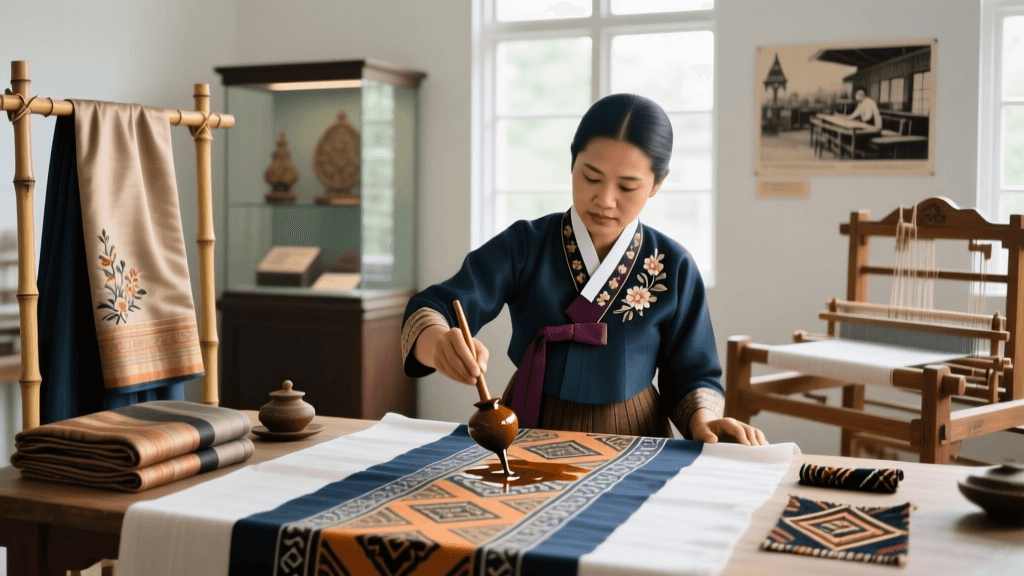
At the heart of authentic Indonesian batik lies the canting—a small, handheld copper tool with a narrow spout attached to a bamboo handle. Originating in Central Java around the 6th century CE, the canting enabled artisans to apply hot, liquid wax (traditionally a blend of beeswax and tree resin) with extraordinary control. Unlike stamp-based batik methods, the canting technique demands steady hands and years of apprenticeship. Each artisan custom-carves their bamboo handle for ergonomic balance; standard canting spouts range from 0.5 mm to 3 mm in diameter, allowing for fine lines as delicate as human hair or bold contours up to 2.5 mm wide. The wax must be maintained at precisely 60–65°C during application—too cool, and it clogs the spout; too hot, and it seeps unpredictably into fabric fibers.
Historical Roots and Royal Patronage
Batik’s earliest documented presence appears on 9th-century temple reliefs at Borobudur, where figures wear garments bearing motifs later codified in royal courts. By the 13th century, the Sultanate of Mataram formalized batik production under strict sumptuary laws: certain patterns like parang rusak and semen gedhe were reserved exclusively for royalty. These regulations persisted through Dutch colonial rule, when batik became both a site of cultural resistance and commercial export. In 2009, UNESCO inscribed Indonesian batik on its Representative List of the Intangible Cultural Heritage of Humanity, citing “its role in expressing identity, social status, and philosophical values across generations” (UNESCO, 2009).
Regional Distinctions Across Java
Javanese batik is not monolithic—it reflects centuries of localized innovation. Solo (Surakarta) emphasizes symmetrical, densely packed motifs with deep indigo and soga brown dyes derived from teak leaves and sugar palm. Yogyakarta batik favors asymmetry and bold, flowing lines, often incorporating laras (musical scale-inspired) compositions. Coastal Pekalongan, influenced by Chinese and Arab traders, features vibrant floral palettes and naturalistic birds—its artisans pioneered synthetic dyes as early as 1924, expanding color ranges beyond traditional five-hue palettes.
Fabric Foundations: Cotton, Silk, and Preparation Rituals
Traditional batik relies almost exclusively on handwoven cotton—specifically primissima grade, with thread counts averaging 120–140 threads per inch. Before waxing, cloth undergoes ngeleng: soaking in rice water for 48 hours, then sun-drying for three consecutive days to strengthen fibers and reduce shrinkage. Silk batik, practiced mainly in Bali and West Java, uses habotai silk (12–16 momme weight) and requires lower wax temperatures (52–55°C) to prevent scorching. A single 2.2-meter selendang (scarf) may consume 1.8 liters of wax across three dye cycles—a process taking 12–18 days from start to finish.
Dyeing Stages: From Indigo Vats to Soga Mastery
Traditional dyeing follows a precise sequence: first, indigo immersion for blue tones, then soga brown (from Caesalpinia sappan wood chips boiled for 12 hours), and finally, optional black achieved via iron acetate mordant. Artisans in Kotagede, Yogyakarta, maintain indigo vats that ferment continuously for over 30 years—each vat holds 200 liters and requires daily stirring with wooden paddles calibrated to 72 strokes per session. The number of dips determines depth: three dips yield pale sky blue (12% reflectance), seven dips produce navy (4% reflectance), and twelve achieve near-black (1.2% reflectance).
- Standard canting spout diameters: 0.5 mm, 1.2 mm, 2.0 mm, 2.5 mm, 3.0 mm
- Wax application temperature range: 60–65°C
- Rice water soak duration: 48 hours
- Sun-drying requirement: three consecutive days
- Indigo vat fermentation longevity: 30+ years in Kotagede workshops
Museums and Living Archives
The Museum Batik Danar Hadi in Surakarta houses over 1,200 historic pieces, including a 17th-century keris-patterned cloth worn by Prince Mangkubumi during the Giyanti Treaty negotiations. In Jakarta, the Textile Museum (Museum Tekstil), operated by Indonesia’s Ministry of Education and Culture since 1976, preserves 2,400 batik artifacts and offers weekly canting workshops led by master artisans certified by the National Institute of Cultural Heritage. Meanwhile, the Taman Wisata Candi Borobudur complex includes a dedicated batik education center where visitors observe live demonstrations using tools replicated from archaeological finds unearthed near the temple’s eastern gate in 2017.
Contemporary Practice Meets Tradition
Modern practitioners navigate tension between authenticity and accessibility. At the Institut Seni Indonesia (ISI) Yogyakarta, students complete a mandatory 14-week canting practicum, producing at least 24 meters of hand-drawn batik before graduation. Their curriculum references archival standards set by the Balai Pelestarian Nilai Budaya (BPBN) Yogyakarta, which documents regional variations using digital mapping of motif density, line width consistency, and dye saturation levels. One BPBN study (2021) found that master artisans in Bantul Regency maintain wax line deviation under ±0.15 mm across 10-meter panels—a tolerance stricter than industrial textile printing standards.
“The canting is not a tool—it is an extension of breath, wrist, and intention. To hold it is to inherit centuries of silent dialogue between maker and cloth.” — Ibu Sri Mulyani, Senior Master Artisan, Kampung Batik Laweyan, Surakarta (2022)
Material Specifications and Conservation Standards
Authentic batik conservation requires climate-controlled environments: relative humidity held at 55±5%, ambient temperature at 22±2°C, and UV-filtered lighting below 50 lux. The Museum Tekstil’s storage vaults meet ISO 11799:2015 archival standards, with acid-free tissue interleaving every 15 cm of folded cloth. For display, batik pieces are mounted on inert aluminum frames angled at 12° to minimize gravitational stress on wax-resist areas. A 2018 condition survey by the Asian Civilisations Museum in Singapore found that improperly stored batik loses 37% of its soga brown pigment intensity within five years—underscoring the necessity of museum-grade protocols.
- Thread count for primissima cotton: 120–140 threads per inch
- Indigo vat capacity: 200 liters
- Minimum workshop apprenticeship duration: 7 years
- Maximum allowable wax line deviation: ±0.15 mm
- Light exposure limit for display: 50 lux
Learning canting is less about replicating patterns than internalizing rhythm—the pause between breath and wax flow, the subtle tilt of the wrist that transforms a dot into a seed, a curve into a river. It is practiced daily in villages like Kauman in Yogyakarta, where children begin tracing motifs on paper at age eight before touching cloth at twelve. The National Gallery of Indonesia’s 2023 exhibition “Wax and Water” featured 37 contemporary works using canting techniques, including a 3.2-meter triptych dyed with indigo sourced from organic farms in Pacitan, East Java, where cultivation plots average 0.8 hectares per family cooperative. These living traditions remind us that batik is not preserved in glass cases alone—it pulses in the callus on a master’s thumb, the scent of warm wax at dawn, and the quiet concentration of a student holding her first canting steady for six full minutes without blinking.