Decoding Imperial Chinese Court Dress: Rank Badges and Colors
The Visual Language of Imperial Power
For over two millennia, traditional Chinese clothing served as a highly regulated visual language, but it was during the Qing Dynasty (1644–1912) that this system reached its zenith of complexity. The Manchu rulers established rigorous sumptuary laws that dictated every aspect of court dress, from the cut of the garment to the specific hues and motifs permitted. Clothing was not merely a matter of aesthetic preference or seasonal fashion; it was a strict, wearable manifestation of the cosmic order, political hierarchy, and ethnic identity. To wear a color or motif above one's station was not just a faux pas—it was considered an act of treason punishable by severe penalties.
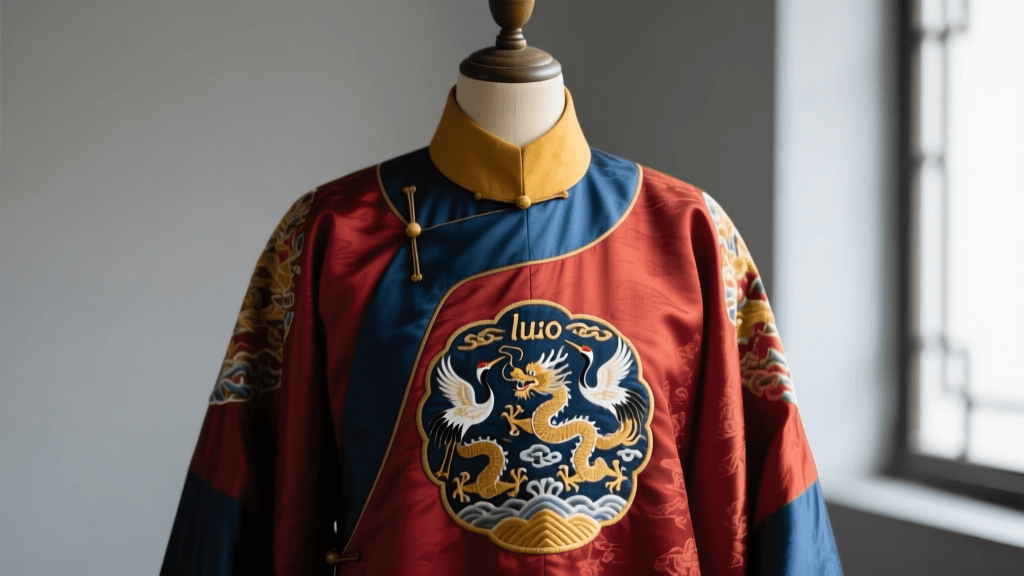
According to the Victoria and Albert Museum, the Qing dynasty dragon robe, or jifu, was a masterclass in cosmic symbolism, designed to represent the universe with the wearer at its center. Understanding these garments requires a deep dive into the rigid color codes, the intricate rank badges known as buzi, and the hidden meanings woven into the silk. Today, these codes provide antique collectors, historians, and modern reproduction enthusiasts with a precise framework for authentication and appreciation.
The Hierarchy of Color: Who Could Wear What?
Color in the Qing court was inextricably linked to the Five Elements theory (Wuxing) and the social hierarchy. The imperial family claimed exclusive rights to specific shades of yellow, a color historically associated with the center of the universe and the earth element. The Metropolitan Museum of Art notes that the Qing court strictly enforced these color boundaries, ensuring that a glance across the courtyard of the Forbidden City immediately revealed the rank and lineage of every official and royal present.
| Color | Chinese Term | Permitted Rank & Usage |
|---|---|---|
| Bright Yellow | Minghuang | Emperor, Empress, Empress Dowager. Reserved for the highest imperial authority. |
| Apricot Yellow | Xinghuang | Crown Prince and his immediate consort. |
| Golden Yellow | Jinhuang | Imperial Consorts, Princes of the First Rank, and their wives. |
| Blue | Shiqing | Court officials, Princes of lower ranks. Also used by the Emperor for rituals at the Altar of Heaven. |
| Red | Hong | High-ranking officials, imperial guards, and used for rituals at the Altar of the Sun. |
| White | Bai | Used primarily for mourning, but also for rituals at the Altar of the Moon. |
Actionable Advice for Collectors: When evaluating antique textiles, pay close attention to the fading patterns of yellow dyes. Imperial Minghuang was traditionally dyed using pagoda tree buds and turmeric. Over a century, these organic dyes mellow into a soft, muted ochre. If a 'Bright Yellow' robe appears neon or unusually vibrant, it may be a modern reproduction or a late-19th-century piece dyed with synthetic aniline colors, which drastically alters its historical valuation.
The Twelve Symbols of Imperial Authority
While color denoted broad categories of rank, the motifs embroidered onto the Emperor's Chaofu (formal court robe) and Jifu (semi-formal dragon robe) denoted absolute sovereignty. The 'Twelve Symbols of Imperial Authority' were exclusively reserved for the Emperor. These included the sun, moon, and stars (representing the heavens); the mountain (representing the earth and stability); the dragon (representing adaptability and yang energy); and the pheasant (representing literary refinement). Other symbols included the fu character (moral integrity), the water weed (purity), the grain (prosperity), fire (light), the sacrificial axe (courage), and the fu symbol of interlinked diamonds (benevolence). A robe featuring all twelve is instantly identifiable as belonging to the Emperor, whereas princes and high officials were permitted robes with fewer dragons and none of the twelve sacred symbols.
Buzi: Reading the Chest and Back
For the vast bureaucracy of the Qing empire, rank was displayed via the buzi, or rank badge. These were large, intricately embroidered squares worn on the front and back of the official's outer surcoat (bufu). The system was brilliantly simple: Civil officials, who achieved their ranks through rigorous literary examinations, were represented by birds, symbolizing grace and literary elegance. Military officials, who earned their ranks through martial prowess, were represented by mythical and real beasts, symbolizing courage and strength.
| Rank | Civil Official (Bird) | Military Official (Beast) |
|---|---|---|
| 1st Rank | Red-crowned Crane | Qilin (Mythical Unicorn) |
| 2nd Rank | Golden Pheasant | Lion |
| 3rd Rank | Peacock | Leopard |
| 4th Rank | Wild Goose | Tiger |
| 5th Rank | Silver Pheasant | Bear |
| 6th Rank | Egret | Panther |
| 7th Rank | Mandarin Duck | Rhinoceros |
| 8th Rank | Quail | Rhinoceros (Late Qing variation) |
| 9th Rank | Paradise Flycatcher | Sea Horse (Mythical water horse) |
Authentication Tip: Civil rank badges were split down the middle to accommodate the front opening of the surcoat, meaning the bird on the front left badge would often be halved. Military badges were typically whole. Furthermore, the background of the badge should feature 'lishui' (standing water) waves at the bottom and clouds above. In late Qing examples (post-1850), the waves become noticeably steeper, more stylized, and crowded with Buddhist and Daoist precious objects, a detail that helps date the piece.
A Collector’s Guide to Antique and Reproduction Robes
Whether you are bidding on a 19th-century artifact or commissioning a modern replica for a historical event, understanding the material realities of these garments is crucial.
Authentication and Dye Analysis
The introduction of synthetic aniline dyes from Europe in the 1880s revolutionized Chinese textile production. To date a robe, use a UV blacklight in a dark room. Traditional mineral and botanical dyes (like cinnabar for red or indigo for blue) will appear dull or dark under UV light. Conversely, early synthetic aniline reds and purples will fluoresce brightly. This non-destructive test is a standard practice among textile conservators to pinpoint whether a robe predates or postdates the 1880s.
Market Timing and Pricing
The market for Qing court textiles is highly active but seasonal. Major auction houses like Sotheby's and Christie's hold their premier Asian Art sales in March and September. This is the optimal time to acquire verified pieces.
- Antique Jifu (Dragon Robes): A late-Qing Jifu in fair condition with minor silk shattering typically fetches between $3,500 and $8,000. Pristine examples with extensive gold couching and imperial provenance can exceed $50,000.
- Antique Buzi (Rank Badges): Single badges are more accessible, ranging from $400 to $2,500 depending on the rarity of the rank (1st rank crane badges command a massive premium over 8th rank quail badges).
- Modern Bespoke Reproductions: Commissioning a historically accurate, hand-embroidered Jifu from master artisans in Suzhou or Hangzhou takes 6 to 12 months and costs between $1,500 and $4,000, depending on the density of the silk floss and gold thread work.
Sizing, Measurements, and Archival Storage
Qing robes were cut in a T-shape from straight loom widths of silk, meaning they lack the tailored shoulders and darts of Western clothing. If you are purchasing a reproduction or altering a vintage piece for wear, ignore modern sizing charts and focus on two critical measurements:
- Sleeve Span (Yi Chang): Measured from cuff to cuff across the back. Authentic robes often feature a massive span of 210 cm to 230 cm to allow for the dramatic 'horse-hoof' cuffs to fold back elegantly.
- Hem Width: Typically measures between 115 cm and 125 cm. Because the robe wraps and overlaps, a modern wearer should ensure their hip measurement is at least 20 cm smaller than the hem width to allow for proper draping and walking.
Storage Warning: Never hang an antique silk robe on a wooden or wire hanger. The heavy embroidery and metallic gold threads will pull the fragile, aging silk apart at the shoulders over time. Invest in an archival-quality, acid-free textile box (approximate cost: $75 - $120) and stuff the sleeves and folds with unbuffered, acid-free tissue paper to prevent hard creases that lead to silk shattering.
Conclusion
The traditional garments of the Qing court are far more than beautiful artifacts; they are intricate historical documents woven in silk and gold. By learning to read the strict color codes, decipher the avian and bestial hierarchies of the buzi, and apply rigorous authentication techniques, collectors and historians can unlock the profound stories embedded in every thread. Whether preserving a fragile 19th-century rank badge or commissioning a flawless modern reproduction, respecting these ancient sumptuary laws ensures that the visual language of imperial China continues to be understood and revered today.