The Hanfu Revival: A Practical Guide to Authentic Chinese Dress
The Genesis of the Hanfu Yundong (Hanfu Movement)
The Hanfu Yundong, or Hanfu Movement, is not merely a fleeting fashion trend; it is a profound cultural renaissance that has swept across China and the global diaspora over the last two decades. Emerging in the early 2000s on niche internet forums, the movement was driven by a generation of young Chinese netizens seeking to reclaim the traditional clothing of the Han ethnic group, which had been largely lost to history following the Qing Dynasty's mandatory sartorial changes in the 17th century. Today, Hanfu has evolved from a fringe hobby into a mainstream lifestyle choice and a multi-billion-dollar industry. According to industry analyses highlighted by the South China Morning Post, millions of young consumers now incorporate Hanfu into their daily wardrobes, commuting to work, attending university, and traveling in garments that echo the silhouettes of ancient dynasties.
For the uninitiated, navigating the modern Hanfu market can be overwhelming. The terminology is dense, the historical rules are strict, and the e-commerce landscape is vast. This comprehensive guide will decode the Hanfu revival, providing actionable advice on how to identify authentic garments, take precise measurements, and build a historically inspired wardrobe that respects traditional craftsmanship while fitting modern budgets.
Decoding the Eras: A Buyer’s Comparison Chart
When entering the Hanfu market, it is crucial to understand that 'Hanfu' is not a single monolithic garment. It encompasses thousands of years of evolving fashion. However, the modern revival primarily focuses on three distinct dynastic eras, each offering a unique silhouette, fabric preference, and aesthetic. Below is a practical comparison chart to help you decide which era aligns with your personal style and climate needs.
| Dynasty | Key Garments | Silhouette & Vibe | Est. Price (USD) | Best For |
|---|---|---|---|---|
| Tang (618–907) | Qixiong Ruqun, Banbi | High-waisted, flowing, opulent | $40 - $90 | Summer, festivals, photography |
| Song (960–1279) | Beizi, Baizhe Skirt | Slender, elegant, minimalist | $35 - $80 | Daily wear, office, layering |
| Ming (1368–1644) | Mamian Skirt, Aoqun | Structured, layered, modest | $50 - $200+ | Winter, formal events, luxury |
Tang Dynasty: Opulence and Flow
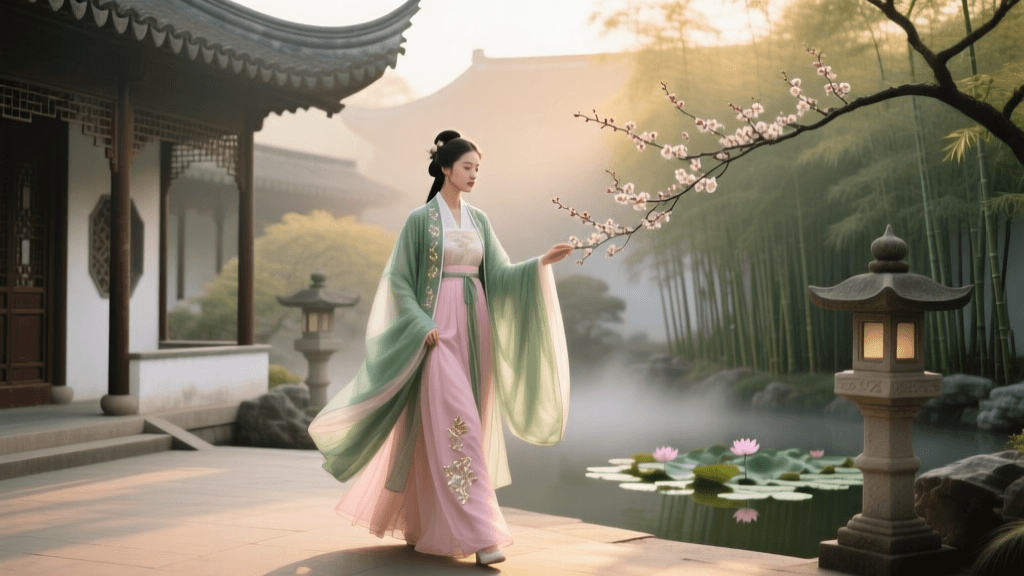
The Tang Dynasty is renowned for its cosmopolitan culture and bold aesthetics. The most iconic garment from this era is the Qixiong Ruqun (chest-high skirt), which ties above the bust, creating an elongated, flowing silhouette. It is often paired with a Banbi (half-sleeve jacket) and a sheer Pibo (silk shawl) draped over the arms. Tang-style Hanfu is heavily favored in warmer months and is characterized by vibrant colors, large floral embroidery, and lightweight silks or chiffons.
Song Dynasty: Minimalist Elegance
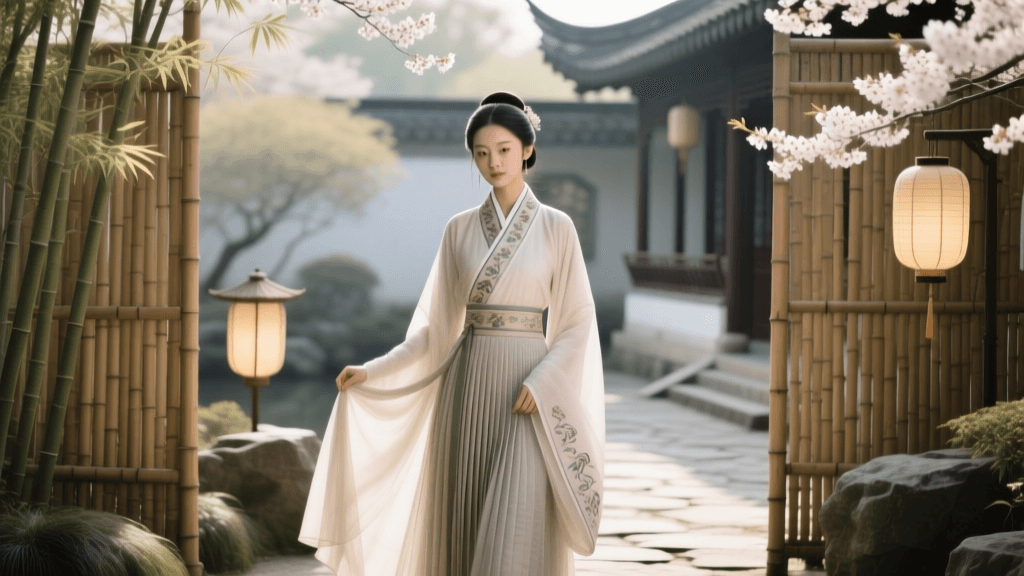
Reflecting the era's neo-Confucian philosophy, Song Dynasty Hanfu is understated, slender, and highly practical. The defining piece is the Beizi, a long, open-front coat with straight lines and side slits, worn over a camisole and a pleated skirt. The color palettes lean towards muted, earthy tones like celadon, pearl white, and soft mauve. Because of its resemblance to modern longline cardigans, Song-style Hanfu is the most accessible for beginners looking to integrate traditional pieces into a contemporary, everyday wardrobe.
Ming Dynasty: Structure and Modesty
The Ming Dynasty represents the pinnacle of traditional Hanfu tailoring and textile weaving. The most famous garment is the Mamian skirt (horse-face skirt), featuring two overlapping flat panels in the front and back, with deep pleats on the sides. It is typically paired with an Ao (a lined, structured top with a stand collar or crossed collar). Ming garments often utilize heavy brocades, jacquards, and intricate woven gold threads, making them the preferred choice for winter wear and formal occasions like weddings or Lunar New Year celebrations.
Authentic Form (Xingzhi) vs. Han Element (Hanyuansu)
One of the most critical distinctions in the Hanfu revival is the difference between authentic Xingzhi (historical form/silhouette) and Hanyuansu (Han element fashion). Purists and historical societies strictly adhere to Xingzhi, which dictates that garments must follow exact historical cutting patterns, avoid modern fasteners like zippers or buttons, and maintain the traditional Jiaoling Youren (right lapel crossed over the left). In traditional Chinese philosophy, the left-over-right crossing is reserved exclusively for the deceased; wearing it right-over-left is a profound cultural faux pas.
Conversely, Hanyuansu blends traditional aesthetics with modern conveniences. These garments might feature zippers, elastic waistbands, shorter hemlines, or synthetic lace. While Hanyuansu is excellent for fast fashion and daily commuting, it is not considered 'true' Hanfu by the revivalist community. When shopping on platforms like Taobao or Weidian, always look for the characters 正品 (authentic/original) and 形制正确 (correct form) in the product description to ensure you are purchasing a historically accurate garment rather than a costume or fusion piece.
The Practical Measurement Guide
Unlike Western fast fashion, authentic Hanfu is rarely sold in standard S/M/L sizes. Because the garments are wrapped, tied, and layered, they rely on precise flat-lay measurements. To order from Chinese e-commerce sites, you will need a soft measuring tape and a basic understanding of Chinese sizing terminology. Here is your actionable measurement checklist:
- 胸围 (Bust/Chest): Measure around the fullest part of your chest. For Ming dynasty tops (Ao), add 4-6 cm to your actual measurement to allow for the overlapping lapels and comfortable breathing room.
- 腰围 (Waist): Measure your natural waist. For Tang dynasty Qixiong skirts, measure the circumference just above your bust where the skirt will sit. For Ming Mamian skirts, measure your natural waist or where you prefer the waistband to rest.
- 裙长 (Skirt Length): This is the most common point of failure for international buyers. Measure from your waist (or chest, for Tang styles) down to your ankle bone. A standard Mamian skirt length is usually between 95 cm and 105 cm. If you are 170 cm tall, a 100 cm skirt will hit perfectly at the ankle.
- 通袖长 (Total Sleeve Length): Crucial for long-sleeved Ming tops. Measure from the center of the back of your neck, across your shoulder, and down to your wrist. Traditional sleeves often extend past the hands, so a measurement of 180 cm to 200 cm is common for formal garments.
Navigating the Market: Brands, Costs, and Timing
The Hanfu market operates on a unique e-commerce model heavily reliant on Yushou (pre-sales). Because authentic Hanfu requires specialized looms, intricate embroidery, and small-batch production, brands often release design renders and open pre-sale windows to fund manufacturing. If you buy during a Yushou period, expect to wait anywhere from 30 to 90 days for shipping. However, the trade-off is a significantly lower price and guaranteed availability.
According to cultural market reports covered by the Global Times, the Hanfu economy has birthed a diverse ecosystem of brands catering to every budget tier. Here is a breakdown of where to invest your money:
- Entry-Level ($30 - $60): Brands like Shisanyu (十三余) and Lanyanfang offer beautiful, accessible designs. While they sometimes lean towards Hanyuansu or use synthetic polyesters, they are perfect for beginners wanting to experiment with Tang and Song silhouettes without a massive financial commitment.
- Mid-Tier ($80 - $150): Brands such as Zhongzheng Hanfu (中正汉服) and Tingyue Lou (听月楼) are highly respected for their strict adherence to Ming dynasty Xingzhi. They utilize high-quality cotton-linen blends, accurate jacquard weaves, and traditional tailoring techniques.
- High-End / Luxury ($300 - $1,000+): Minghuatang (明华堂) is the undisputed king of luxury Ming Hanfu. They invest heavily in textile research, recreating museum-grade brocades and utilizing genuine silk and gold-wrapped threads. Purchasing from Minghuatang is considered an investment in wearable cultural heritage.
Hanfu is not a costume for a single day; it is a living wardrobe that connects the wearer to millennia of Eastern philosophy, aesthetics, and meticulous craftsmanship.
Timing Your Purchases
To maximize your budget, align your shopping with China's major e-commerce festivals. The 618 Shopping Festival (mid-June) and Double 11 (November 11th, Singles' Day) offer the steepest discounts and cross-store coupons on Taobao and Tmall. However, be warned: purchasing during these peaks exacerbates the Yushou delay, and popular colorways will sell out in seconds. Set alarms, join brand WeChat groups, and have your Alipay ready.
Essential Accessories and Styling
A Hanfu outfit is incomplete without its accompanying accessories. The footwear and hair ornaments are just as bound by historical context as the garments themselves. For footwear, avoid modern stilettos or chunky sneakers. Instead, invest in a pair of Yunxie (cloud shoes) or embroidered cloth boots, which cost between $15 and $40 and provide the correct grounded posture required to make the heavy skirts drape properly.
For hair, the revival movement has sparked a massive resurgence in traditional metalwork. Look for Buyao (dangling hairpins) and Zanzi (single-prong hair sticks) crafted from brass, jade, or velvet flowers (Ronghua). A beginner can find beautiful, historically inspired alloy sets on Taobao for under $20, while authentic Nanjing velvet flowers handcrafted by intangible cultural heritage artisans will cost upwards of $100.
Conclusion
The Hanfu revival movement is a testament to the enduring power of cultural memory. Building an authentic Hanfu wardrobe requires patience, an eye for historical detail, and a willingness to navigate a unique e-commerce landscape. By understanding the distinctions between dynastic eras, mastering the art of traditional measurements, and respecting the sacred geometry of the Xingzhi, you are not just buying clothes. You are participating in a living, breathing renaissance that bridges the ancient world with the modern day. Whether you choose the breezy elegance of a Song Beizi or the majestic weight of a Ming Mamian skirt, your first step into the Hanfu community is a step into history.