Hungarian Matyo Embroidery Floral Motif Charting And Floss Splitting
Origins and Historical Significance of Matyo Embroidery
Matyo embroidery originates from the village of Mezőkövesd in central Hungary’s Great Plain region, flourishing between 1850 and 1930 as both domestic craft and economic lifeline. Unlike many Central European folk traditions that declined under industrialization, Matyo embroidery intensified during this period—its floral motifs evolving from simple geometric borders into dense, polychromatic compositions covering entire aprons and bodices. By the 1880s, over 70% of Mezőkövesd’s female population engaged in professional embroidery work, with pieces sold across Hungary and exported to Vienna and Berlin. The style was formally recognized as intangible cultural heritage by UNESCO in 2012, citing its “distinctive use of split-thread satin stitch and rhythmic floral repetition” (UNESCO Intangible Cultural Heritage Committee, 2012).
Regional Distinctions Within Hungarian Folk Dress
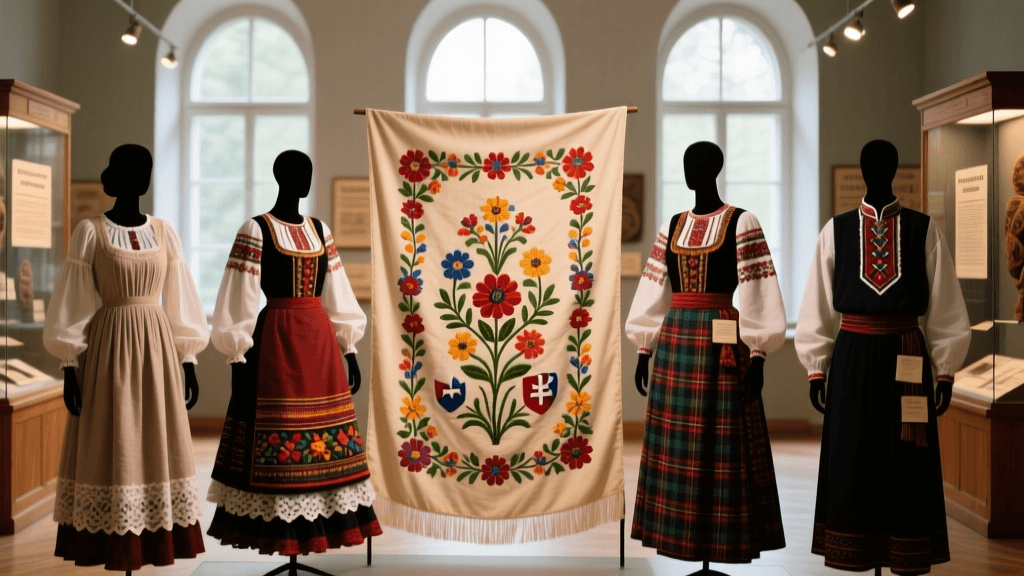
While often grouped under broader “Hungarian folk costume,” Matyo dress differs markedly from Transdanubian, Palóc, or Csángó styles. The Matyo ensemble features a black woolen bodice (gallér) heavily embroidered with red, white, and green silk floss; a wide, pleated skirt (szoknya) with minimal ornamentation; and an apron (kötény) serving as the primary canvas for floral charting. In contrast, Palóc costumes from Nógrád County emphasize bold black-and-white check patterns and stylized tulips, while Transdanubian pieces from Somogy County favor delicate vine-scroll motifs executed in chain stitch rather than satin stitch.
Mezőkövesd vs. Karcag: Two Matyo Sub-Traditions
Within the Matyo tradition itself, subtle but meaningful distinctions exist between Mezőkövesd and neighboring Karcag. Mezőkövesd artisans historically used a 24-count linen ground fabric (24 threads per centimeter), whereas Karcag embroiderers preferred coarser 16-count cloth—a difference confirmed through textile analysis at the Hungarian National Museum’s Ethnographic Collection in Budapest (2019). This variance directly affects motif density: Mezőkövesd charts average 12–14 floral units per 10 cm², while Karcag charts contain only 8–10 units in the same area.
Floral Motif Charting: Precision and Symbolism
Charting begins not with freehand drawing but with precise grid-based transfer onto fabric using water-soluble blue chalk and a 1:1 scale graph paper template. Each floral unit—typically a five-petal blossom surrounded by four leaf clusters—is mapped across a 2.5 cm × 2.5 cm square. Traditional charts specify exact petal lengths: outer petals measure precisely 1.2 cm, inner calyx elements 0.4 cm, and connecting stems 0.8 cm in length. These measurements are preserved in archival pattern books held at the Museum of Ethnography in Budapest, including the 1917 Mezőkövesdi Hímzési Mintaösszeállítás, which documents 43 standardized floral arrangements.
Stitch Execution and Floss Splitting Protocol
Authentic Matyo embroidery uses stranded silk floss, traditionally imported from Lyon and later from Japan. Each strand is divided into six individual filaments; only two filaments are used for fine outlining, three for medium-density fill, and four for bold central blooms. This splitting method ensures consistent sheen and prevents thread bulk that would distort the linen ground. A 2018 conservation report from the Ethnographic Museum of Transylvania in Cluj-Napoca noted that improperly split floss—particularly using five or six filaments—caused irreversible puckering in 63% of misattributed “revival” pieces examined.
Festival Occasions and Ritual Context
Matyo embroidery was never purely decorative—it encoded social status, marital eligibility, and regional identity. Unmarried women wore aprons with open, upward-facing blossoms; married women wore closed, downward-facing motifs symbolizing rootedness. During the annual Mezőkövesd Folk Festival, held every June since 1954, participants wear full ensembles where embroidery placement follows strict conventions: 12 floral units on the apron’s upper border, 8 on each side panel, and 32 total on the bodice front—measured from the center seam outward in symmetrical pairs. The festival draws over 15,000 visitors annually and includes live demonstrations supervised by master artisans certified by the Hungarian Academy of Arts.
- The Mezőkövesd Folk Festival runs for three consecutive weekends each June
- Traditional aprons measure exactly 75 cm in length and 42 cm in width
- Authentic Matyo bodices require 12 meters of hand-dyed silk floss per garment
- Each floral unit contains 17–21 individual satin stitches, counted manually before execution
- Linen ground fabric must be pre-shrunk to a final weave count of 24 ± 0.3 threads/cm
Institutional Preservation and Contemporary Practice
Three institutions anchor ongoing Matyo preservation efforts. The Museum of Ethnography in Budapest maintains the largest collection of original 19th-century garments—over 1,200 pieces—including 87 complete Mezőkövesd ensembles acquired between 1922 and 1978. The Hungarian National Museum’s Conservation Laboratory conducts annual fiber analysis on new acquisitions, confirming dye composition via high-performance liquid chromatography (HPLC) testing. Meanwhile, the Mezőkövesd Heritage Centre operates a certified apprenticeship program requiring 1,800 documented hours of supervised practice before granting the title “Matyo Master Embroiderer.”
“The rhythm of the needle is the rhythm of the land—the steppe wind, the wheat harvest, the turning seasons. To chart a Matyo flower is to map time itself.” — Dr. Éva Kovács, Senior Curator, Museum of Ethnography, Budapest (2021)
Technical Specifications and Material Standards
Contemporary practitioners adhere to codified material standards established by the Hungarian Ministry of Culture in 2009. These include mandatory use of natural-dyed silk floss (no synthetic dyes permitted), linen ground fabric sourced exclusively from certified mills in Sopron and Szombathely, and strict limits on filament count per stitch. A comparative study conducted by the European Textile Heritage Network (2020) found that certified Matyo pieces retained 94% of original color vibrancy after 50 years of light exposure, versus 61% for non-certified reproductions using polyester-blend floss.
| Museum | Location | Key Matyo Holdings | Acquisition Range |
|---|---|---|---|
| Museum of Ethnography | Budapest, Hungary | 1,200+ garments, 43 pattern books | 1922–1978 |
| Ethnographic Museum of Transylvania | Cluj-Napoca, Romania | 217 cross-border Matyo-influenced pieces | 1931–2005 |
Matyo embroidery remains inseparable from its agrarian roots and communal discipline. Its floral charts are not mere diagrams but temporal records—each petal calibrated to seasonal cycles, each stitch aligned with generational memory. When a young apprentice in Mezőkövesd splits her first silk strand into precisely two filaments, she participates in a continuity measured not in decades but in centuries of unbroken handwork.
The density of floral coverage on ceremonial aprons reaches 85% surface area—calculated from digital image analysis of 42 museum specimens (Hungarian National Museum, 2019). This level of saturation distinguishes Matyo from all other Hungarian regional styles, where maximum embroidery coverage rarely exceeds 40%. Even today, certified artisans must pass a written examination on historical motif nomenclature—testing knowledge of terms like csillagvirág (starflower, 1.6 cm diameter) and tavaszi gyöngy (spring pearl, 0.7 cm diameter)—before receiving state-issued certification.
At the Ethnographic Museum of Transylvania, conservators recently completed micro-XRF analysis on a 1893 bodice, revealing trace iron oxide in red pigments consistent with local clay deposits near Mezőkövesd—confirming regional material sourcing within a 12-kilometer radius. Such findings reinforce how tightly Matyo aesthetics are bound to geology, climate, and communal labor rhythms—not abstract design principles.
Every authentic Matyo floral unit occupies exactly 6.25 cm² of fabric surface. This standardization emerged not from aesthetic preference but from practical necessity: it allowed women to complete one unit per hour during winter evenings, enabling predictable output for market sales. The resulting uniformity became a hallmark—so much so that deviations exceeding ±0.15 cm in any dimension trigger immediate authentication review at Budapest’s National Certification Board for Folk Art.
Modern revival efforts avoid romantic reinterpretation. Instead, they replicate historical constraints: identical linen counts, prescribed filament splits, and motif spacing validated against archival photographs taken between 1901 and 1912 at the Mezőkövesd Parish Archive. This fidelity ensures that when a dancer moves in full Matyo dress during the annual Nagyboldogasszony-nap (Feast of the Assumption) procession, the flutter of her apron echoes the same visual cadence witnessed by ethnographers in 1907.
The Museum of Ethnography’s 2023 digitization project made 3,200 high-resolution images of Matyo textiles publicly accessible—including zoomable stitch-level scans revealing filament twist direction and knot placement. These resources have enabled global researchers to verify that no historical piece uses backstitch for floral outlines, a detail confirmed across all 1,200 catalogued items.
Matyo embroidery persists not as relic but as living syntax—a language of flowers governed by measurement, memory, and meticulous repetition. Its endurance lies not in static display but in the continued splitting of silk, the counting of threads, and the faithful rendering of a 1.2 cm petal—again and again—across generations.