Heian to Edo: The Evolution of Japanese Dynasty Fashion
The Historical Tapestry of Japanese Garments
The history of Japanese traditional clothing is not merely a chronicle of changing fabrics; it is a vivid reflection of shifting political power, social hierarchies, and philosophical ideals. From the opulent, multi-layered ensembles of the imperial court to the restrained, elegantly dyed garments of the merchant class, Japanese dynasty fashion offers a masterclass in sartorial evolution. Understanding this trajectory—from the Heian period's extravagant layers to the Edo period's streamlined silhouettes—is essential for any enthusiast of Asian traditions. According to The Metropolitan Museum of Art's Heilbrunn Timeline of Art History, the transformation of Japanese dress mirrors the nation's transition from an isolated aristocratic society to a highly structured, urbanized culture.
The Heian Period (794–1185): The Pinnacle of Layered Elegance
The Heian period represents the zenith of courtly refinement, an era where aesthetic sensibility dictated social standing. The defining garment of this epoch for aristocratic women was the jūnihitoe, or 'twelve-layer robe.' In reality, the number of layers often exceeded twelve, sometimes weighing up to 20 kilograms. The ensemble consisted of multiple kosode (small-sleeved under-robes) layered beneath a karaginu (a short, Chinese-inspired jacket) and a mo (a long, pleated train).
The true artistry of the Heian period lay in kasane no irome—the precise, codified layering of colors to reflect the changing seasons, poetic allusions, and the wearer's rank. For instance, a combination of a pale green outer layer over a deep pink inner layer evoked the blooming of plum blossoms over fresh spring leaves. The sleeves were designed to cascade outward, allowing observers to appreciate the color gradients at the cuffs and hems. This era was characterized by a profound connection between nature, poetry, and textile design.
The Kamakura and Muromachi Shift: Practicality and the Samurai
As political power shifted from the imperial court in Kyoto to the military dictatorships of the Kamakura (1185–1333) and Muromachi (1336–1573) periods, the cumbersome jūnihitoe was abandoned in favor of mobility. The samurai class favored practical, unrestrictive clothing. The kosode, which had previously served merely as an undergarment during the Heian period, began to be worn as the primary outer garment by both men and women.
During this transitional era, the obi (sash) was introduced to secure the kosode at the waist, though it remained narrow and tied simply at the front or side. The hakama (pleated trousers) became standard attire for warriors and high-ranking men, establishing a bifurcated silhouette that prioritized function and martial readiness over courtly ostentation.
The Edo Period (1603–1867): Sumptuary Laws and the Kosode
The Edo period, governed by the Tokugawa shogunate, brought unprecedented peace, economic growth, and strict social stratification. The kosode fully evolved into the modern kimono. However, the ruling samurai class imposed rigorous sumptuary laws to prevent the wealthy merchant class (chōnin) from displaying their financial power through lavish clothing. Merchants were forbidden from wearing expensive silks, bold colors, or conspicuous embroidery.
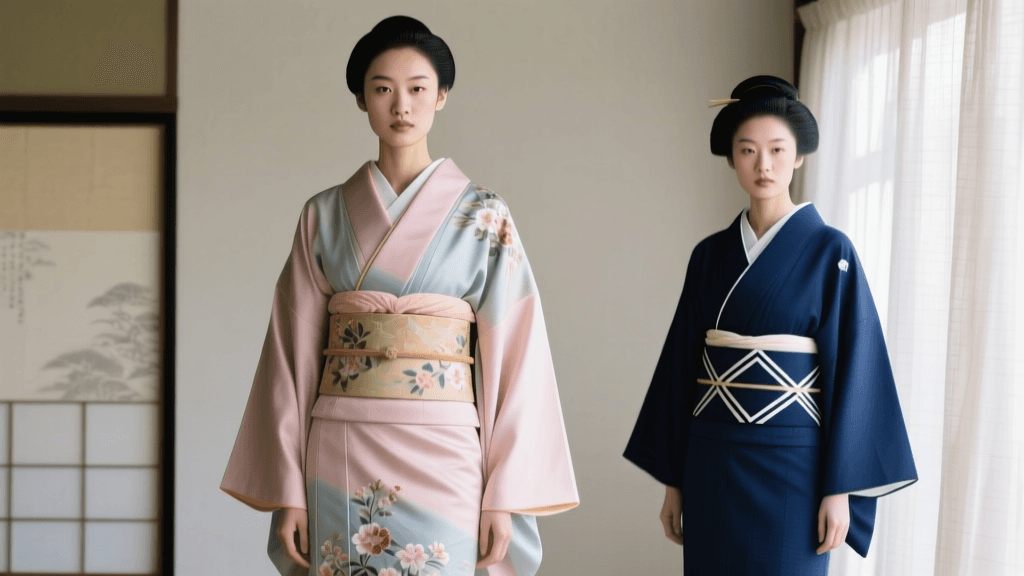
This suppression birthed the aesthetic philosophy of Iki—a sophisticated, understated elegance. Merchants circumvented sumptuary laws by wearing subdued, dark-colored outer garments lined with exorbitantly expensive, vividly patterned silk. This era also saw the invention of Yuzen paste-resist dyeing, which allowed for intricate, painterly designs directly on the fabric. The obi grew wider and more elaborate, eventually moving to the back of the body, solidifying the iconic kimono silhouette recognized globally today. As noted by the Victoria and Albert Museum (V&A), the Edo period's urban culture transformed the kimono into a canvas for artistic expression and social signaling.
'The essence of Iki is not found in blatant display, but in the subtle revelation of refined taste hidden beneath a subdued exterior.' — Edo Period Aesthetic Proverb
Comparative Analysis: Heian Jūnihitoe vs. Edo Kosode
To understand the drastic shift in Japanese dynasty fashion, one must compare the structural and cultural differences between the defining garments of the Heian and Edo periods.
| Feature | Heian Jūnihitoe (Court) | Edo Kosode (Merchant/Samurai) |
|---|---|---|
| Primary Silhouette | Wide, cascading, floor-dragging layers | Straight, T-shaped, ankle-length |
| Number of Layers | 5 to 20+ layered robes | 1 to 2 primary layers (Kosode + Uchikake) |
| Fastening Method | Unfastened, held by weight and posture | Secured by a wide, structured Obi |
| Decoration Focus | Layered color combinations (Kasane) | Surface dyeing (Yuzen) and embroidery |
| Mobility | Highly restricted, required attendants | Moderate, allowed for urban navigation |
| Modern Equivalent Cost | $5,000+ (Reproduction) / $250 (Rental) | $150 - $800 (Vintage/Antique Market) |
Actionable Guide: Sourcing and Styling Historical Silhouettes Today
For modern collectors, practitioners, and cultural enthusiasts, integrating historical Japanese garments into a contemporary wardrobe or collection requires an understanding of traditional measurements, seasonal timing, and market sourcing. The Izutsu Costume Museum in Kyoto remains a premier reference for those studying the exact draping and layering techniques of historical Japanese dress.
1. Understanding Kimono Measurements
Unlike Western clothing, kimono are not sized by chest or waist measurements. They are cut from a single bolt of fabric called a tanmono, which has a standard width of approximately 38 cm (15 inches). When sourcing vintage Edo-style kosode, focus on these critical measurements:
- Yuki (Sleeve-to-Center-Back): Measure from the base of your neck, over the shoulder, to the wrist. A standard vintage women's yuki is 64–68 cm. If the yuki is too short, the garment will pull tightly across the back.
- Mitake (Back Length): This is the length of the kimono from the base of the collar to the hem. The ideal mitake is generally your total height minus 30 cm (12 inches), allowing for the ohashori (the fold at the waist).
- Gusets (Underarm Panels): Ensure the width across the hips (calculated by adding the front and back panel widths plus the overlap) accommodates your hip measurement plus at least 20 cm for proper wrapping.
2. Seasonal Timing and Fabric Selection
Historical Japanese fashion is intrinsically tied to the micro-seasons. Wearing the incorrect fabric weight is considered a major faux pas in traditional dressing.
- Awase (Lined Kimono): Worn from October 1st to May 31st. These feature a secondary silk lining and are ideal for autumn, winter, and early spring.
- Hitoe (Unlined Kimono): Reserved strictly for the transitional months of June and September. They are made of a single layer of silk or hemp.
- Usumono (Sheer Summer Garments): Worn during the peak heat of July and August. Crafted from translucent ro (leno weave) or sha (gauze) silk, revealing the undergarments beneath.
3. Sourcing and Cost Guide
Acquiring authentic historical garments or high-quality reproductions requires navigating specialized markets.
- Vintage Edo/Taisho Kosode: While true Edo-period (pre-1868) textiles are fragile museum pieces, Taisho (1912–1926) and early Showa era kosode retain the Edo aesthetic and are widely available. Expect to pay between $80 and $300 on Japanese export auction sites for wearable condition pieces featuring Yuzen dyeing.
- Obi Selection: To properly style an Edo-inspired silhouette, avoid modern, stiff Nagoya obi. Instead, source a vintage Fukuro obi (maru-style bag obi) or a Kyōto Nishijin woven brocade. These range from $120 to $450 and provide the necessary width and structural integrity for historical knot styles like the taiko musubi or the elaborate darari knots.
- Heian Reproduction Rentals: For those wishing to experience the jūnihitoe without the prohibitive purchase cost, specialized studios in Kyoto offer full dressing sessions and rentals starting at $200 per day, including professional hair styling with traditional suberakashi wigs.
Conclusion
The evolution from the Heian jūnihitoe to the Edo kosode is a testament to the adaptability and enduring artistry of Japanese textile culture. By understanding the historical context, sumptuary influences, and precise structural requirements of these garments, modern enthusiasts can appreciate and preserve the profound legacy of Japanese dynasty fashion.