Murasaki Shikibu's Legacy: Mastering Heian Kimono Layering
The Heian-Era Fashion Revolution
When discussing the foundational pillars of traditional Japanese clothing, few historical figures cast as long and enduring a shadow as Murasaki Shikibu. Best known as the author of The Tale of Genji in the early 11th century, Murasaki was not merely a literary giant; she was a meticulous observer and arbiter of Heian-era court fashion. Her writings provide the most authoritative historical record of Kasane no Irome—the intricate, highly regulated system of layered color combinations that defined the aristocracy's aesthetic sensibilities.
In the Heian period (794–1185), fashion was a visual language. The nobility communicated their rank, seasonal awareness, and refined taste through the jūnihitoe, a twelve-layered ensemble of silk robes. Murasaki Shikibu’s diaries and novels frequently paused to describe the breathtaking effect of sleeves cascading from beneath one another, where the subtle contrast of a hidden inner lining against an outer robe could evoke the melting of spring snow or the turning of autumn maple leaves. Today, while modern women no longer wear thirty pounds of layered silk, the sartorial principles established by Murasaki and her contemporaries remain the bedrock of modern kimono layering, dictating how we pair undergarments, collars, and outer garments.
Decoding Kasane no Irome: The Architecture of Layering
The transition from the voluminous Heian jūnihitoe to the streamlined Edo-period kosode (the direct ancestor of the modern kimono) meant that the physical layers were reduced. However, the illusion of layering was preserved through ingenious structural adaptations. According to the Victoria and Albert Museum, the evolution of the kimono relied heavily on undergarments and removable collars to maintain the historical depth of color that Japanese aesthetics demand.
Modern kimono dressing achieves the Heian legacy primarily through three garments:
- Hadajuban: The innermost cotton or silk camisole and wrap skirt, protecting the outer layers from body oils.
- Nagajuban: The primary under-kimono. While only the collar and occasionally the hem are visible, the color of the nagajuban acts as the "inner lining" of the Heian era.
- Han-eri and Kasane-eri: The removable half-collar (han-eri) sewn onto the nagajuban, often paired with a thin, decorative basting collar (kasane-eri) to simulate the edge of a second, contrasting silk robe peeking out at the neckline.
"The true elegance of the kimono lies not in the outer pattern, but in the secret glimpses of color revealed at the collar, the hem, and the inner lining—a direct inheritance from the Heian court."
Seasonal Kasane no Irome Combinations
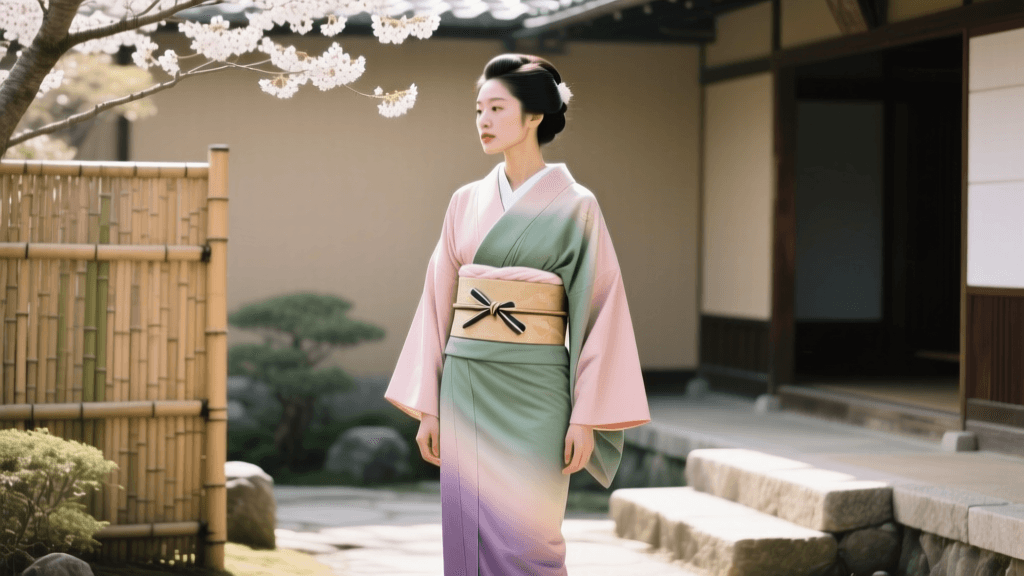
Murasaki Shikibu’s contemporaries strictly adhered to seasonal color pairings. Today, modern kimono stylists use these historical combinations to select their nagajuban and kasane-eri colors. Below is a practical guide to historical pairings adapted for modern wear:
| Season | Outer Kimono Base | Nagajuban (Inner Layer) | Kasane-eri (Collar Accent) | Historical Name & Meaning |
|---|---|---|---|---|
| Early Spring | Pale Pink (Sakura) | Crimson Red | White | Kōbai (Red Plum): Evokes plum blossoms blooming through late snow. |
| Summer | Sheer Indigo (Ro/Sha) | Ice Blue or White | Silver or Pale Grey | Kawasemi (Kingfisher): Suggests cool, flowing water to combat humidity. |
| Autumn | Golden Yellow | Deep Burgundy | Dark Brown | Kōyō (Autumn Leaves): Mirrors the changing canopy of maple forests. |
| Winter | Pine Green | Pure White | Silver Thread | Matsu no Yuki (Snow on Pine): Represents resilience and purity in cold. |
Modern Application: Recreating the Legacy Today
To channel Murasaki Shikibu’s aesthetic in the 21st century, one must master the art of the neckline. The Heian court prized a slight, calculated looseness at the nape of the neck (eri-nuki), allowing the contrasting layers to fan out beautifully.
Step-by-Step Layering Technique
- Prepare the Collar: Sew your chosen han-eri (half-collar) onto the nagajuban. For a Heian-inspired look, baste a 2mm to 3mm kasane-eri (layered collar strip) just beneath the edge of the han-eri. This creates the optical illusion of multiple silk robes.
- Dress the Nagajuban: Wrap the under-kimono left over right. Use an erishin (collar stay) made of stiff mesh or plastic to keep the collar crisp and prevent it from collapsing into the neckline.
- Adjust the Nape: Pull the back of the collar down so that exactly one fist-width of skin is visible between the hairline and the collar. This is crucial for displaying the layered colors at the nape.
- Align the Outer Kimono: When putting on the outer kimono, ensure the kasane-eri is visible by exactly 1-2 millimeters along the entire V-shape of the neckline and at the nape.
Sourcing, Measurements, and Costs
Building a wardrobe capable of executing Heian-style layering requires specific investments. The Kyoto National Museum frequently highlights the importance of textile quality in historical garments, a principle that holds true for modern undergarments.
- Han-eri (Half-Collars): Standard measurements are 15.5 cm wide by 110 cm long.
- Machine-embroidered polyester: $15 – $25 (Easy care, machine washable).
- Hand-dyed silk with metallic thread (Shishu): $80 – $150 (Reserved for formal tomesode or homongi).
- Kasane-eri (Basting Collars): Usually sold in 1-meter strips. Cost: $10 – $20. Available in silk crepe (chirimen) for winter and sheer linen for summer.
- Nagajuban (Under-Kimono):
- Two-piece polyester (Nibushiki): $40 – $70. Highly practical, allows for easy washing and adjustable length.
- Full-length Silk Ro/Sha (Summer): $150 – $300. Essential for wearing beneath sheer summer kimono, as the undergarment becomes a visible part of the outfit.
- Vintage Silk Rinzu (Figured Satin): $100 – $250. Often features hidden linings (hakkake) with hand-painted motifs at the hem, a direct nod to Heian-era hidden luxuries.
Timing your purchases: The traditional wardrobe change, Koromogae, occurs on June 1st (transitioning to sheer, unlined summer garments) and October 1st (transitioning back to lined autumn/winter garments). Department stores in Japan and specialized online kimono retailers discount the outgoing season's nagajuban and collars by up to 40% in late May and late September.
Etiquette and Dress Code Rules for Layered Kimono
While Murasaki Shikibu’s court allowed for flamboyant displays of layered silks, modern Japanese etiquette requires a more subdued approach to layering, governed by the formality of the event.
Formal Events (Weddings, Tea Ceremonies, Graduations)
When wearing formal silk kimono (kurotomesode, irotomesode, or homongi), the nagajuban must be pristine white or pale ivory. The han-eri should be heavily embroidered with auspicious motifs (cranes, pine, plum blossoms) using gold or silver threads. A kasane-eri is highly recommended here to add weight and formality to the collar line. The inner layers should never feature loud, contrasting colors that distract from the outer garment's dyed crests (kamon).
Semi-Formal and Casual (Visiting Shrines, Dining, Theater)
For tsukesage, komon, or high-quality tsumugi (woven silk), you have the freedom to play with the Kasane no Irome color wheel. A deep plum nagajuban beneath a grey woven kimono, accented with a pale pink kasane-eri, is a sophisticated, historically grounded choice for an autumn theater outing. However, avoid wearing brightly colored or patterned nagajuban beneath sheer summer kimono (usumono), as the undergarment pattern will clash with the outer dye.
Conclusion: The Enduring Whisper of Silk
Murasaki Shikibu understood that true elegance is often found in what is partially concealed. By mastering the modern applications of Kasane no Irome—through the careful selection of nagajuban colors, the precise basting of a kasane-eri, and the seasonal awareness of your textiles—you do more than just wear a traditional garment. You participate in a thousand-year-old dialogue about nature, seasonality, and the quiet beauty of hidden layers, ensuring that the fashion legacy of the Heian court continues to breathe in the modern world.