Heian to Edo: Sourcing Historical Japanese Kimono Replicas
The Evolution of Japanese Court and Commoner Dress
Japanese fashion history is not a monolith; it is a dynamic tapestry woven from the shifting political, social, and aesthetic values of its distinct historical eras. For collectors, historical reenactors, and cultural enthusiasts, understanding the transition from the opulent court layers of the Heian period to the refined, structured garments of the Edo period is essential. This guide explores the sartorial evolution of traditional Japanese clothing, specifically focusing on the junihitoe and the kosode, while providing actionable advice on how to source, measure, and maintain historical replicas today.
Heian Period (794–1185): The Layered Elegance of the Junihitoe
The Heian period represents the pinnacle of Japanese court culture, an era where aesthetics and literary pursuits were paramount. The defining garment of aristocratic women was the junihitoe, which translates to "twelve-layer robe." In reality, the number of layers could vary, but the ensemble was renowned for its breathtaking complexity and weight. As noted by the Metropolitan Museum of Art's Heian Period overview, the Heian elite used clothing to communicate rank, season, and poetic sensibility.
The true artistry of the junihitoe lay in the kasane no irome—the specific color combinations of the layered silk robes. The edges of the sleeves and hems were deliberately staggered to reveal glimpses of contrasting colors, mimicking the natural world, such as the pale green of a willow shoot or the deep crimson of autumn maple leaves.
Sourcing Heian Replicas: Costs and Considerations
Acquiring a full junihitoe replica is a significant undertaking, usually reserved for museums, professional reenactors, or high-end collectors. Here is what you need to know before commissioning or purchasing one:
- Cost: A complete, authentic silk junihitoe replica crafted by traditional Kyoto ateliers will cost between $15,000 and $30,000 USD. High-quality synthetic blends (polyester chirimen) suitable for theater or lightweight reenactment can be sourced for $3,000 to $6,000 USD.
- Weight and Mobility: A full silk ensemble can weigh upwards of 20 kilograms (44 lbs). Wearers must undergo physical conditioning to manage the weight and practice the specific, gliding suriashi walking technique to avoid tripping on the trailing mo (apron-like skirt).
- Time to Dress: Dressing in a junihitoe requires at least two trained assistants and takes approximately 45 to 60 minutes. The layers must be tied precisely at the waist with a specific braided cord.
Edo Period (1603–1867): The Rise of the Kosode and Obi
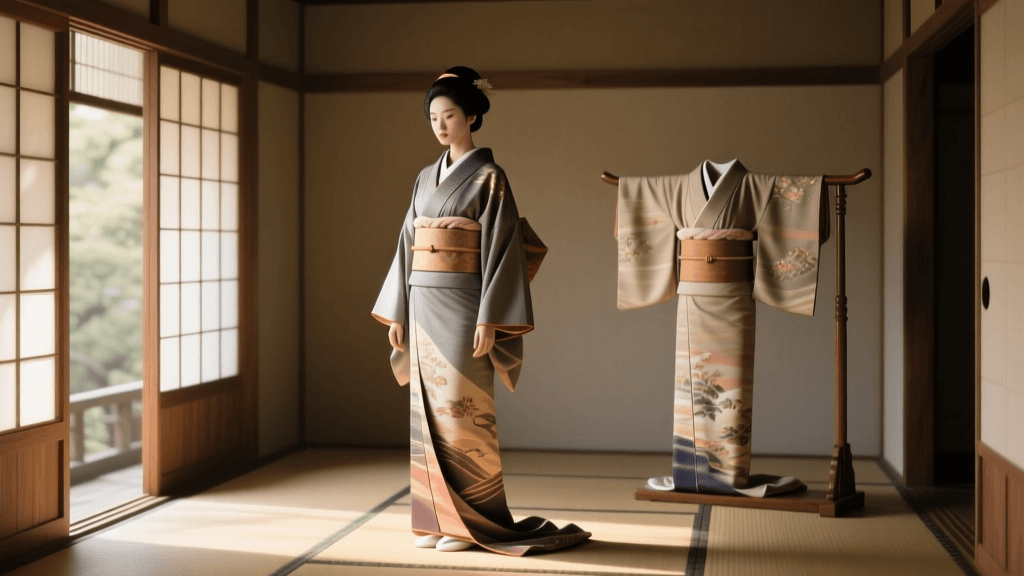
As the samurai class consolidated power and the capital shifted to Edo (modern-day Tokyo), fashion underwent a radical transformation. The kosode (meaning "small sleeves"), which had served as a simple undergarment during the Heian and Muromachi periods, emerged as the primary outer garment for both men and women of all classes. The Metropolitan Museum of Art's guide to Edo period Kosode highlights how this shift allowed for an explosion of surface design, as the broad, flat canvas of the kosode was ideal for intricate dyeing and embroidery.
During the Edo period, the obi (sash) also evolved. Initially a narrow, functional cord, it widened dramatically to secure the heavier, more elaborately decorated kosode. By the late Edo period, women's obi had become wide, stiff, and highly decorative, often tied in elaborate bows at the back, fundamentally altering the silhouette of Japanese fashion.
Actionable Guide: Buying Edo-Style Kosode
For those looking to acquire Edo-period-style garments, the antique and vintage markets in Kyoto and Tokyo are treasure troves. When sourcing, keep the following details in mind:
- Textile Identification: Look for Tango chirimen (a highly textured silk crepe) or habutai (a smooth, tightly woven silk). Chirimen was highly prized in the Edo period for its excellent dye absorption and beautiful drape.
- Dyeing Techniques: Seek out garments featuring Yuzen dyeing, a resist-dye technique invented in the late 17th century that allowed for pictorial, multi-colored designs. According to the Victoria and Albert Museum's history of the Kimono, Yuzen revolutionized garment decoration, allowing artisans to paint directly onto silk.
- Condition Checks: Vintage Edo and Meiji-era kosode often suffer from "shattering" (silk degradation due to metallic mordants used in black dyes). Always inspect the black and deep red panels for brittleness before purchasing. Expect to pay $200 to $800 USD for a wearable vintage piece, and $1,500+ for museum-quality antique examples.
Comparison Chart: Heian Junihitoe vs. Edo Kosode
| Feature | Heian Junihitoe (Court Replicas) | Edo Kosode (Vintage/Replicas) |
|---|---|---|
| Primary Function | Ceremonial court dress | Everyday outerwear / Formal wear |
| Number of Layers | 5 to 12+ layered robes | 1 main robe (worn over under-kimono) |
| Sleeve Style | Wide, open, unlined edges | Narrow openings, sewn shut at back/bottom |
| Obi (Sash) | Narrow braided cords tied at front | Wide, stiff brocade tied at back |
| Average Weight | 15 - 20+ kg | 1.5 - 3 kg (including undergarments) |
| Dressing Time | 45 - 60 minutes (requires assistance) | 10 - 15 minutes (can be done solo) |
| Replica Cost (USD) | $3,000 (synthetic) - $30,000 (silk) | $200 (vintage) - $2,500 (custom silk) |
Practical Measurement Guide for Historical Garments
Unlike Western clothing, which is tailored to the contours of the body, traditional Japanese garments are constructed from straight bolts of fabric (tanmono) and rely on precise, standardized measurements. If you are commissioning a historical replica or altering a vintage piece, you must understand the following metrics:
- Yuki (Arm Span): This is the most critical measurement. Stand straight and have a partner measure from the center of your spine (the prominent vertebra at the base of the neck), across the shoulder, and down to the wrist bone. For historical Edo kosode, the yuki was traditionally shorter, ending at the base of the thumb, typically measuring between 60cm and 64cm for women. Modern wearers often prefer 66cm to 68cm. If buying a vintage Edo-style piece, be prepared for shorter yuki lengths.
- Mitake (Back Length): Measured from the base of the neck down to the desired hemline. Historically, the hem was meant to brush the floor or fold over the hips, but modern practicalities often dictate an ankle-length mitake. For a standard woman of 160cm (5'3"), the mitake is usually around 125cm to 130cm.
- Maemigoro and Ushiromigoro (Front and Back Widths): The standard width of a tanmono bolt is about 36cm to 38cm. The front and back panels are cut directly from this width. If your hip measurement exceeds 100cm, you will need a custom replica woven from extra-wide fabric, as standard historical bolts will not provide enough overlap at the front.
Archival Storage and Maintenance
Whether you have invested in a $20,000 Heian court replica or a $500 vintage Edo kosode, proper storage is non-negotiable. Silk is a protein fiber that is highly susceptible to humidity, light, and acidic environments.
Expert Archival Tip: Never store historical silk garments in plastic bins or vacuum-sealed bags. Plastic traps moisture and off-gasses chemicals that will permanently stain and degrade the silk fibers over time. Always allow the fabric to "breathe."
Actionable Storage Steps:
- Tatoushi Wrapping: Wrap the garment in tatoushi, which are specially sized, acid-free Japanese paper envelopes. Replace these papers every two years, as they absorb ambient moisture and protect the silk from dust.
- Kiribako (Paulownia Wood Boxes): Store the wrapped garments in a kiribako. Paulownia wood naturally regulates humidity and repels insects. A custom-made, unfinished kiribako from a traditional Japanese woodworker will cost between $200 and $400 USD, but it is an essential investment for preserving historical textiles.
- Airing Out (Mushiboshi): Twice a year, preferably in late autumn when the air is dry and cool, remove the garments from their boxes, unfold them, and let them air out in a shaded, well-ventilated room for 2 to 3 hours. This prevents mold and resets the fibers.
Conclusion
From the sweeping, multi-layered majesty of the Heian junihitoe to the intricately dyed, structured elegance of the Edo kosode, Japanese historical garments are masterpieces of textile engineering and cultural expression. By understanding the specific measurements, material requirements, and archival care techniques unique to each era, collectors and enthusiasts can responsibly source and preserve these incredible garments, keeping the rich legacy of Asian sartorial traditions alive for future generations.