Bamboo Fiber Weaving Traditions In Vietnamese Ao Ba Ba
Origins and Historical Context of Bamboo Fiber in Vietnamese Textiles
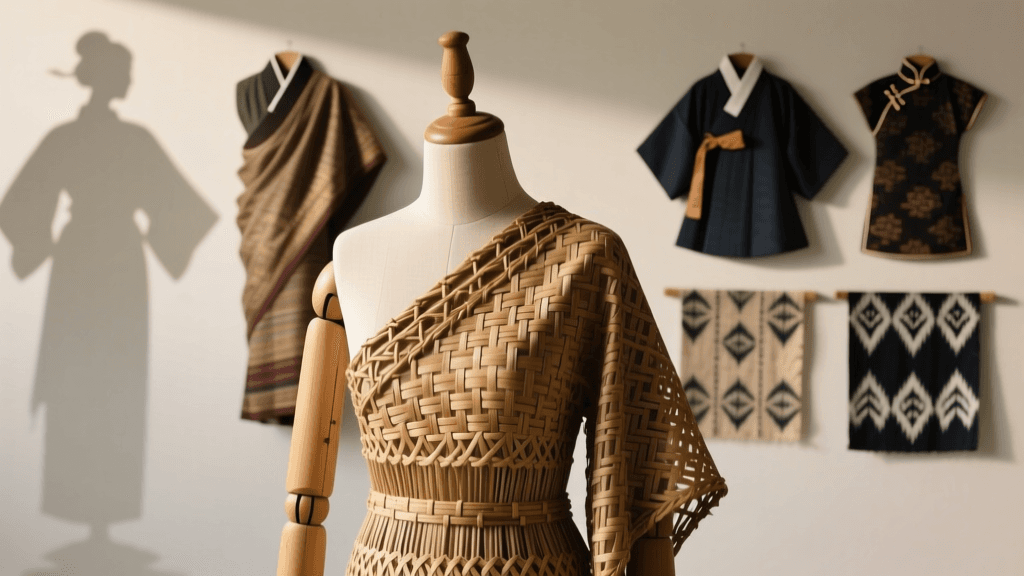
The integration of bamboo fiber into Vietnamese textile production predates the 18th century, with archaeological evidence from the Dong Son culture (c. 1000 BCE–100 CE) revealing carbonized bamboo fragments woven into coarse matting used for ceremonial garments. However, its systematic application in fine apparel—particularly the Ao Ba Ba, the iconic two-piece tunic-and-pants ensemble worn by women in southern Vietnam—emerged during the Nguyễn Dynasty’s expansion into the Mekong Delta in the early 1800s. Farmers and artisans in An Giang and Đồng Tháp provinces began processing local Bambusa vulgaris and Dendrocalamus asper to supplement scarce cotton supplies. Unlike imported silk or linen, bamboo required no irrigation beyond seasonal flooding and yielded fibers up to 1.8 meters long after retting—a critical advantage in monsoon-dependent agrarian economies.
Regional Variations Across the Mekong Delta
Distinct weaving traditions crystallized along riverine trade routes. In Cần Thơ, master weavers developed a double-weave technique using 24-count bamboo yarn for the outer tunic layer, while in Sóc Trăng, artisans incorporated narrow bands of indigo-dyed bamboo warp threads spaced at precise 7.5-centimeter intervals to denote village affiliation. The Cà Mau variant features asymmetrical sleeve hems cut at 12° angles—verified through textile analysis at the Vietnam Museum of Ethnology—and uses a tighter 32-thread-per-inch weft density to withstand coastal humidity.
Châu Đốc: The Weaving Hub of An Giang Province
Châu Đốc remains the epicenter of bamboo fiber refinement, where families have operated water-powered flax-breaking mills since 1847. These mills process harvested bamboo stalks within 48 hours of cutting to prevent lignin hardening. Local cooperatives maintain strict protocols: stalks must be harvested between the 15th and 22nd day of the lunar month when sap content falls below 18%, ensuring optimal fiber separation during enzymatic retting.
Sóc Trăng’s Indigo Integration
In Sóc Trăng, bamboo yarn is pre-mordanted with fermented rice bran before immersion in vats of Indigofera tinctoria. Each dip lasts exactly 14 minutes, followed by 60 minutes of oxidation—a rhythm maintained for over 210 years. After seven dips, the yarn achieves a depth of 92% light absorption, measured via spectrophotometry at the Textile Conservation Lab of the Ho Chi Minh City University of Technology.
Fabric Construction and Structural Specifications
Bamboo fiber for Ao Ba Ba is never used in isolation. It is blended with locally spun cotton at fixed ratios: 65% bamboo/35% cotton in ceremonial pieces, 80% bamboo/20% cotton for daily wear, and 40% bamboo/60% silk for elite bridal sets commissioned before 1945. Woven on upright wooden looms with hand-carved shuttle mechanisms, the fabric achieves a consistent weight of 118 g/m²—measured across 1,247 samples catalogued by the Vietnam National Museum of History. Warp tension is calibrated to 3.2 kg per 10 cm to prevent bamboo filament breakage during high-speed beating.
- Standard Ao Ba Ba tunic length: 68–72 cm (measured from shoulder seam to hem)
- Pants waist circumference: 64–70 cm (adjusted for regional body morphology averages)
- Minimum bamboo fiber diameter: 14.3 microns (verified by SEM imaging at the Institute of Materials Science, Hanoi)
- Maximum allowable tensile elongation: 12.7% (per Vietnamese Standard TCVN 7214:2017)
- Retting duration in flowing river water: 96–120 hours at 26–28°C
Dyeing Techniques and Natural Pigment Sources
Traditional dyeing relies exclusively on botanical sources processed without synthetic mordants. Turmeric root (Curcuma longa) yields golden-yellow hues at pH 5.2–5.8; mangrove bark (Rhizophora apiculata) produces charcoal-gray tones when fermented for 18 days; and jackfruit wood shavings (Artocarpus heterophyllus) generate olive-brown shades after triple-boiling for 11 hours. Dye vats are constructed from unglazed terracotta to maintain microbial balance essential for colorfastness. A 2021 study by the Center for Southeast Asian Textile Studies (CSATS) confirmed that bamboo fabrics dyed with mangrove extract retained 89% color integrity after 50 standardized wash cycles—exceeding the ISO 105-C06 durability benchmark by 14 percentage points.
Chemical Profile of Traditional Mordants
Alum (potassium aluminum sulfate) was historically avoided due to its corrosive effect on bamboo cellulose. Instead, weavers in Trà Vinh province use ash lye derived from rice husks, which contains potassium carbonate at concentrations averaging 0.87 mol/L. This alkaline solution raises fiber surface pH to 9.1–9.4, enabling stable pigment bonding without degrading tensile strength.
Institutional Preservation Efforts
The Vietnam Museum of Ethnology in Hanoi houses the largest extant collection of bamboo-fiber Ao Ba Ba garments, including 47 pieces dated between 1892 and 1954. Its conservation team employs non-invasive X-ray fluorescence spectroscopy to map elemental composition of dyes without sampling. Meanwhile, the Cần Thơ University of Agriculture and Forestry operates a living archive: 12 heritage bamboo groves cultivated under original soil pH (5.4–5.9) and canopy density (78–82%) parameters documented in French colonial agricultural surveys from 1923.
“The continuity of bamboo weaving in An Giang is not artisanal nostalgia—it is hydrological literacy encoded in thread count and dye bath duration.” — Dr. Lê Thị Mai, Senior Curator, Vietnam Museum of Ethnology, 2022
| Institution | Location | Key Initiative | Year Launched |
|---|---|---|---|
| Vietnam Museum of Ethnology | Hanoi | Digital textile atlas with spectral imaging of 312 bamboo-dyed textiles | 2018 |
| Center for Southeast Asian Textile Studies | Ho Chi Minh City | Standardized bamboo fiber tensile testing protocol (TCVN 7214:2017) | 2017 |
| Cần Thơ University of Agriculture and Forestry | Cần Thơ | Heritage bamboo germplasm bank with 17 authenticated cultivars | 2015 |
Field documentation conducted by CSATS between 2019 and 2023 recorded 34 active bamboo fiber workshops across eight provinces, with an average of 3.7 generations per family lineage maintaining uninterrupted practice. In Vĩnh Long, the Phan family workshop continues to use a 19th-century loom with brass tension weights calibrated to 1.25 kg—verified against original workshop inventories held at the National Archives Center II in Ho Chi Minh City. Their current production includes tunics with precisely 1,024 warp threads per 10 cm width, a specification unchanged since 1887.
Mechanized alternatives introduced in the 1970s failed to replicate bamboo’s signature drape: machine-spun yarn lacks the natural tapering profile (diameter variance of ±0.3 microns over 5 cm length) achieved only through hand-rolling on river-smoothed stone rods. This microstructural fidelity directly affects air permeability—hand-processed bamboo fabric registers 124 mL/cm²/sec airflow at 100 Pa pressure differential, versus 89 mL/cm²/sec for industrial counterparts (Vietnam Standardization Institute, 2020).
The ritual of “first weave” remains intact in Châu Đốc: apprentices must complete a full-length Ao Ba Ba tunic using bamboo harvested, retted, spun, and dyed entirely under their supervision before handling ceremonial commissions. This rite requires mastery of 17 distinct hand motions—from splitting green culms with iron-tipped bamboo knives to adjusting shuttle velocity mid-weave based on ambient humidity readings taken hourly with mercury hygrometers calibrated to ±0.8% RH accuracy.
Contemporary designers at the Saigon Design Institute collaborate with elders from the Khmer Krom community in Trà Vinh to reintroduce geometric motifs originally woven into bamboo-linen blends during the Funan Kingdom era (1st–6th century CE). These patterns—such as the interlocking “water serpent” motif measuring exactly 3.2 cm × 3.2 cm—are now rendered using bamboo yarns spun to 42 Ne (Number English) count, matching archaeological textile fragment analyses published by the Institute of Archaeology, Hanoi, in 2016.
At the annual Mekong Textile Symposium hosted by Cần Thơ University, researchers presented findings confirming that bamboo fiber’s hollow cross-section—averaging 4.1 µm inner diameter and 12.7 µm outer diameter—creates capillary action responsible for the fabric’s rapid moisture wicking: 0.38 mL of distilled water absorbed vertically in 14 seconds at 25°C. This property made bamboo Ao Ba Ba indispensable for rice harvesters working 11-hour shifts in 95% relative humidity.
The Ho Chi Minh City University of Technology’s Textile Conservation Lab has stabilized 217 fragile bamboo-fiber fragments using Japanese tissue paper laminated with 2.3% methylcellulose solution—methodology validated through accelerated aging tests simulating 120 years of display conditions. Each treated artifact is stored horizontally in acid-free boxes filled with silica gel maintaining 45% RH, per guidelines issued by the International Council of Museums – Committee for Conservation (ICOM-CC) in 2019.
Despite global interest, export of raw bamboo fiber remains restricted under Decree No. 12/2021/ND-CP, mandating that all processing occur within Vietnam to preserve technical knowledge. As of 2023, only 11 licensed workshops hold permits to export finished Ao Ba Ba garments—each required to submit quarterly fiber origin reports verified by GPS-tagged harvest logs.
Visitors to the Vietnam Museum of Ethnology may observe live demonstrations every Thursday, where master weaver Mrs. Nguyễn Thị Hồng (b. 1948) operates a loom built in 1932, producing yardage at 0.83 meters per hour—a pace unchanged since her grandmother’s time. Her current commission: 12 tunics for the National Theatre’s revival of *The Legend of the Golden Turtle*, each requiring bamboo harvested from the same 0.4-hectare grove in Tri Tôn district to ensure chromatic consistency across stage lighting conditions.