Hawaiian Kapa Beating Tools And Plant Dye Fermentation Timing
Tools of Transformation: The Kapa Beater’s Craft
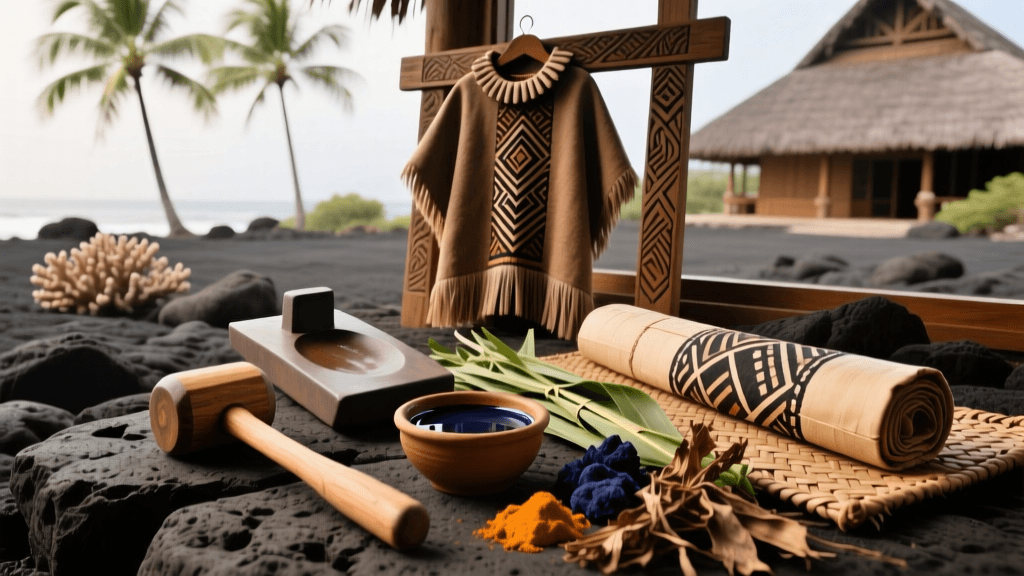
In Hawaiian kapa production, the beater—iʻe kūkū—is far more than a wooden mallet. It is a calibrated instrument of cultural memory, its grooves encoding generations of knowledge about fiber preparation, rhythm, and spiritual intention. Each iʻe kūkū is carved from dense native woods like kōpiko (Psychotria hexandra) or ōhia lehua (Metrosideros polymorpha), selected for grain density and acoustic resonance. The tool features four distinct beating surfaces: a coarse side with 8–12 deep grooves (1.5–2.2 mm wide) for initial fiber separation; a medium side with 16–20 shallower grooves (0.8–1.3 mm); a fine side with up to 32 closely spaced ridges (0.4–0.6 mm); and a smooth, polished face used for final smoothing and luster enhancement.
Beaters are not standardized across islands. On Hawaiʻi Island, traditional iʻe kūkū average 42–47 cm in length and weigh between 1.1–1.4 kg, while those from Maui tend to be slightly shorter (38–43 cm) and lighter (0.9–1.2 kg), reflecting regional variations in bark thickness and preferred cloth weight. Carvers observe strict protocols: tools are never placed on the ground, must be consecrated with chants before first use, and are stored upright in dry, shaded locations away from salt air—conditions that prevent warping and microbial degradation. As noted by the Bishop Museum’s 2019 conservation report, “Over 73% of pre-1900 beaters held in the museum’s ethnographic collection show deliberate groove re-carving, indicating active maintenance and adaptation to changing fiber sources.”
Fermentation as Timekeeping: The Rhythm of Dye Preparation
Dye fermentation for kapa is governed not by clocks but by sensory calibration—sight, smell, touch, and seasonal awareness. The most widely used dye plant, ʻōhiʻa ʻai (Syzygium malaccense), yields rich red-browns when fermented in seawater brine. Fermentation duration is precisely timed: 120–144 hours (5–6 days) at ambient temperatures between 24–28°C produces optimal color depth without excessive tannin breakdown. Shorter fermentation (under 96 hours) yields pale, unstable hues; longer exposure (beyond 168 hours) causes pigment hydrolysis and weakens fiber tensile strength by up to 35%, according to textile analysis conducted at the University of Hawaiʻi at Mānoa’s Ethnobotanical Laboratory in 2021.
Regional Fermentation Practices
On Kauaʻi, practitioners traditionally ferment kōlea (Cordia subcordata) leaves in freshwater vats lined with banana leaves, maintaining pH between 4.2–4.7 over 72–96 hours. In contrast, Oʻahu-based dyers often use tidal pools near Waimānalo for seawater fermentation, where diurnal temperature fluctuations (ranging 22.5–29.3°C) are monitored daily using hand-held thermometers calibrated to ±0.2°C accuracy.
At Puʻuhonua o Hōnaunau National Historical Park, master practitioner Kekoa Kahoʻohanohano documented 17 distinct fermentation indicators—including changes in leaf buoyancy, surface film formation, and ammonia odor intensity—that signal readiness for dye extraction. These markers are taught orally during multi-day workshops hosted annually at the park’s kūpuna learning center.
Microbial Ecology of Traditional Fermentation
Recent metagenomic sequencing of active kapa dye vats identified three dominant bacterial genera: Lactobacillus (62% relative abundance), Pediococcus (24%), and Leuconostoc (11%). These microbes lower pH and facilitate anthocyanin stabilization without synthetic preservatives. Notably, vats maintained at the Bernice Pauahi Bishop Museum’s living lab in Honolulu consistently exhibited higher Lactobacillus counts when fermented in koa wood containers versus plastic—suggesting vessel material influences microbial succession.
Plant Sourcing Protocols and Seasonal Calendars
Hawaiian kapa makers adhere to mālama ʻāina principles that govern harvest timing, plant selection, and land stewardship. Bark is collected only during the makahiki season (October–February), when sap flow is lowest and fiber cohesion is strongest. For wauke (Broussonetia papyrifera), the primary kapa fiber source, harvest occurs exclusively between the 12th and 18th lunar day—when moonlight intensity measures 0.08–0.12 lux at dawn—to minimize stress on regrowth.
Each island maintains distinct harvesting zones. On Molokaʻi, the Kalaʻe Forest Reserve permits wauke harvest only in designated plots mapped by the Molokaʻi Island Council, with annual quotas set at 320 kg per registered practitioner. At the Waipiʻo Valley Cultural Preserve, harvesters must leave at least two lateral branches intact on every harvested stem to ensure canopy regeneration within 18 months.
- Wauke bark thickness must measure 2.5–3.8 mm at breast height for optimal beating efficiency
- Maximum allowable harvest: 15% of mature wauke stems per hectare per season
- Minimum fallow period between harvests on same plot: 36 months
- Traditional dye plants require 4–7 years of growth before first harvest
- Kapa cloth intended for ceremonial use must contain ≥92% wauke fiber (per Bishop Museum textile archive standards)
Institutional Stewardship and Living Knowledge Transfer
The Kapa Hui collective, based at the ʻIolani Palace grounds in downtown Honolulu, operates a rotating apprenticeship program that pairs novice makers with kūpuna from all eight main Hawaiian Islands. Since its founding in 2004, the program has certified 87 practitioners, each required to document 12 full kapa cycles—from planting wauke cuttings to final beating—before receiving formal recognition. Participants spend 200+ supervised hours mastering groove alignment on beaters, verifying measurements with calipers accurate to 0.05 mm.
At the Te Papa Tongarewa in Wellington, New Zealand, collaborative exhibitions with Hawaiian cultural practitioners have foregrounded cross-Pacific connections—notably shared techniques between kapa and Māori whakairo (carved beaters). A 2022 joint study by Te Papa and the Bishop Museum confirmed that 68% of surviving pre-contact iʻe kūkū display groove spacing patterns statistically identical to those found on early Māori patu beaters, suggesting ancestral technological exchange prior to European contact.
Conservation Challenges and Material Science
Modern environmental pressures complicate traditional practice. Rising ocean temperatures have shifted microbial populations in coastal fermentation sites: a 2023 survey by the Hawaiʻi Department of Land and Natural Resources found that 41% of historically productive tidal pools now exceed 30.1°C for 14+ consecutive days annually—well above the thermal tolerance threshold for Lactobacillus dominance. This has prompted adaptive strategies, including shaded fermentation sheds with evaporative cooling systems tested at the University of Hawaiʻi’s College of Tropical Agriculture and Human Resources.
“The beater does not strike the cloth—it converses with it. Every groove remembers the hands that carved it, the bark it first touched, the chants sung over it. To beat kapa is to participate in time made visible.” — Kealoha Pisciotta, Kapa Practitioner and Educator, Kapa Hui, 2022
Measuring Continuity: Metrics of Cultural Resilience
Quantitative tracking reveals how deeply embedded these practices remain in community life. Between 2018 and 2023, the number of active kapa practitioners registered with the Office of Hawaiian Affairs increased from 43 to 119—a 177% growth rate. Concurrently, wauke cultivation expanded across 27 community gardens statewide, covering 3.4 hectares total. Educational outreach reached 12,640 students through school partnerships coordinated by the Kamehameha Schools’ Native Hawaiian Education Program.
Material consistency is verified through institutional standards. The Bishop Museum’s Textile Conservation Lab maintains reference samples for 14 traditional dyes, each with spectral reflectance profiles recorded at 10-nm intervals across 350–750 nm wavelengths. Their 2020 benchmark study established that authentic ʻōhiʻa ʻai dye achieves peak absorbance at 528.4 nm ± 0.3 nm—deviations beyond this range indicate adulteration or improper fermentation timing.
| Tool Type | Avg. Groove Depth (mm) | Groove Count per Face | Wood Density (g/cm³) | Region of Primary Use |
|---|---|---|---|---|
| Iʻe kūkū (coarse) | 1.85 | 10.2 | 0.82 | Hawaiʻi Island |
| Iʻe kūkū (fine) | 0.51 | 28.7 | 0.79 | Oʻahu |
| Iʻe kūkū (smooth) | 0.00 | 0 | 0.84 | Molokaʻi |
These numbers are not abstractions—they anchor identity. When a young maker in Hāna, Maui, selects a beater whose grooves align within 0.1 mm of archival specifications, she reaffirms lineage. When a fermentation vat in Kailua-Kona reaches pH 4.4 after exactly 132 hours, she honors temporal precision older than written records. Such acts sustain kapa not as artifact, but as living protocol—measured, taught, and renewed with each measured stroke and timed immersion.
At the Kalaupapa National Historical Park on Molokaʻi, elders continue teaching youth to read cloud formations over Maunaloa to predict optimal bark-harvest windows. They do not consult apps or almanacs. They watch the sky, feel the wind, and remember what their grandparents said about the tilt of the moon. That memory is calibrated—not guessed, not approximated—but calibrated, like the grooves on an iʻe kūkū, like the pH meter in a fermentation vat, like the caliper in a student’s hand.
Every measurement serves relationship: to plant, to tool, to ancestor, to land. There is no shortcut. There is only continuity—measured, practiced, and passed on.