Hardanger Bunad Guide 2026: Regional Patterns & Silver Costs
The Enduring Legacy of the Hardanger Bunad in 2026
When discussing traditional European folk dress, few garments command the respect, meticulous craftsmanship, and cultural reverence of the Norwegian bunad. Unlike generic folk costumes that faded into historical obscurity, the bunad is a living, breathing tradition worn at weddings, national holidays, and confirmations across Norway. As of 2026, the demand for authentic, regionally accurate bunads continues to surge, driven by a renewed interest in sustainable, slow-fashion heritage garments. According to the Norwegian Home Crafts Association (Husfliden), the bunad remains a cornerstone of Norwegian cultural identity, with strict guidelines governing its construction, embroidery, and accessories.
Among the most iconic and historically significant of these regional garments is the Hardanger bunad (Hardangerbunaden). Originating from the breathtaking fjord-carved region of Hardanger in Vestland county, this specific folk dress is often cited as the very first official bunad, having gained national prominence during the early 20th-century romantic nationalism movement. Today, in 2026, the Hardanger bunad stands as a masterclass in textile artistry, characterized by its stark black wool base, intricate white linen embroidery, and elaborate oxidized silver jewelry.
Regional Variations: Hardanger vs. Sunnhordland
While the untrained eye might group all Norwegian folk costumes under a single umbrella, regional variations are fiercely protected. The Norwegian Institute for Bunad and Folk Costumes rigorously documents these distinctions. The Hardanger bunad is distinct from its neighboring Sunnhordland and Voss variants. The classic Hardanger women's bunad features a black wool bodice and skirt, adorned with white cutwork embroidery (Hardangersøm) on the linen apron, cuffs, and collar. The bodice is typically laced with a silver chain through metal eyelets, and the skirt is accented with a vibrant woven silk or wool band at the hem.
In contrast, the men's Hardanger bunad is equally striking, featuring a black wool jacket with intricate silver buttons, a richly embroidered vest, and knee-length breeches paired with hand-knit wool stockings. Understanding these regional boundaries is crucial for anyone looking to commission, inherit, or recreate a bunad in 2026, as mixing elements from different regions is considered a major faux pas in Norwegian folk dress culture.
The Art of Hardangersøm: Embroidery Specifications
The defining feature of the Hardanger bunad is its namesake embroidery, Hardangersøm. This geometric, cutwork embroidery technique requires immense precision. For modern makers and restorers working in 2026, sourcing the correct base fabric is paramount. Authentic Hardanger embroidery is executed on 28-count or 32-count evenweave linen, ensuring the drawn-thread work maintains its structural integrity.
- Thread Count: Traditional pieces use a specific matte cotton or linen thread, typically in white or off-white, to contrast against the black wool and white linen base.
- Cutwork Technique: Blocks of satin stitches are sewn before the underlying fabric threads are carefully cut and removed, creating a delicate, lace-like grid that is then woven with needle and thread.
- Time Investment: Completing a full set of Hardanger embroidery for a woman's bunad (apron, collar, cuffs, and under-skirt trim) takes an experienced embroiderer between 250 and 400 hours.
The Bunad Shirt (Bunadskjorte)
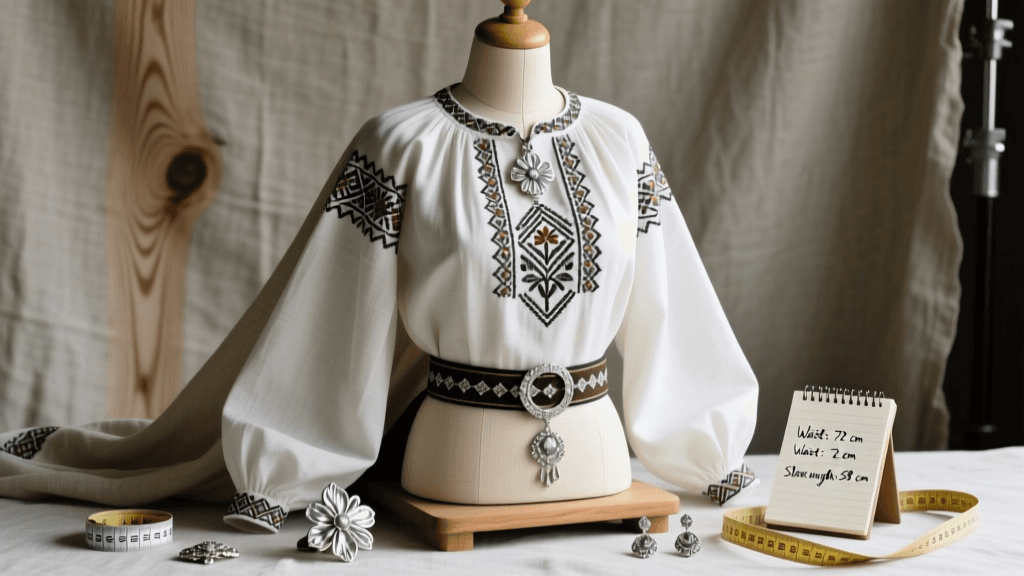
Beneath the heavy wool lies the bunadskjorte, a shirt made from high-quality, lightweight linen. In 2026, the standard for authentic bunad shirts requires 100% European-grown linen, weighing between 120 and 140 grams per square meter (GSM). The shirt features delicate white-on-white embroidery on the cuffs and collar, often utilizing drawn-thread work that complements, but does not exactly copy, the heavier apron embroidery. The shirt is fastened with small, specific silver cufflinks and a neck brooch, anchoring the garment to the silver ecosystem of the costume.
Bunad Silver (Bunadsølv): 2026 Pricing and Authenticity
No Hardanger bunad is complete without its silver (sølje). The silver jewelry of the Hardanger region is renowned for its oxidized finishes, filigree work, and dangling elements that historically were believed to ward off evil spirits. In 2026, the cost of bunad silver has seen an upward trend due to the fluctuating global price of precious metals and the scarcity of master silversmiths capable of traditional hand-forging techniques.
When purchasing silver, buyers must look for the official Norwegian silver hallmark, alongside the maker's mark, to guarantee authenticity. Mass-produced, imported cast silver is heavily discouraged by heritage organizations and lacks the historical accuracy required for a true bunad.
2026 Silver Accessory Cost Breakdown
The following table outlines the estimated costs for authentic, Norwegian-made Hardanger bunad silver pieces as of early 2026. Prices are listed in Norwegian Kroner (NOK) with approximate US Dollar (USD) conversions.
| Silver Piece | Description & Placement | Estimated Cost (NOK) | Estimated Cost (USD) |
|---|---|---|---|
| Halsring (Neck Ring) | Thick, twisted silver ring worn at the base of the throat. | 4,500 - 6,200 NOK | $420 - $580 |
| Brystsølje (Bodice Brooch) | Large, ornate filigree brooch with dangling spoons and leaves. | 8,500 - 14,000 NOK | $800 - $1,320 |
| Beltestøler (Belt Buckles) | Pair of decorative, oxidized silver plates for the leather belt. | 5,500 - 7,800 NOK | $520 - $730 |
| Skospenner (Shoe Buckles) | Silver buckles for the traditional black bunad shoes. | 3,200 - 4,500 NOK | $300 - $420 |
| Ermeknapper (Cufflinks) | Small domed buttons for the linen shirt cuffs. | 1,200 - 1,800 NOK | $110 - $170 |
"Investing in bunad silver is not merely a fashion choice; it is the acquisition of generational wealth and cultural heritage. A complete, high-quality silver set is routinely passed down through four or five generations of Norwegian families." — Curator notes from the Norwegian Museum of Cultural History.
Tailoring and Measurements: Getting the Perfect Fit
A bunad is not bought off the rack; it is tailored to the individual. The wool used in the Hardanger bunad has minimal stretch, meaning precise measurements are non-negotiable. In 2026, most reputable tailors and Husfliden branches require an in-person measurement session, though remote tailoring has improved with standardized video-guided measuring protocols.
Essential Measurement Guide for the Hardanger Bunad
If you are commissioning a Hardanger bunad, you will need to provide the following specific measurements to your tailor. Note that bunad measurements differ slightly from standard bespoke suit or dress measurements.
- Bust (Overvidde): Measured around the fullest part of the chest, wearing the specific undergarments you intend to wear with the bunad. The bodice must fit snugly to support the heavy silver.
- Waist (Midje): Measured at the natural waistline (the narrowest part of the torso), not the modern low-rise waist. The bodice sits high on the natural waist.
- Hips (Hoftevidde): Measured around the fullest part of the hips. This dictates the pleating volume of the heavy black wool skirt.
- Back Length (Rygglengde): Measured from the prominent bone at the base of the neck (C7 vertebra) down to the natural waist. This ensures the bodice does not pull at the shoulders.
- Skirt Length (Skjørtelengde): Critical Rule: The bunad skirt must fall exactly 2 to 3 centimeters above the floor when you are kneeling on a flat surface, wearing your bunad shoes. For a person of average height (165 cm), this usually translates to a finished skirt length of 88 to 92 cm from the natural waist.
Sourcing Authentic Materials and Navigating 2026 Waitlists
Acquiring a Hardanger bunad in 2026 requires patience and a commitment to authenticity. The most reliable route is through local Husfliden (Home Crafts) stores, which hold the official patterns and employ certified bunad seamstresses. However, due to a shortage of skilled traditional tailors and high demand, waitlists for a fully commissioned, custom-made Hardanger bunad currently range from 14 to 24 months.
For those seeking a more immediate solution, the secondary market is highly active. Platforms like Finn.no feature dedicated bunad categories where vintage and pre-owned garments are sold. When buying vintage, it is vital to verify the presence of the official Bunad- og folkedraktrådet (Bunad and Folk Costume Council) approval labels inside the garment, ensuring it was constructed to historical specifications rather than being a mass-produced tourist costume.
Whether you are embroidering your own linen collar, saving for a complete set of oxidized silver, or preparing for your first Norwegian Constitution Day (Syttende Mai) in your regional dress, the Hardanger bunad remains a profound connection to European folk history. By adhering to strict regional guidelines, supporting master artisans, and respecting the garment's construction, wearers in 2026 ensure that this magnificent textile tradition will endure for centuries to come.