Crafting the Hardanger Bunad: Pleating & Embroidery 2026
The Resurgence of Authentic Hardanger Bunad Construction in 2026
The Hardanger bunad remains one of Norway's most iconic and meticulously constructed folk dresses, characterized by its striking black wool, vivid green and red embroidery, and intricate whitework aprons. As we move through 2026, there has been a massive cultural shift away from mass-produced, overseas-manufactured folk costumes. Today's artisans and heritage enthusiasts are returning to the strict, historical construction patterns championed by the Norsk Folkedrakt (Norwegian Institute for Bunad and Folk Costumes). This revival prioritizes sustainable, locally milled Norwegian wool and hand-executed embroidery techniques that honor the garment's 18th-century origins.
Constructing a Hardanger bunad is not merely a sewing project; it is an exercise in historical preservation, textile mathematics, and extreme patience. Whether you are an advanced seamstress looking to draft your first traditional Norwegian skirt or an embroidery specialist tackling the famous Hardangersøm (whitework), understanding the foundational architecture of this garment is essential. This guide breaks down the precise construction patterns, pleating ratios, and embroidery techniques required to build an authentic Hardanger bunad skirt and apron in 2026.
Sourcing Authentic Materials: The 2026 Market
Before cutting a single thread, sourcing the correct materials is paramount. The foundation of the skirt is a heavy, tightly woven black wool tabby, while the apron requires high-count linen. In 2026, heritage mills like Hillesvåg Ullvarefabrikk continue to supply the exact historical weight and weave required for official bunad certification. According to guidelines from Norges Husflidslag (the Norwegian Craft Association), substituting modern synthetic blends or lightweight suit wools will fundamentally alter the drape and pleat retention of the skirt.
2026 Material Requirements and Cost Breakdown
Below is a comprehensive table detailing the materials required for a standard women's Hardanger bunad skirt and apron, along with estimated 2026 market prices sourced from official Husfliden retailers.
| Material Component | Specification / Weight | Quantity Needed | Est. 2026 Cost (USD) |
|---|---|---|---|
| Skirt Wool (Black) | 100% Norwegian Wool, 450 g/m² | 3.5 meters | $280 - $320 |
| Apron Linen (White) | 28-count or 32-count Evenweave | 1.5 meters | $90 - $110 |
| Embroidery Thread (Wool) | 2-ply crewel wool (Green, Red, Yellow) | 15 skeins (mixed) | $75 - $95 |
| Embroidery Thread (White) | Mercerized cotton or linen (Size 8 & 12) | 4 spools | $25 - $35 |
| Waistband Canvas | Heavy cotton duck or linen canvas | 0.5 meters | $15 - $20 |
| Hook and Eye Tape | Brass, heavy-duty historical reproduction | 1 set | $30 - $45 |
Note: Prices reflect early 2026 retail averages and may fluctuate based on import taxes and local Husflid branch pricing.
The Architecture of the Skirt: Cartridge Pleating
The most defining structural element of the Hardanger bunad skirt is its waistline. Unlike modern garments that use darts or simple gathers, the bunad skirt utilizes dense cartridge pleating (also known as pipe pleating) to manage the massive volume of wool while maintaining a flat, smooth front panel. This technique allows the heavy wool to flare out gracefully from the hips without adding bulk to the stomach.
Calculating the Pleat Ratio
The mathematical precision required for cartridge pleating is where many modern sewists falter. The standard historical ratio for a Hardanger skirt requires the pleated section to consume between 3.5 to 4 times the fabric width relative to the finished waist measurement. For a waist circumference of 70 cm, the pleated portion of the skirt must span roughly 245 cm to 280 cm of raw fabric.
- Marking the Grid: Using a water-soluble fabric pen, mark a grid on the wrong side of the wool's top edge. For a deep, traditional pipe pleat, mark dots every 1.5 cm horizontally and 2 cm vertically. You will need at least two rows of dots to create the structural 'hinge' of the pleat.
- Running Stitch: Thread a heavy, waxed linen buttonhole thread. Do not use standard polyester sewing thread, as it will snap under the tension of the 450 g/m² wool. Sew a running stitch precisely through every marked dot.
- Pulling and Stacking: Once the running stitches are complete, pull the threads taut. The fabric will naturally fold into tight, accordion-like tubes. Use your thumbs to press each 'pipe' flat against the next, ensuring they are perfectly uniform.
- Whipstitching to the Waistband: The waistband must be reinforced with canvas. Fold the top edge of the pleats over the canvas waistband. Using a heavy needle, whipstitch the very top edge of each individual pleat to the bottom edge of the waistband. You must catch only the outer fold of the pleat to maintain the 'hinge' effect, allowing the skirt to fall in deep, vertical columns.
Hardangersøm: The Whitework Embroidery Technique
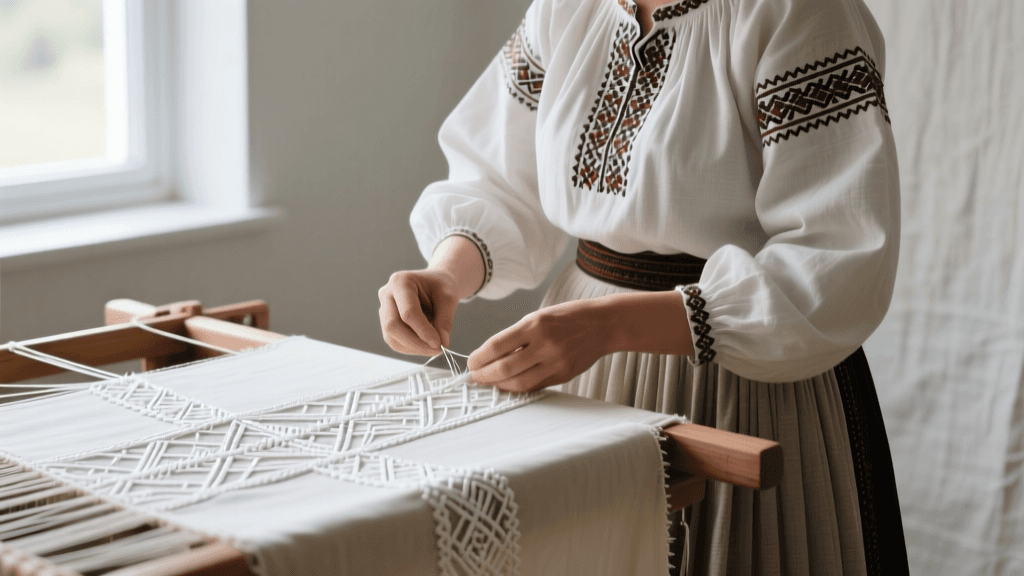
No Hardanger bunad is complete without the accompanying apron and chemise featuring Hardangersøm, a counted-thread whitework embroidery technique that combines geometric surface stitching with drawn-thread cutwork. Historical archives documented by the Digitalt Museum show that 19th-century aprons featured incredibly dense cutwork, a tradition that remains strictly enforced in modern bunad committees.
Mastering the Kloster Block
The foundation of all Hardanger cutwork is the Kloster block. This stitch creates the structural 'walls' that prevent the fabric from fraying once the interior threads are cut and removed.
- The Stitch Structure: A Kloster block consists of five straight satin stitches worked over four fabric threads. The blocks are arranged in geometric patterns (squares, diamonds, or zig-zags).
- Tension Control: In 2026, textile conservators emphasize that modern embroiderers often pull their Kloster stitches too tightly. The thread should lay snugly on the surface of the linen without distorting the 28-count weave. If the fabric puckers, the tension is too high.
- Directional Changes: When turning a corner to form a square, the needle must enter the exact same hole on the fabric grid to ensure the threads interlock securely. A gap here will result in catastrophic fraying during the cutting phase.
Cutting and Needle-Weaving
Once all Kloster blocks in a specific motif are completed, the cutting phase begins. Using a pair of micro-serrated embroidery scissors, carefully snip the four fabric threads running parallel to the blocks. Gently pull these cut threads out with tweezers, leaving only the perpendicular threads spanning the open space. These remaining threads are then wrapped or needle-woven with a finer size 12 thread to create intricate, lace-like bridges within the geometric cutouts.
'The integrity of a Hardanger apron lies not in the complexity of its motif, but in the absolute uniformity of its tension and the precision of its cutwork. A single misplaced cut compromises the structural integrity of the entire linen grid.' — 2026 Textile Conservation Guidelines, Norsk Folkedrakt.
Bodice Construction and Linen Lining
While the skirt and apron command the most attention, the bodice (liv) requires its own specialized drafting techniques. The Hardanger bodice is heavily structured, designed to provide support without the use of modern boning. Traditional construction relies on multiple layers of heavy linen canvas and a technique called 'pad stitching' to mold the fabric to the wearer's torso.
The outer layer of black wool is embroidered with the signature stylized floral motifs using the 2-ply crewel wool before the bodice is assembled. This 'embroider-then-assemble' method ensures that the tension of the embroidery does not warp the final seams. The bodice is lined with unbleached, heavy-weight linen, and the edges are bound with a narrow, hand-woven silk or wool ribbon. The closure is traditionally achieved with hidden brass hooks and eyes, ensuring a seamless front silhouette that highlights the intricate silver sølje (brooch) worn at the collar.
Preserving the Craft for the Future
As the demand for authentic, hand-crafted European folk dress continues to surge in 2026, mastering these historical construction patterns is more important than ever. The Hardanger bunad is a testament to the ingenuity of traditional tailoring, where mathematics, structural engineering, and fine art intersect. By adhering to strict material guidelines, respecting the geometry of cartridge pleating, and exercising patience in Hardangersøm cutwork, modern makers ensure that this spectacular piece of Norwegian heritage remains a living, breathing textile tradition for generations to come.