Hardanger Bunad & Dalarna Folkdräkt: 2026 Regional Guide
The Resurgence of Scandinavian Heritage Dress in 2026
As the global fashion industry continues its pivot toward sustainability and slow fashion in 2026, traditional European folk costumes are experiencing an unprecedented revival. Nowhere is this more evident than in Scandinavia, where the donning of regional heritage garments is not merely a historical reenactment, but a vibrant, living practice. Among the most iconic and meticulously preserved of these traditions are the Norwegian bunad and the Swedish folkdräkt. While both serve as profound expressions of regional identity, their construction, textile choices, and cultural applications differ vastly. In this comprehensive 2026 regional guide, we delve deep into two of the most celebrated Scandinavian costumes: Norway’s Hardanger bunad and Sweden’s Dalarna folkdräkt, exploring their anatomy, 2026 market pricing, and the precise tailoring techniques required to wear them authentically.
The Norwegian Hardanger Bunad: Whitework and Hand-Forged Silver
Originating from the rugged fjord landscapes of Hordaland in western Norway, the Hardanger bunad is widely considered one of the oldest and most historically significant bunads in the country. Its roots trace back to the Renaissance and Baroque periods, heavily influenced by European court fashions that filtered down to the prosperous farming communities of the Hardanger region. Today, the Norsk institutt for bunad og folkedrakt (Norwegian Institute for Bunad and Folk Costume) strictly regulates its production to ensure historical accuracy.
Anatomy of the Hardanger Ensemble
The defining feature of the Hardanger bunad is its exquisite Hardangersaum (Hardanger embroidery), a form of drawn-thread whitework that requires immense precision. In 2026, master embroiderers in the region still utilize traditional linen threads, creating geometric cutwork patterns on the apron, cuffs, and the iconic white linen skaut (headpiece worn by married women).
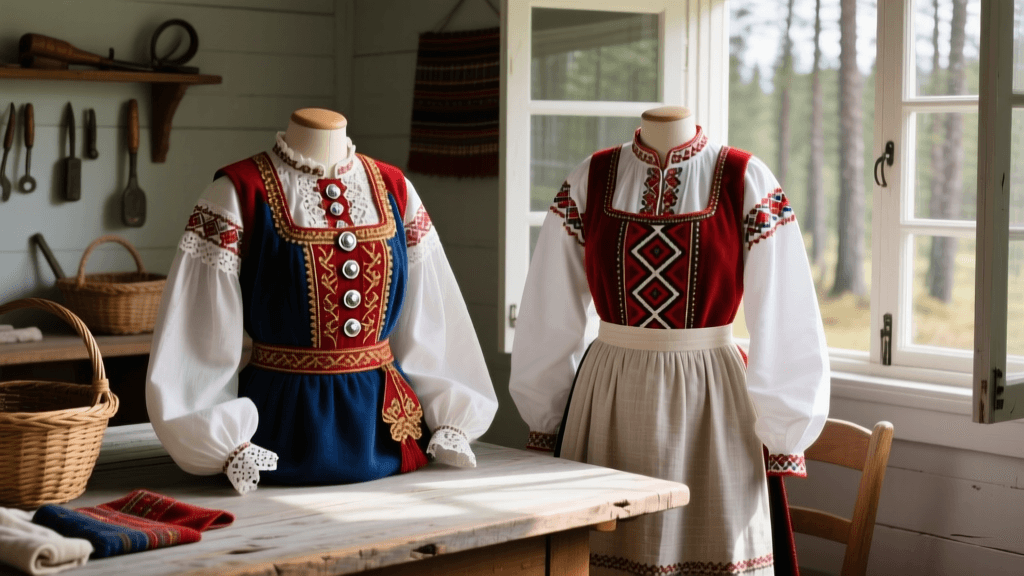
- The Bodice (Liv): Typically crafted from deep black or dark blue wool broadcloth, heavily embroidered with floral motifs in silk threads. The neckline is squared and edged with delicate lace.
- The Skirt (Stakk): A heavy, pleated wool skirt that falls to the mid-calf, featuring a broad, embroidered velvet band at the hem.
- The Silver (Sølv): The Hardanger silver is arguably its most valuable component. A full bridal set includes the sølje (neck brooch), bryststykke (breastpiece), and elaborate belt buckles, often featuring oxidized silver and dangling spoon-shaped pendants designed to ward off evil spirits.
2026 Tailoring and Measurement Guide
Securing a custom-tailored Hardanger bunad in 2026 requires planning, as waitlists for certified bunadtilvirker (bunad tailors) frequently exceed fourteen months. When measuring for the bodice, precision is paramount. The tape measure must be pulled snugly at the underbust but allow exactly two fingers of breath at the natural waist to accommodate the rigid structure of the internal boning. The back length, measured from the prominent vertebra at the base of the neck to the natural waist, dictates the placement of the silver clasps. A poorly measured bodice will not only cause discomfort but will distort the historical silhouette.
The Swedish Dalarna Folkdräkt: Woven Wool and the Red Kulla
Crossing the border into central Sweden, the province of Dalarna stands as the cultural heartland of the Swedish folkdräkt. Unlike the Norwegian bunad, which saw a structured, romanticized revival in the early 20th century, the Dalarna costumes represent an unbroken lineage of daily peasant wear that evolved organically until the mid-19th century. According to archives at the Dalarnas Museum, the region boasts over 80 distinct parish-specific variations, with the costumes of Rättvik and Leksand being the most globally recognized.
Regional Variations: Rättvik and Leksand
The Dalarna folkdräkt is characterized by its vibrant use of color, intricate weaving techniques, and highly specific headwear that immediately communicates the wearer’s marital status and parish of origin.
- The Rättvik Costume: Famous for its striking vertical stripes in black, white, and red on the skirt, paired with a dark bodice laced with pewter hooks over a crisp white linen shift. The married woman’s bindel (cap) is a stiff, white linen bonnet, while unmarried women wear the iconic red kulla.
- The Leksand Costume: Distinguished by its shorter, pleated blue skirt and the elaborate, winged white linen cap worn by married women, which requires a specialized wire frame to maintain its structural integrity.
Textile Sourcing in 2026
A major shift in 2026 has been the return to hyper-local textile sourcing. Artisans in Dalarna are increasingly utilizing locally raised Swedish landrace sheep wool, spun and naturally dyed using madder root (for reds) and woad (for blues). This localized supply chain has insulated Dalarna weavers from the international textile shortages that impacted broader European markets in recent years, ensuring that authentic vadmal (dense, fulled wool) remains available for traditional skirt construction.
Comparative Analysis: Hardanger vs. Dalarna
While both garments serve as markers of regional pride, their material cultures reflect the distinct economic and geographical realities of their respective homelands. The table below outlines the primary differences for collectors, historians, and prospective buyers in 2026.
| Feature | Hardanger Bunad (Norway) | Dalarna Folkdräkt (Sweden) |
|---|---|---|
| Primary Skirt Material | Heavy black/blue wool broadcloth | Striped or solid woven wool (vadmal) |
| Signature Embroidery | Hardangersaum (whitework cutwork) & silk floral | Cross-stitch and wool appliqué |
| Metallurgy | Hand-forged, oxidized silver (Sølv) | Cast pewter and brass hooks/clasps |
| Headwear Indicator | Linen Skaut (married) / Crown (bride) | Red Kulla (unmarried) / Linen Cap (married) |
| 2026 Avg. Base Cost | 45,000 - 60,000 NOK (approx. $4,200 - $5,600 USD) | 15,000 - 25,000 SEK (approx. $1,400 - $2,300 USD) |
Sourcing Authentic Garments in 2026
Acquiring an authentic Scandinavian folk dress requires navigating a specialized market. In Norway, purchasing a bunad is heavily regulated by the Bunad- og folkedraktrådet. Consumers in 2026 have two primary purchasing routes: selvsydd (flat-pack materials with patterns for the buyer to sew under the guidance of a certified instructor) or fully commissioned tailoring. The flat-pack route for a Hardanger bunad typically costs around 35,000 NOK, excluding the silver, but demands over 300 hours of meticulous embroidery and sewing labor from the buyer.
In Sweden, the market is slightly more decentralized. While institutions like Nordiska Museet provide the definitive historical patterns and guidelines, local hemslöjdsföreningar (craft associations) in Dalarna connect buyers directly with independent weavers and seamstresses. In 2026, many of these associations have launched digital portals allowing international buyers to commission custom-measured folkdräkts, though shipping and export taxes for heritage textiles should be factored into the final budget.
Conservation and Care for Heritage Textiles
Proper maintenance of these heirloom garments is critical, particularly given the 2026 emphasis on preserving antique textiles without the use of harsh, environmentally damaging chemicals.
Wool and Linen Maintenance
- Airing and Brushing: Never machine wash a bunad or folkdräkt skirt. After wearing, hang the wool garments in a humid environment (such as a bathroom during a hot shower) to naturally release wrinkles and odors. Use a soft-bristled horsehair brush to gently remove surface dust along the grain of the fabric.
- Spot Cleaning: For localized stains on wool, use a 2026-approved, pH-neutral lanolin-based wool wash. Apply with a damp microfiber cloth using a dabbing motion; never rub, as this will cause the wool fibers to felt and distort the pleats.
- Linen Shifts and Aprons: The underlying linen shifts and Hardanger whitework aprons can be hand-washed in lukewarm water (maximum 30°C). To maintain the stark whiteness of the Hardangersaum without chlorine bleach, utilize oxygen-based brighteners and dry the linen flat in indirect sunlight to prevent fiber degradation.
Storing Silver and Pewter
The silver components of the Hardanger bunad must be removed before storage to prevent the metal from staining the wool. In 2026, conservators recommend wrapping each silver piece in unbleached, acid-free tissue paper, followed by a layer of anti-tarnish silver cloth. Store the silver in a climate-controlled cedar box. Avoid traditional chemical silver dips, which strip the intentional oxidation from the crevices of the sølje, destroying the three-dimensional contrast intended by the original silversmith.
Conclusion
The Hardanger bunad and the Dalarna folkdräkt are far more than mere costumes; they are wearable archives of European agrarian history, textile innovation, and regional pride. As we navigate 2026, the dedication of Scandinavian artisans to preserving these techniques—while adapting to sustainable, localized supply chains—ensures that these garments will continue to grace the valleys and fjords for generations to come. Whether you are commissioning your first Rättvik skirt or investing in a bridal Hardanger silver set, understanding the profound craftsmanship behind each stitch and clasp is the first step in becoming a true custodian of European folk dress.