Kimono on 2026 Runways: Haori Silhouettes & Obi Corsetry
The Structural Renaissance of the Kimono in 2026
As the global fashion industry navigates the Spring/Summer and Fall/Winter 2026 seasons, a profound shift has occurred in how traditional Japanese garments are interpreted on international runways. Moving far beyond the superficial print-matching and cultural appropriation debates of the early 2020s, today’s leading design houses are engaging in a deep, structural dialogue with the kimono. From Paris to Tokyo, the 2026 collections highlight a sophisticated appreciation for the garment’s zero-waste engineering, T-shaped architecture, and modular layering systems.
According to The Metropolitan Museum of Art's Costume Institute, the traditional kimono is fundamentally distinct from Western tailoring; it is constructed from straight bolts of fabric that create a flat, two-dimensional canvas, only achieving three-dimensional form when wrapped around the human body. In 2026, this philosophy of 'garment as architecture' has become a cornerstone for designers aiming to meet the European Union’s stringent new zero-waste textile directives. By adopting the kimono’s straight-seam pattern cutting, avant-garde houses are eliminating offcut waste while delivering striking, volumetric silhouettes that dominate the runway.
Key Kimono Elements Dominating the 2026 Runways
The 2026 runway season is defined by the deconstruction and re-engineering of three specific kimono components: the haori jacket, the obi sash, and the furisode sleeve. Designers are no longer simply copying the look; they are adapting the mechanics of these garments for modern, kinetic movement.
The Deconstructed Haori Jacket
Traditionally worn as a hip-length outer layer, the haori has been reimagined in 2026 as a versatile, modular piece of outerwear. Unlike the heavy wools of Western overcoats, the 2026 runway haori is crafted from bio-engineered silks and technical ripstop nylons. Designers are preserving the signature straight-line drop of the haori’s sleeves but introducing hidden magnetic closures along the side seams, allowing the garment to transition from a closed, cocoon-like silhouette to an open, flowing duster. The haori himo (the decorative front ties) have been replaced by utilitarian paracord and matte-black hardware, bridging the gap between Edo-period elegance and 2026 tech-wear.
Obi-Inspired Corsetry and Waist Cinching
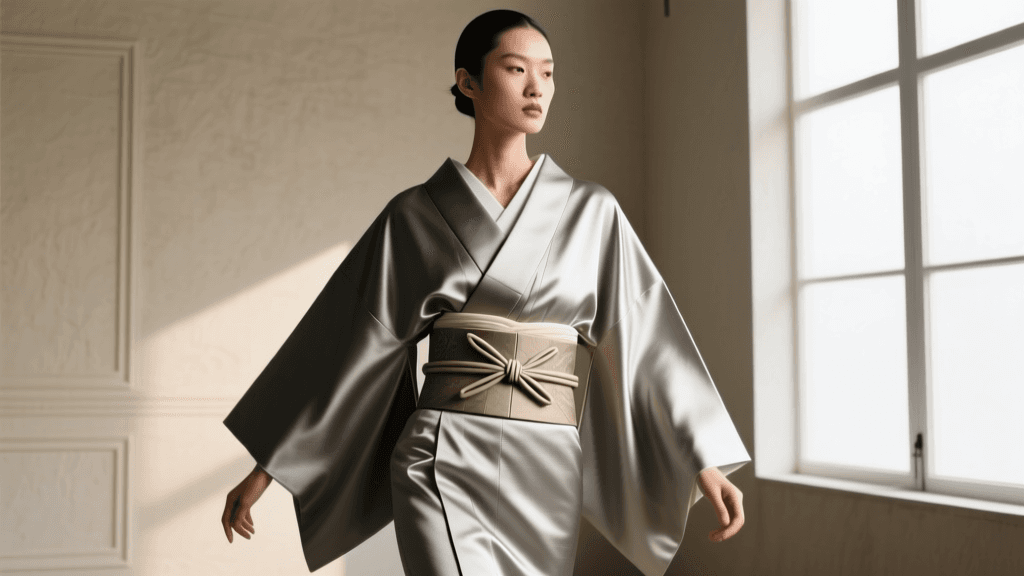
Perhaps the most striking innovation of the 2026 fashion weeks is the translation of the fukuro obi into structured corsetry. The traditional obi is a flat, unboned wrap that relies on tension and precise folding to shape the torso into a smooth cylinder. This season, maisons like Mugler and Thom Browne have interpreted this cylindrical shaping through the lens of modern ergonomic boning. Runway corsets now feature wide, 30-centimeter panels that mimic the exact width of a formal women’s obi, utilizing flexible memory-titanium boning that provides the posture-support of a traditional kimono wrap without restricting diaphragmatic breathing. These obi-corsets are being styled over fluid, T-shaped slip dresses, creating a striking contrast between rigid structure and liquid drape.
Furisode Sleeves and Kinetic Drape
The furisode, characterized by its long, swinging sleeves, has historically been reserved for unmarried women attending formal ceremonies. In 2026, the dramatic 110-centimeter sleeve drop has been adopted for gender-neutral evening wear. Designers are utilizing weighted hems and internal silk organza scaffolding to ensure the sleeves create a sweeping, kinetic arc during the runway walk, transforming the model into a moving sculpture.
2026 Runway Adaptation vs. Traditional Garment Data
For stylists, buyers, and fashion historians tracking the evolution of these garments, understanding the precise metrics of 2026 adaptations compared to their historical counterparts is crucial. The table below outlines the structural shifts seen across major fashion capitals this year.
| Garment Element | Traditional Metric & Material | 2026 Runway Adaptation | Primary Styling Application |
|---|---|---|---|
| Haori Silhouette | Silk crepe; straight drop; open front | Bio-nylon; magnetic side-seams; modular sleeves | Transitional outerwear; tech-wear layering |
| Obi Width & Structure | 30cm width; silk brocade; unboned wrap | 30cm width; memory-titanium boning; corset back | Waist cinching over fluid slip dresses |
| Furisode Sleeve Drop | 110cm drop; heavy lined silk | 90-110cm drop; weighted hems; organza scaffolding | Gender-neutral evening wear; kinetic movement |
| Tabi Footwear | Cotton split-toe; flat straw or wood sole | Leather split-toe; 3D-printed ergonomic wedge | Avant-garde footwear; runway staple |
Designer Spotlight: Leading the Integration
Several key players have emerged as the vanguard of the 2026 kimono-integration movement, prioritizing collaboration with Japanese artisans over mere aesthetic imitation.
Maison Margiela (Artisanal Collection): John Galliano’s 2026 Artisanal showcase featured a masterclass in deconstruction. Rather than using the exterior of vintage Meiji-era kimono, the atelier utilized the hakkake (the inner lining of the lower half of the kimono), which historically features hidden, vibrant artwork meant only for the wearer’s intimate knowledge. By reversing these vintage silks, Margiela created trench coats that appear austere on the outside but reveal explosive, hand-painted Yuzen landscapes when the model walks and the coat flares open.
Anrealage: Kunihiko Morinaga continues to push the boundaries of textile technology. For the 2026 Spring/Summer season, Anrealage collaborated with master weavers in Kyoto’s Nishijin district to integrate photochromic threads into traditional brocade. Under the specific UV lighting of the Paris runway, the seemingly monochrome black obi belts bloomed into intricate, multi-colored chrysanthemum patterns in real-time, merging centuries-old weaving techniques with cutting-edge material science.
Sourcing and Styling Guide for 2026
For fashion buyers, editorial stylists, and private collectors looking to source authentic pieces or 2026 runway hybrids, the market requires a nuanced approach. The demand for vintage kimono to be upcycled or layered with contemporary haute couture has driven specific market trends this year.
- Authentication and Sourcing: When sourcing vintage haori for editorial layering, prioritize pieces from the Taisho era (1912-1926). The 2026 market highly values the romantic, art-nouveau-influenced motifs of this period. Expect to pay between $450 and $900 at premium Tokyo and Kyoto auction houses for mint-condition, unlined summer sha (gauze) silk haori.
- Proportions for Modern Layering: Traditional kimono are designed to hide the body's natural curves, which can overwhelm modern, tailored runway pieces beneath them. Stylists in 2026 are employing the o-hashori technique—folding the excess fabric at the waist—using hidden internal elastic belts to raise the hemline and create a more cropped, jacket-like proportion that pairs seamlessly with high-waisted, wide-leg trousers.
- Investment in Runway Hybrids: Contemporary pieces that genuinely collaborate with Japanese artisans, such as those featuring authentic Shibori (tie-dye) executed in Kyoto but tailored in Milan, are commanding premium prices. Entry-level retail for these 2026 hybrid jackets starts at $3,800, with fully hand-woven Nishijin-ori runway coats reaching upwards of $14,500.
Cultural Collaboration Over Appropriation
The most vital conversation surrounding the kimono on the 2026 runways is the shift from extraction to collaboration. As highlighted by the Victoria and Albert Museum's comprehensive research on the global journey of the kimono, the garment has always been a site of cross-cultural exchange. However, the 2026 approach is defined by direct financial and creative partnerships with aging artisan communities in Japan.
Design houses are no longer simply buying vintage textiles; they are commissioning new weaves from the Kyoto Costume Academy's network of master craftsmen, ensuring that the revenue from high-fashion runway sales flows directly back into the preservation of endangered techniques like Kanoko Shibori and Yuzen resist dyeing. This symbiotic relationship ensures that the kimono is not treated as a relic of the past, but as a living, evolving framework that continues to challenge and inspire the vanguard of global fashion in 2026 and beyond.
Conclusion
The 2026 runway season has definitively proven that the kimono’s influence on global fashion is not a fleeting trend, but a permanent structural pillar. Through the architectural brilliance of the haori, the ergonomic innovation of obi corsetry, and the kinetic drama of the furisode sleeve, designers are finding new ways to honor Japanese heritage while pushing the boundaries of modern silhouette and sustainability. For the fashion industry, the kimono remains the ultimate masterclass in the art of the drape.