Haori Streetwear: Styling Traditional Japanese Jackets Today
The Evolution of the Haori: From Samurai Armor to Streetwear Staple
The intersection of heritage and hype has never been more apparent than in the modern revival of traditional Japanese garments. Among the kimono, yukata, and hakama, the haori has emerged as the undisputed champion of Asian-inspired streetwear. Originally developed in the Sengoku period (1467–1615) as a protective outer layer worn by samurai over their armor, the haori eventually transitioned into a symbol of status and aesthetic refinement during the Edo period. Today, it has transcended its historical roots to become a highly coveted layering piece in global street fashion, championed by avant-garde designers, vintage collectors, and hypebeasts alike.
According to The Metropolitan Museum of Art, the evolution of Japanese dress is deeply tied to shifting social hierarchies and sumptuary laws, which forced merchants to hide their wealth in the subtle linings of their garments. This historical context of hidden luxury perfectly aligns with modern streetwear’s obsession with subtle flexes, insider knowledge, and understated silhouettes. Unlike the kimono, which requires complex wrapping and binding, the haori is inherently accessible. It slips on like a modern cardigan or coach jacket, making it the perfect bridge between centuries-old Asian traditions and contemporary urban style.
Anatomy and the Concept of 'Iki'
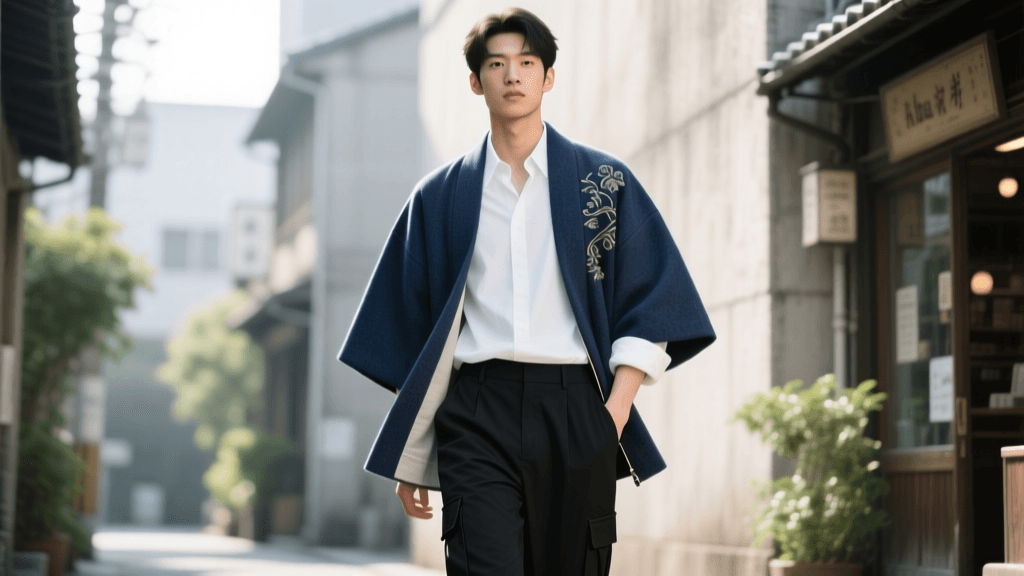
To style a haori correctly, one must understand its anatomy. The garment features an open front that does not overlap, wide sleeves (sode) that taper at the wrist, and a distinctive collar (eri). Traditionally, it is fastened at the chest using braided silk cords known as haori-himo. However, in modern streetwear, these ties are almost always removed or left untied to promote a relaxed, flowing drape that mimics the silhouette of an oversized chore coat or duster.
One of the most fascinating aspects of vintage haori is the concept of iki—an Edo-period aesthetic ideal of understated, hidden elegance. Because strict sumptuary laws forbade commoners from wearing flashy fabrics on the outside of their clothing, merchants commissioned spectacular, hand-painted silk linings (uragawa) that were only visible when the jacket was removed or caught by the wind. The Victoria and Albert Museum highlights how these hidden linings featured everything from fierce dragons and kabuki actors to intricate landscapes. In a modern streetwear context, a vintage haori with a loud, hand-painted silk lining serves as the ultimate statement piece, revealing its true value only in motion.
Sizing, Measurements, and the Perfect Fit
Buying vintage Japanese garments online can be daunting due to the lack of standardized Western sizing (S, M, L). Vintage haori were typically tailored to be worn over a kimono, meaning the shoulder seams drop significantly and the body is cut wide. To achieve the perfect oversized streetwear fit, you must rely on flat-lay measurements. Here is an actionable guide to measuring and selecting your haori:
- Yuki (Sleeve Length from Center Back): Measure from the center of your spine, over your shoulder, down to your wrist. For a traditional fit, look for 60–65cm. For a modern, oversized streetwear drape that covers the knuckles, seek out a yuki of 70–78cm.
- Migoro (Body Width): Measure across the chest of your favorite oversized hoodie. A vintage haori migoro typically ranges from 60cm to 68cm. Ensure the combined width (front and back) allows for a thick hoodie underneath without pulling the collar taut.
- Take (Garment Length): Measure from the base of your neck to your desired hemline. A standard vintage haori falls between 75cm and 85cm, hitting right at the mid-thigh. This is the ideal length for layering over cropped streetwear tees or wide-leg denim.
Traditional vs. Modern Streetwear Haori
The adaptation of the haori into streetwear has led to distinct shifts in how the garment is constructed and worn. Below is a comparison chart outlining the differences between a traditional haori and its modern streetwear counterparts.
| Feature | Traditional Vintage Haori | Modern Streetwear Haori (e.g., Visvim, Kapital) |
|---|---|---|
| Fastening | Haori-himo (woven silk ties) | Open-front, corozo toggles, or hidden zippers |
| Fabric | Rinzu silk, Tsumugi, Ro/Sha (summer) | Heavyweight cotton, indigo denim, Boro patches |
| Lining | Hand-painted silk (Uragawa) | Unlined, fleece-backed, or contrast cotton |
| Styling | Worn over kimono, tied at chest | Worn open, layered over hoodies and graphic tees |
| Price Range | $40 – $150 (Vintage Thrift) | $600 – $2,500 (Designer/Artisan) |
Fabric Profiles for Streetwear
When hunting for a haori to integrate into your wardrobe, the fabric dictates the season and the aesthetic. Japan’s Agency for Cultural Affairs places immense importance on the preservation of traditional textile techniques, many of which are highly prized in the streetwear community today.
- Boro and Sashiko: Translating to 'rags', Boro textiles were born out of necessity in rural Japan, where farmers patched together indigo-dyed hemp and cotton using Sashiko (decorative reinforcement stitching). Brands like Kapital and Visvim have popularized this wabi-sabi aesthetic. A Boro haori is a heavy, textured grail piece perfect for autumn layering.
- Tsumugi (Pongee Silk): A slubbed, matte-finish silk that lacks the shiny luster of formal satin. Tsumugi haori have a rugged, almost tweed-like appearance that pairs exceptionally well with raw selvedge denim and leather boots.
- Cotton and Linen Blends: Modern reproductions often utilize washed cotton or linen to mimic the haori silhouette while offering machine-washability and a broken-in, vintage drape right off the rack.
Three Actionable Streetwear Styling Formulas
Integrating a traditional garment into a modern wardrobe requires a balance of proportions. Here are three tested styling formulas for the haori:
1. The Techwear Duster
Pair a lightweight, synthetic or dark silk haori with technical cargo pants, a tactical chest rig, and chunky trail sneakers like the Salomon XT-6. The haori replaces the traditional trench coat, offering a wider, more dramatic silhouette that catches the wind. Keep the color palette strictly monochromatic (black, charcoal, or navy) to maintain a futuristic, utilitarian edge.
2. The Americana Workwear Clash
Contrast Japanese heritage with American workwear. Wear a heavily textured Tsumugi or cotton haori over a faded heavyweight graphic tee, a denim chore coat, and wide-leg carpenter pants. Finish with silver-toe derby shoes or beaten-up engineer boots. The juxtaposition of the haori’s elegant collar against rugged workwear creates a visually rich, globally-minded outfit.
3. Minimalist Monochrome Elegance
For a cleaner, high-fashion approach, opt for a solid black or deep indigo haori. Layer it over a crisp, oversized white poplin shirt, tailored wide-leg trousers, and minimal leather loafers. This look leans into the 'quiet luxury' trend, relying on the drape of the fabric and the hidden silk lining to provide visual interest without loud logos.
'The haori is unique because it does not wrap or bind the body like a kimono; it frames the wearer, allowing the garments underneath to dictate the silhouette. It is a canvas for personal expression rather than a uniform of conformity.'
Sourcing, Costs, and Timing
Acquiring an authentic haori requires knowing where to look and when to buy. For those seeking vintage pieces, the thrift stores of Shimokitazawa and Koenji in Tokyo are meccas for vintage streetwear. Stores like Chicago and New York Joe Exchange frequently stock haori in their outerwear sections.
Timing is crucial: The best time to hunt for vintage haori is during seasonal transitions—specifically March/April and September/October. This is when Japanese thrift stores rotate their stock, moving heavy winter wools out and bringing in lighter silks and cottons, or vice versa. Furthermore, many elderly Japanese women sell their pristine, unworn kimono and haori collections to recycling shops during the spring cleaning season, flooding the market with high-quality, low-cost textiles.
Costs: A standard vintage silk haori in good condition will cost between $40 and $120 at a Japanese thrift store or on eBay. Pieces with exceptional hand-painted linings or rare Boro patchwork can command $300 to $800 on specialized vintage archives. Conversely, modern designer interpretations from brands like Visvim or Kapital will range from $800 to over $2,000 at retail.
Garment Care and Preservation
Treating a vintage haori with respect ensures its longevity. Silk haori should never be machine washed. Instead, air them out in a shaded, well-ventilated area after wearing to remove odors and moisture. Store them folded with acid-free washi paper to prevent the silk from creasing or yellowing over time. If a stain occurs, seek out a dry cleaner who specializes in traditional Asian garments, as standard chemical solvents can strip the delicate dyes used in Edo and Meiji-era textiles.
By understanding the history, measurements, and styling potential of the haori, you do more than just adopt a trend; you participate in the ongoing, global dialogue of Asian traditions, proving that true style is timeless, adaptable, and deeply rooted in cultural appreciation.