2026 Hanfu Storage Rotation & Seasonal Maintenance Guide
The Evolution of Hanfu Archival Care in 2026
As the global appreciation for traditional Chinese clothing continues to mature in 2026, the modern Hanfu enthusiast is no longer just a casual wearer, but often a dedicated collector. With the rise of intricate Ming-style winter coats, delicate Tang-style summer silks, and the highly sought-after Xiangyunsha (gambiered Canton silk), managing a robust Hanfu wardrobe requires moving beyond basic closet organization. Proper preservation is now an intersection of traditional textile wisdom and modern archival science.
Improper storage leads to permanent creasing, protein fiber degradation, and irreversible dye bleeding. This comprehensive 2026 guide outlines the precise seasonal rotation schedules, micro-climate management techniques, and museum-grade handling protocols necessary to protect your investment and preserve these cultural artifacts for generations to come.
Understanding Hanfu Textile Profiles
Before implementing a rotation schedule, it is critical to understand the specific vulnerabilities of the fabrics commonly used in Hanfu construction. According to the Victoria and Albert Museum's textile conservation guidelines, different fibers react uniquely to light, humidity, and physical stress.
Mulberry Silk (Sangcan Si)
The backbone of luxury Hanfu, mulberry silk is a protein fiber. It is highly susceptible to alkaline environments, prolonged UV exposure, and protein-eating pests like clothes moths. Silk loses up to 20% of its tensile strength when wet, meaning it must be completely bone-dry before entering long-term storage to prevent mildew.
Xiangyunsha (Gambiered Canton Silk)
This prestigious fabric is dyed with薯莨 (Dioscorea cirrhosa) juice and coated in iron-rich river mud. The resulting chemical reaction creates a unique, crackling glaze on the fabric. In 2026, conservationists emphasize that Xiangyunsha must never be stored in completely airtight plastic, as the natural coating requires minimal air exchange to prevent the glaze from becoming brittle and flaking off.
Ramie and Linen (Xia Bu)
Cellulose fibers like ramie and linen are staples for summer Hanfu. While highly breathable and resistant to moths, they are incredibly prone to hard creasing and mildew if stored in high-humidity environments. They require flat storage to prevent permanent fiber breakage along fold lines.
The 2026 Seasonal Rotation Matrix
Rotating your Hanfu collection is not merely about swapping heavy coats for light robes; it is a scheduled intervention to inspect, air out, and refold garments to prevent permanent structural memory in the fabric. Below is the recommended 2026 rotation matrix for a comprehensive collection.
| Fabric Type | Garment Examples | Ideal Storage Method | Target Humidity | Rotation Frequency |
|---|---|---|---|---|
| Mulberry Silk | Ruqun, Aoqun, Song-style Beizi | Archival Box, Acid-Free Tissue | 45% - 50% | Bi-Annually |
| Gambiered Silk | Xiangyunsha Summer Robes | Padded Hanger, Breathable Cotton Cover | 50% - 55% | Seasonally |
| Ramie / Linen | Summer Hanfu, Inner Garments | Flat Fold, Cedar Drawer | 40% - 45% | Seasonally |
| Brocade / Jacquard | Ming-style Winter Coats, Pifeng | Wide Padded Hanger, Breathable Bag | 45% - 50% | Bi-Annually |
Advanced Folding and Hanging Techniques
The way a garment is physically supported in storage dictates its lifespan. Wire hangers are strictly forbidden in 2026 archival standards, as they concentrate the garment's weight on a tiny surface area, leading to shoulder tearing and distortion of the traditional flat-cut silhouette.
The Mamianqun Pleat Preservation Method
The Mamianqun (horse-face skirt) features complex, knife-pleated side panels. Storing these skirts folded in standard drawers will crush the pleats, requiring aggressive heat to restore them, which degrades the silk over time.
- The Hanging Roll Method: Lay the skirt flat, align the pleats perfectly, and roll the skirt around an acid-free, archival-quality cardboard tube (wrapped in unbleached muslin). Store the tube horizontally in a drawer.
- The Pleat Board Method: For collectors with deep wardrobes, specialized cedar pleat boards are now available. The skirt is laid flat between two boards and secured with light tension, preserving the structural integrity of the pleats without hanging stress.
Hanging Heavy Brocade
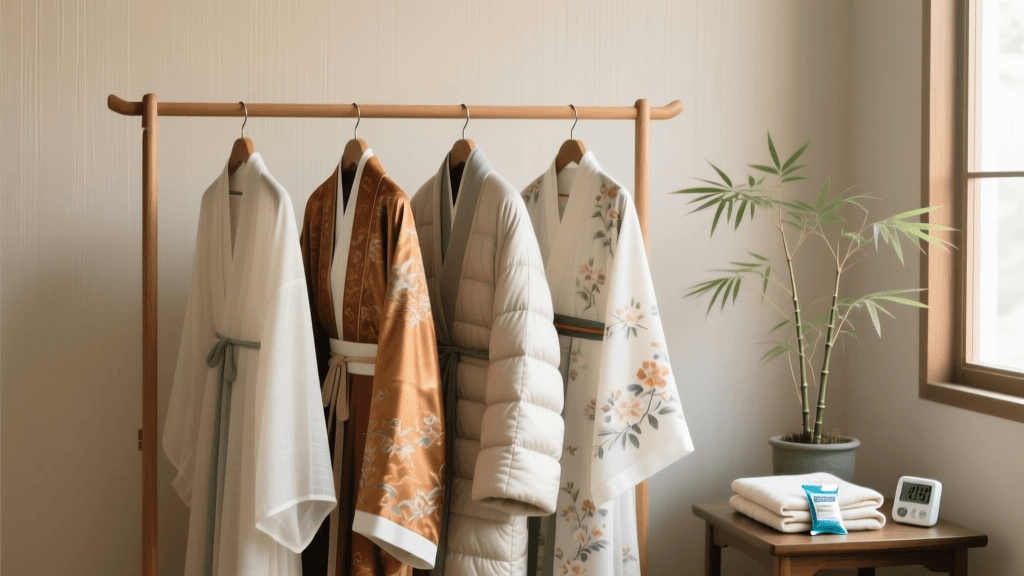
Winter garments like the thick, lined Pifeng or brocade coats should be hung on wide, contoured wooden hangers padded with polyester batting. This mimics the natural slope of the human shoulder, supporting the heavy metallic threads and preventing the warp and weft from pulling apart under gravity.
Micro-Climate Management: Humidity and Smart Sensors
Textile conservation is fundamentally about moisture control. The Canadian Conservation Institute notes that fluctuating humidity causes fibers to continually swell and contract, leading to mechanical fatigue and eventual snapping of the threads.
"Maintaining a stable relative humidity (RH) between 45% and 55% is critical for mixed-media textile collections. Spikes above 65% RH invite mold and foxing, while drops below 30% cause protein fibers like silk to become brittle and shatter."
In 2026, smart wardrobe integration is the gold standard for Hanfu collectors. Instead of relying on passive silica gel packets that require unpredictable recharging, modern collectors utilize Wi-Fi-enabled wardrobe dehumidifiers with automated drainage. These units maintain a strict 48% RH, monitored via Bluetooth hygrometers placed directly inside the archival storage boxes. If the ambient humidity shifts during the monsoon season, the system automatically adjusts, ensuring the micro-climate around your Ming-style Aoqun remains perfectly stable.
Pest Deterrence Without Chemical Damage
Historically, camphor and naphthalene (mothballs) were used to protect Asian garments. Today, these are recognized as highly detrimental to Hanfu. Naphthalene sublimates into a gas that can react with the metallic threads in brocade, causing tarnishing, and the acidic off-gassing can weaken silk proteins.
For 2026 pest management, adopt an Integrated Pest Management (IPM) approach:
- Pheromone Traps: Place non-toxic clothes moth pheromone traps in the corners of your storage room to monitor and intercept male moths before they can breed.
- Virgin Cedar Wood: Use untreated, aromatic red cedar blocks. Cedar naturally repels pests through its oils. Sand the blocks lightly every six months to refresh the scent and efficacy.
- Freezing Protocol: If you suspect a newly acquired vintage Hanfu piece harbors pest eggs, seal it in an airtight polyethylene bag and place it in a deep freezer at -20°C for 72 hours. This safely eliminates all life stages of textile pests without using chemicals.
Pre-Storage Cleaning Protocols
Never store a worn Hanfu garment, even if it appears clean. Human perspiration contains salts, urea, and lactic acid. Over a period of six months in storage, these invisible residues will oxidize, resulting in permanent yellow stains that are nearly impossible to remove from delicate silks without damaging the dye.
For water-silks and synthetic blends, a gentle hand-wash using a pH-neutral, enzyme-free detergent is recommended. For heavily embroidered pieces, Xiangyunsha, or structured brocades, professional dry cleaning using liquid silicone (a green, gentle alternative to harsh perc) is the 2026 standard. Ensure the garment is entirely free of starch before boxing, as starch acts as a primary food source for silverfish and mold spores.
Conclusion
Maintaining a Hanfu collection in 2026 is a rewarding discipline that bridges the gap between historical reverence and modern material science. By adhering to strict seasonal rotation schedules, utilizing smart climate control, and employing museum-grade folding techniques, you ensure that these magnificent garments remain vibrant, structurally sound, and ready to be worn with pride for years to come.