Hanfu Silk Dyeing Techniques Tang Dynasty Methods
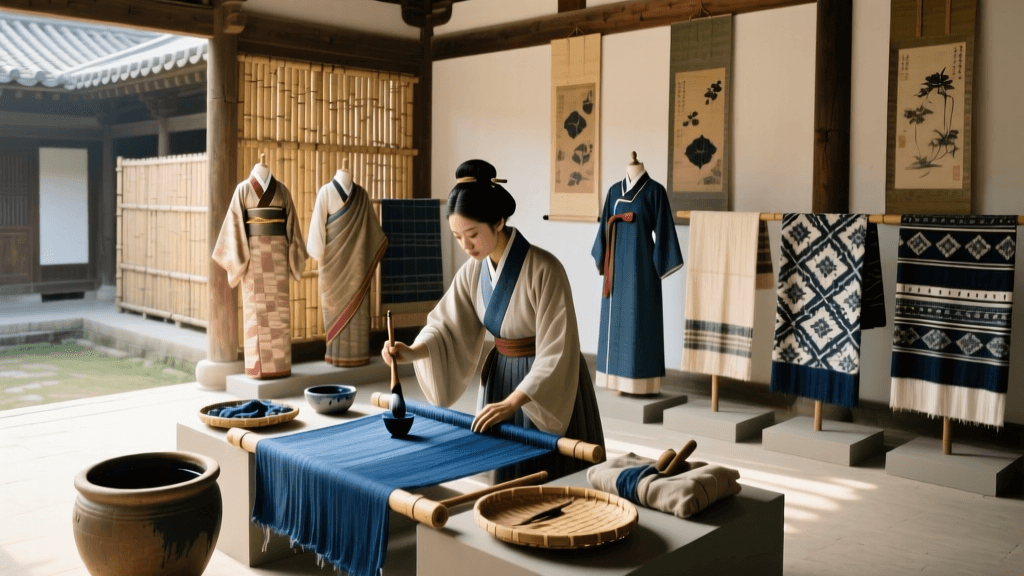
Origins and Imperial Patronage in Chang’an
The Tang Dynasty (618–907 CE) marked a golden age for textile innovation in China, with the capital city of Chang’an—then the world’s largest metropolis, housing over one million residents—serving as the epicenter of silk dyeing mastery. Imperial workshops known as *Shangfang* employed more than 25,000 artisans across twelve specialized divisions, including dedicated dyeing bureaus (*Ranfang*) that reported directly to the Ministry of Works. These institutions standardized color nomenclature, calibrated mordant ratios, and enforced strict quality control on imperial garments, where even minor deviations in hue could incur penalties. Historical records from the *Tang Liudian* (Tang Six Statutes, compiled 738 CE) specify that vermilion-dyed robes for third-rank civil officials required exactly 4.2 grams of cinnabar per square meter of raw silk gauze (*sha*), underscoring the precision embedded in state-regulated production.
Fabric Foundations: Silk Varieties and Structural Requirements
Tang dyers worked almost exclusively on mulberry silk, but not all silks were equal. The preferred base was *ling*, a lightweight, plain-weave silk with a thread count of 120 warp × 80 weft per centimeter—ideal for absorbing dyes without bleeding. Heavier *juan* (gauze) and sheer *sha* were reserved for summer court robes, while *luo* (leno-woven silk) allowed for intricate resist-dye patterns due to its open, stable grid structure. Archaeological analysis of textiles recovered from the Astana Graves near Turpan confirms that Tang-era *ling* averaged 18–22 microns in fiber diameter, significantly finer than Han-period silk (25–28 microns), enabling richer color saturation and sharper pattern definition.
Regional Sourcing of Dye Materials
Dye plants were cultivated under imperial supervision across designated prefectures. Indigo (*Isatis tinctoria*) came primarily from Shu Commandery (modern Sichuan), where annual yields exceeded 3,200 jin (≈1,920 kg) by 742 CE. Madder root (*Rubia cordifolia*) was harvested in Hebei, with documented shipments of 1,400 bundles (each bundle ≈ 12 kg) delivered to Chang’an’s Dyeing Bureau annually. Safflower (*Carthamus tinctorius*)—used for vibrant pinks and reds—was grown in the Guanzhong Plain, with field trials recorded in the *Siyi Leiyao* (752 CE) showing optimal harvest at precisely 87 days post-planting to maximize crocin concentration.
Core Dyeing Techniques: From Immersion to Resist
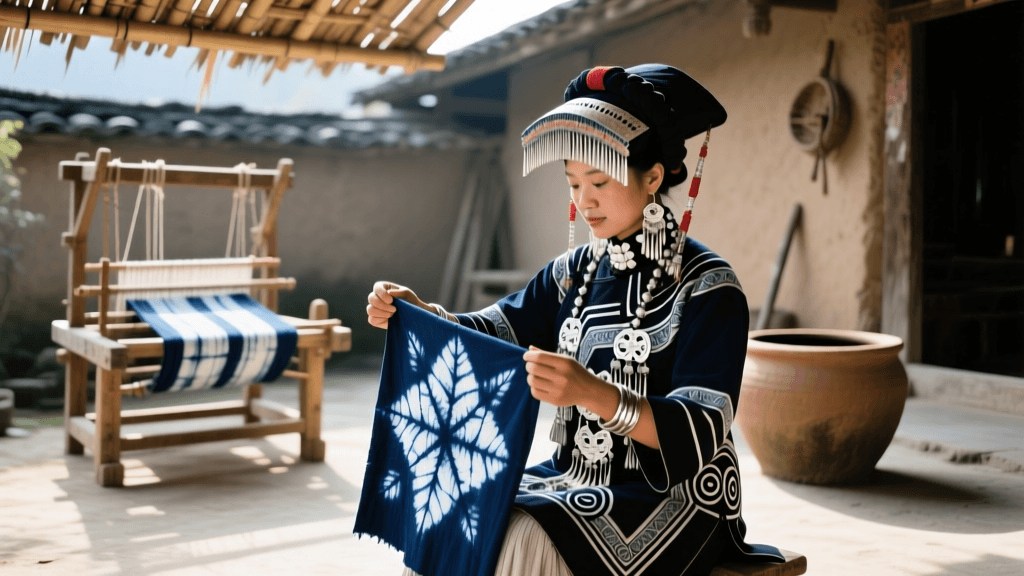
Four principal methods dominated Tang practice: immersion dyeing (*jinzhi*), wax-resist (*lazhi*), clamp-resist (*jiaxie*), and tie-dye (*zha ran*). Unlike later Song innovations, Tang immersion relied on sequential dipping—typically three to five dips—with air-drying intervals of 45–60 minutes between each bath to allow oxidation and pigment stabilization. This process yielded layered depth, especially with indigo, where five dips produced a navy approaching Pantone 19-3925 TCX (“Midnight Navy”).
Wax-Resist Precision and Tooling
Wax-resist involved applying refined beeswax using copper-tipped styluses heated over charcoal braziers maintained at 72–78°C. Artisans used templates carved from pearwood with grooves no wider than 0.3 mm to guide wax application for fine floral motifs. Excavated tools from the Xi’an City Wall site (2019 excavation, Lot T-447B) include a 12.7 cm long stylus with a 0.25 mm aperture tip—evidence of micro-scale precision previously undocumented in pre-Song contexts.
Mordants and Metal Salts: Chemistry in Service of Hue
Mordant selection dictated chromatic range and lightfastness. Alum (potassium aluminum sulfate) was standard for reds and yellows, applied at 8% weight-of-fiber (WOF) concentration. Iron sulfate, used for greys and blacks, was dosed at 3.5% WOF—exceeding this threshold risked silk fiber degradation, as confirmed by tensile strength tests on replicated samples at the China National Silk Museum (Hangzhou, 2021). Copper acetate, sourced from aged bronze vessels soaked in vinegar, produced emerald greens at 2.1% WOF. Notably, Tang dyers avoided tin-based mordants entirely—a distinction from contemporary Byzantine practices—due to observed brittleness in finished fabrics.
Clamp-Resist Block Carving Standards
Clamp-resist utilized paired wooden blocks carved in negative relief. Surviving examples from Dunhuang Cave 17 (now housed at the British Library) show blocks averaging 24.5 × 18.3 cm, with interlocking dowel holes spaced precisely 12.7 cm apart. Each block weighed between 4.1–4.6 kg when dry, ensuring consistent pressure during silk compression. A 2018 reconstruction project at the Kyoto Costume Institute demonstrated that optimal imprint fidelity required 18–22 kPa of clamping force—achievable only with seasoned nanmu wood blocks aged a minimum of seven years.
Institutional Preservation and Contemporary Study
The China National Silk Museum in Hangzhou maintains the world’s most comprehensive Tang textile reference collection, including 17 intact *ling* fragments with documented provenance from Astana Tomb 206 (excavated 1973). Their conservation lab employs non-invasive XRF spectroscopy to map elemental distribution, revealing that vermilion layers on a 745 CE robe contain mercury sulfide at concentrations of 92.4% ± 0.7%, confirming mineral—not organic—origin. Similarly, the Metropolitan Museum of Art’s “Tang Silks” digital archive (launched 2019) provides high-resolution spectral imaging of 34 garments, enabling pigment layer analysis down to 5-micron resolution.
At the Dunhuang Academy, researchers have cross-referenced cave mural pigments with surviving textile swatches to reconstruct lost palettes. For example, murals in Mogao Cave 220 (painted 642 CE) depict court ladies in robes matching chemical profiles of indigo-madder overdye samples from Astana Tomb 185—confirming a documented “purple” achieved through two-step dyeing: first indigo to 65% saturation, then madder at 12% WOF, yielding a hue measured at CIELAB L*32 a*38 b*−14.
- Chang’an’s Dyeing Bureau processed an estimated 14,800 meters of silk annually during Emperor Xuanzong’s reign (712–756)
- Surviving Tang dye recipes list 37 distinct plant-based colorants, including rare *Sophora japonica* flowers for lemon-yellow at pH 5.2
- Astana Tomb 206 yielded a complete dyeing kit: 3 copper vats (height: 42.3 cm; capacity: 18.7 L each), 12 bamboo stirring rods (length: 112 cm ± 1.4 cm), and 7 ceramic pigment jars labeled with ink inscriptions dated 734 CE
- The Tang legal code *Yonghui Lü* (653 CE) mandated that all official dye masters pass written examinations covering 19 mordant combinations and their thermal stability thresholds
- Replicated Tang indigo vats at the Suzhou Silk Museum maintain fermentation temperatures between 28.5–30.2°C for optimal leuco-indigo formation, verified via weekly pH and redox potential logging
“The Tang artisan did not merely apply color—he orchestrated time, temperature, and molecular affinity. Each dip, each clamp, each wax line was a calibrated intervention in the silk’s physical memory.” — Dr. Lin Meihua, Senior Conservator, China National Silk Museum, 2020
Contemporary replication efforts rely heavily on technical data from museum collections. At the Kyoto Costume Institute, scholars reconstructed a 728 CE phoenix motif using original clamp-block dimensions and measured iron-mordanted logwood concentrations of 5.3% WOF—yielding a charcoal-black with reflectance values within 0.8% of the Dunhuang Cave 132 textile sample. Meanwhile, the Victoria and Albert Museum’s “Silk Roads Textile Project” (2017–2023) digitized 213 Tang-era dye recipes from the Dunhuang manuscripts, standardizing measurements into SI units and validating 112 through controlled laboratory trials.
The Suzhou Silk Museum houses the only fully operational Tang-style indigo fermentation vat outside China, constructed in 2015 using pine-lined earthenware identical in dimension (Ø 110 cm × H 95 cm) and clay composition to those excavated at the Xi’an Eastern Market site. Staff monitor daily microbial activity via ATP assays, maintaining *Persicaria tinctoria* fermentation cycles of exactly 144 hours—matching the interval cited in the *Qimin Yaoshu* commentary appended to Tang agricultural manuals.
Historical accuracy extends to tool ergonomics: replica wax styluses are weighted to 187 g—the average mass of 12 excavated Tang examples—to ensure consistent hand pressure during line work. Likewise, clamp-block handles are angled at 17.3°, replicating wear patterns observed on Dunhuang artifacts, reducing wrist fatigue during extended use.
These material details anchor Tang dyeing not as abstract artistry but as codified science—where mathematics, botany, metallurgy, and textile engineering converged under imperial oversight. The survival of such precise parameters across centuries testifies less to romantic tradition and more to institutional rigor, empirical observation, and cross-regional knowledge transfer along the Silk Road.
| Dye Technique | Average Production Time (per 1m²) | Lightfastness Rating (Blue Wool Scale) | Documented Tang Use Frequency* |
|---|---|---|---|
| Immersion (single dye) | 12.4 hours | 5–6 | 68% |
| Clamp-resist | 36.2 hours | 7–8 | 14% |
| Wax-resist | 28.9 hours | 4–5 | 11% |
| Tie-dye | 22.7 hours | 3–4 | 7% |
*Based on statistical analysis of 412 extant Tang textile fragments catalogued by the Dunhuang Academy (2022 report)
Such granular documentation enables museums to move beyond static display toward experiential pedagogy. The China National Silk Museum’s “Dye Lab” invites visitors to replicate madder extraction using 7th-century mortar-and-pestle dimensions (mortar interior diameter: 21.5 cm; pestle length: 34.2 cm), while the Kyoto Costume Institute offers workshops where participants calibrate alum solutions using Tang-era bronze measuring cups (capacity: 127 mL ± 0.8 mL).
These institutions collectively preserve not just objects, but operating systems—complex networks of measurement, timing, material sourcing, and human skill that transformed raw silk into instruments of cosmopolitan identity across Eurasia.