The Best Hanfu Styles For Tai Chi And Qigong In 2026
The Intersection of Hanfu and Mindful Movement in 2026
As we navigate the wellness landscape of 2026, the intersection of traditional Chinese clothing and mindful movement has reached an unprecedented level of sophistication. The Xin Zhongshi (New Chinese Style) movement has evolved far beyond mere streetwear or ceremonial fashion; it has deeply infiltrated the realm of health, wellness, and somatic practices. For practitioners of Tai Chi and Qigong, the garments worn during practice are not merely aesthetic choices but functional tools that influence breath, posture, and the flow of Qi (vital energy). In traditional Chinese medicine and martial arts philosophy, restrictive clothing is believed to impede the meridian pathways, whereas flowing, natural fabrics facilitate a harmonious exchange of energy between the body and the environment.
Today's practitioners demand apparel that honors ancient aesthetics while meeting the rigorous biomechanical demands of forms like the Yang style 24-posture routine or the deep, grounded stances of Ba Duan Jin (Eight Brocades). According to Harvard Health Publishing, the slow, deliberate movements of Tai Chi require a full range of motion across the hips, shoulders, and spine to achieve its renowned cardiovascular and musculoskeletal benefits. Therefore, selecting the right Hanfu for your practice in 2026 requires a nuanced understanding of historical silhouettes, textile physics, and modern fabric innovations.
Choosing the Right Fabric for Unrestricted Qi Flow
The foundation of any wellness garment lies in its textile. Historically, Chinese textiles were deeply tied to social status and regional climates, with silk being the most prized. As noted by The Metropolitan Museum of Art, Chinese silk production has a millennia-old history, prized for its thermoregulatory properties and luxurious drape. However, pure silk is not always the most practical choice for vigorous morning Qigong sessions, especially in humid climates or heated indoor studios. In 2026, the market has seen a surge in specialized heritage-weave blends designed specifically for active mindfulness.
When selecting a fabric for Tai Chi, you must consider three primary factors: breathability, drape, and structural memory. The fabric must breathe to release the heat generated by internal energy work, drape elegantly to accentuate the fluidity of movements like 'Cloud Hands,' and possess enough structural memory to return to its original shape after deep lunges.
| Fabric Type | Breathability | Drape & Flow | Durability | Best Use Case |
|---|---|---|---|---|
| Heavyweight Mulberry Silk | Moderate | Exceptional | Low | Indoor Qigong, Ceremonial Forms |
| Traditional Ramie (Xia Bu) | High | Crisp, Structured | High | Summer Tai Chi, Outdoor Practice |
| Bamboo-Silk Tech Blend | Very High | Fluid, Weighted | Very High | Daily Practice, Sweaty Sessions |
| Organic Slub Cotton | High | Soft, Matte | High | Casual Qigong, Travel |
Ideal Hanfu Silhouettes for Tai Chi and Qigong
While the sweeping skirts of the Mamianqun (horse-face skirt) are visually stunning for photography and festivals, they are entirely impractical for the low stances (Ma Bu) and sweeping leg kicks required in advanced Tai Chi. Instead, practitioners in 2026 are turning to historically accurate active-wear and scholarly robes that allow for maximum mobility.
Shuhe (裋褐): The Traditional Active-Wear
The Shuhe is the historical equivalent of modern athletic wear. Originally worn by laborers, farmers, and martial artists, the Shuhe consists of a cross-collared, narrow-sleeved top (Duan Da) paired with loose-fitting, tapered trousers (Ku). This silhouette is arguably the most practical for rigorous Tai Chi practice. The tapered trousers ensure that fabric does not catch under your feet during complex footwork or sweeping kicks, while the wrapped top allows for unrestricted torso rotation. Modern 2026 interpretations of the Shuhe often feature hidden elasticated waistbands and reinforced gussets in the crotch and underarms, marrying Ming Dynasty aesthetics with contemporary ergonomic tailoring.
Daopao (道袍): For Sweeping Qigong Forms
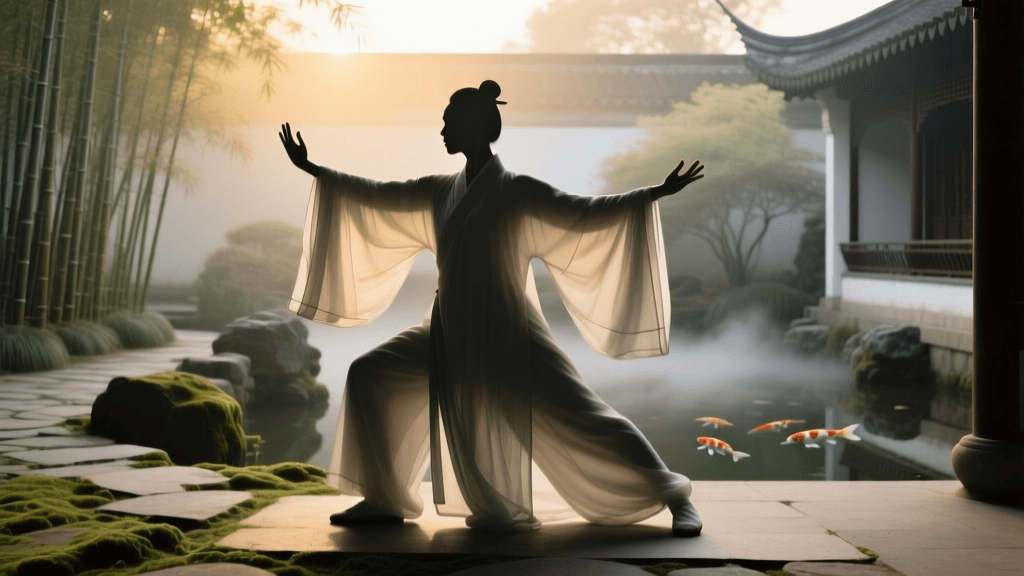
For practitioners who prefer the flowing, meditative aesthetic of traditional robes, the Daopao (Taoist robe) is the premier choice. Characterized by its wide sleeves and side slits, the Daopao creates a breathtaking visual effect during slow, continuous Qigong movements. The 'Dark Sleeves' (An Xiu) design, where the sleeves are sewn closed at the bottom to form deep pockets, adds a slight, satisfying weight to the garment that helps practitioners feel the centrifugal force of their arm movements. However, it is highly recommended to wear fitted Shuhe trousers underneath the Daopao to maintain a stable base and prevent tripping during transitional stances.
The 2026 Xin Zhongshi Innovations for Wellness
The Xin Zhongshi movement of 2026 has introduced remarkable technological advancements to traditional garment construction. Leading heritage brands are now integrating 'invisible stretch' into traditional weaves. By weaving a microscopic percentage of elastane into organic cotton or bamboo yarns, manufacturers have created Hanfu tops that retain the rigid, structured look of a traditional cross-collar (Jiao Ling You Ren) but stretch dynamically when the practitioner reaches overhead in 'White Crane Spreads Its Wings.'
Furthermore, moisture management has become a focal point. Traditional silk can become heavy and clingy when damp with sweat, which disrupts the body's thermoregulation and can lead to chills during the cooling-down phase of a Qigong session. The latest bamboo-charcoal infused linen blends naturally wick moisture away from the skin while maintaining the crisp, structured drape that defines the Hanfu silhouette. These garments also feature antimicrobial properties, essential for practitioners who engage in daily, rigorous routines.
Footwear: Grounding Your Practice
No Tai Chi or Qigong outfit is complete without proper footwear. The connection between the feet and the earth is paramount in internal martial arts; practitioners often speak of 'rooting' or drawing energy up from the ground. According to the National Qigong Association, proper alignment and grounding are foundational to safe and effective practice, preventing joint strain and enhancing balance.
In 2026, the traditional 'thousand-layer sole' cloth shoe remains the gold standard for indoor and dry-weather practice. These shoes feature flat, zero-drop soles made from compressed cotton and natural rubber, allowing the toes to splay naturally and the practitioner to feel the subtle shifts in weight distribution. For outdoor practice on uneven terrain or damp grass, modern Xin Zhongshi Tai Chi shoes offer a compromise: they feature the classic black canvas upper and traditional knot buttons but utilize advanced, flexible EVA foam outsoles with micro-traction patterns to prevent slipping during single-leg balance postures like 'Golden Rooster Stands on One Leg.'
Final Thoughts on Garment and Body Harmony
The revival of Hanfu in the context of traditional Chinese wellness is more than a passing trend; it is a profound reconnection with the holistic philosophy that mind, body, and environment are inextricably linked. When you don a carefully selected Shuhe or a flowing Daopao for your morning practice, you are not just wearing clothes—you are stepping into a lineage of movement that spans centuries. By prioritizing breathable, heritage-inspired fabrics and ergonomically sound silhouettes, practitioners in 2026 can ensure that their garments serve as a seamless extension of their bodies, allowing the Qi to flow as freely as the silk that drapes across their shoulders.