2026 Hanfu Secondhand Resale & Vintage Collector Guide
The Maturation of the Hanfu Secondary Economy in 2026
As we navigate the cultural fashion landscape of 2026, the Hanfu movement has evolved far beyond a niche internet subculture into a robust, multi-billion-dollar global industry. However, as the market for traditional Chinese clothing has matured, so too has the secondary economy. The Hanfu secondhand market is no longer just a place to offload ill-fitting garments; it has transformed into a highly sophisticated arena for vintage collecting, archival preservation, and high-stakes resale. For serious collectors and enthusiasts, the secondary market offers access to discontinued textiles, early revivalist pieces, and bespoke artisan creations that are simply unavailable in mainstream retail.
According to ongoing cultural analyses documented in The World of Chinese's comprehensive Hanfu series, the modern Hanfu revival has undergone distinct generational shifts. Today, buyers are increasingly prioritizing historical accuracy, premium natural fibers, and traditional weaving techniques over the mass-produced polyester blends that dominated the early 2020s. This shift in consumer consciousness has driven the resale value of historically accurate, limited-run garments to unprecedented heights, creating a thriving ecosystem for vintage Hanfu collectors.
Defining 'Vintage' in the Hanfu Revival
In Western fashion, 'vintage' typically refers to garments that are at least 20 years old. However, the modern Hanfu revival operates on an accelerated timeline. The contemporary movement began gaining significant traction in the early 2010s, driven by online forums and early adopters who experimented with historical pattern cutting. Therefore, in the 2026 Hanfu community, 'vintage' or 'early revivalist' pieces generally refer to garments produced between 2012 and 2018.
These early pieces are highly coveted for several reasons. First, they represent the pioneering era of modern Hanfu research, often featuring experimental weaving techniques and small-batch production runs by artisans who have since retired or pivoted. Second, many of these early garments were constructed using pure silk and traditional looms before the market became saturated with fast-fashion alternatives. Collectors actively seek out these foundational pieces not just for their aesthetic beauty, but for their historical significance within the cultural renaissance of traditional Chinese dress. For a deeper understanding of the historical garments that inspire these modern recreations, Wikipedia's extensive documentation on Hanfu provides an excellent baseline for understanding the dynastic silhouettes that early revivalists sought to replicate.
2026 Brand Hierarchy and Resale Premiums
Not all Hanfu holds its value on the secondary market. The resale premium is heavily dictated by the brand's reputation for historical accuracy, textile quality, and production scarcity. In 2026, the market is distinctly stratified. Mass-market brands that rely on synthetic fabrics and printed patterns depreciate rapidly, while heritage-focused ateliers command massive premiums.
| Brand Name | Market Tier | 2026 Average Resale Premium | Most Coveted Collectible Garment |
|---|---|---|---|
| Minghuatang (明华堂) | Ultra-Luxury / Archival | +150% to +300% | Woven Gold (Zhijin) Mamianqun |
| Kongque Peacock | High-End Artisan | +80% to +120% | Song Dynasty Beizi with Silk Embroidery |
| Shisanyu (十三余) | Mass Market / Fast Fashion | -30% to -50% (Depreciates) | Licensed IP Collaboration Sets |
| Zhongling (钟灵记) | Mid-Tier / Accessible | 0% to +20% (Holds Value) | Ming Dynasty Aoqun Sets |
| Early Indie Artisans (Pre-2018) | Vintage / Rare | +200% (Auction Dependent) | Hand-Loomed Zhuanghua Silk Jackets |
Minghuatang remains the undisputed apex of the Hanfu resale market. Often compared to Hermes in terms of waitlists and craftsmanship, their discontinued woven-gold horse-face skirts (Mamianqun) frequently sell for three to four times their original retail price on secondary platforms. Conversely, buyers looking to build a budget-friendly wardrobe often turn to the secondary market to acquire depreciated Shisanyu sets, which can be purchased for a fraction of their original cost.
Sourcing Rare Pieces on Xianyu (Idle Fish)
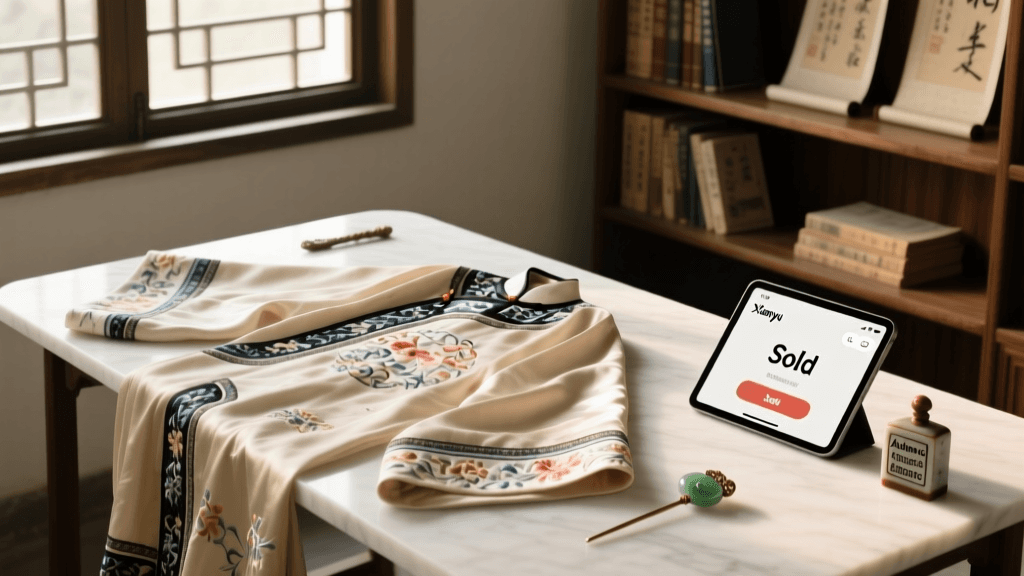
Xianyu (闲鱼), Alibaba's secondhand marketplace, is the undisputed epicenter of the Hanfu resale trade. For international collectors in 2026, navigating Xianyu requires a combination of linguistic precision, algorithmic patience, and the use of reliable proxy shopping agents like Superbuy or CSSBuy. Because Xianyu is a peer-to-peer platform, search optimization is critical.
To uncover hidden gems and avoid overpriced listings, collectors must use specific Chinese terminology rather than generic English translations. Below are the essential search terms for the 2026 Xianyu hunter:
- 汉服 绝版 (Hanfu Jueban): Translates to 'Hanfu out of print' or 'discontinued.' This is the golden keyword for finding rare, limited-run pieces from retired ateliers.
- 明华堂 二手 (Minghuatang Ershou): Specifically targets secondhand listings for the luxury brand Minghuatang. Be prepared for intense competition and immediate buy-it-now sniping.
- 汉服 微瑕 (Hanfu Weixia): Means 'Hanfu with minor flaws.' This is an excellent way to find high-end silk garments with microscopic weaving errors or tiny snags that drastically reduce the price but do not affect the overall drape or wearability.
- 汉服 定制 (Hanfu Dingzhi): Indicates 'custom-made Hanfu.' These are often bespoke pieces commissioned from independent tailors using premium silks, sold by original owners who may have experienced changes in body measurements.
- 来料加工 (Lailiao Jiagong): Meaning 'customer-supplied materials.' Listings with this tag often feature incredible vintage fabrics (like antique Yunjin brocade) that were sent to master tailors for construction. These are highly prized by textile collectors.
When negotiating on Xianyu, always request flat-lay measurements (Pingpu Celiang). Because traditional Hanfu relies on flat-pattern cutting rather than tailored darts, the shoulder span and sleeve length are critical for ensuring the garment will drape correctly on your specific frame.
Authenticating Textiles and Construction
As the financial stakes in the vintage Hanfu market have risen, so has the prevalence of counterfeit textiles. In 2026, unscrupulous sellers sometimes attempt to pass off modern jacquard polyester as traditional silk brocade. Authenticating vintage Hanfu requires a keen eye for textile structure and historical construction methods.
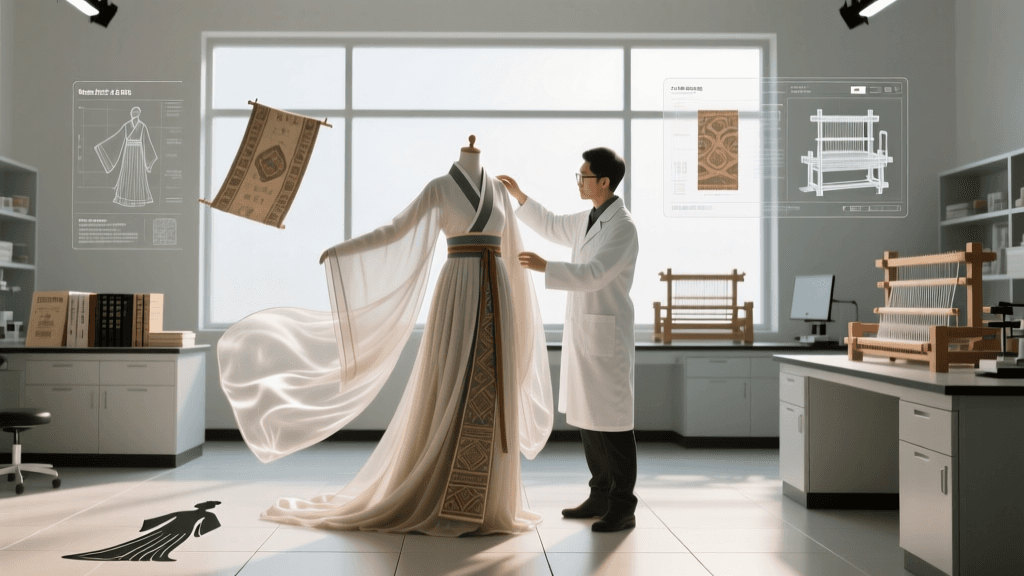
True traditional silk weaving, such as the revered Kesi (cut silk) or Zhuanghua techniques, possesses a distinct structural integrity. According to the UNESCO Intangible Cultural Heritage registry on Chinese sericulture and silk craftsmanship, traditional silk production involves highly specific reeling and weaving methods that impart a unique luster, tensile strength, and acoustic 'scroop' (the rustling sound of silk) that synthetic fibers cannot replicate. When inspecting a secondhand listing, always ask the seller for high-resolution macro photographs of the fabric's reverse side. In authentic woven brocades, the pattern is created by the interlacing of warp and weft threads; in cheap printed polyester, the reverse side will appear flat, muddy, or uniformly dyed without structural pattern integration.
Furthermore, examine the seam construction. Authentic Hanfu is constructed using flat-felled seams and hidden stitches to ensure the garment is reversible and to protect the delicate silk fibers from fraying. If a purported 'vintage artisan' piece features modern overlocked (serged) seams or synthetic polyester thread, it is likely a modern mass-market reproduction masquerading as a high-end collectible.
Archival Care for Secondhand Silk
Acquiring a rare, early-revival Hanfu piece is only half the battle; preserving it is the other. Secondhand silks, particularly those that have been stored improperly by previous owners, require immediate archival intervention upon arrival.
Never hang heavy woven silk garments like Mamianqun or heavily embroidered Daji (overcoats) on standard hangers. The immense weight of the traditional weave will cause the warp threads to stretch and distort over time, ruining the garment's structural integrity. Instead, fold these pieces using acid-free, unbuffered tissue paper to prevent hard creases, and store them flat in archival-quality cotton boxes or cedar chests. Avoid plastic bins entirely, as they trap moisture and off-gas chemicals that will yellow and degrade natural silk proteins.
For pest prevention, avoid direct contact with mothballs or chemical cedar blocks, which can stain and permanently scent the porous silk fibers. Instead, utilize natural dried mugwort or lavender sachets wrapped in breathable cotton, placed in the corners of your storage drawers. By treating these secondhand acquisitions as museum-grade textiles, collectors ensure that the physical history of the Hanfu revival remains intact for decades to come.