Hanfu Fabric Drape Analysis: 2026 Academic Research Guide
The Evolution of Chinese Fashion History Education in 2026
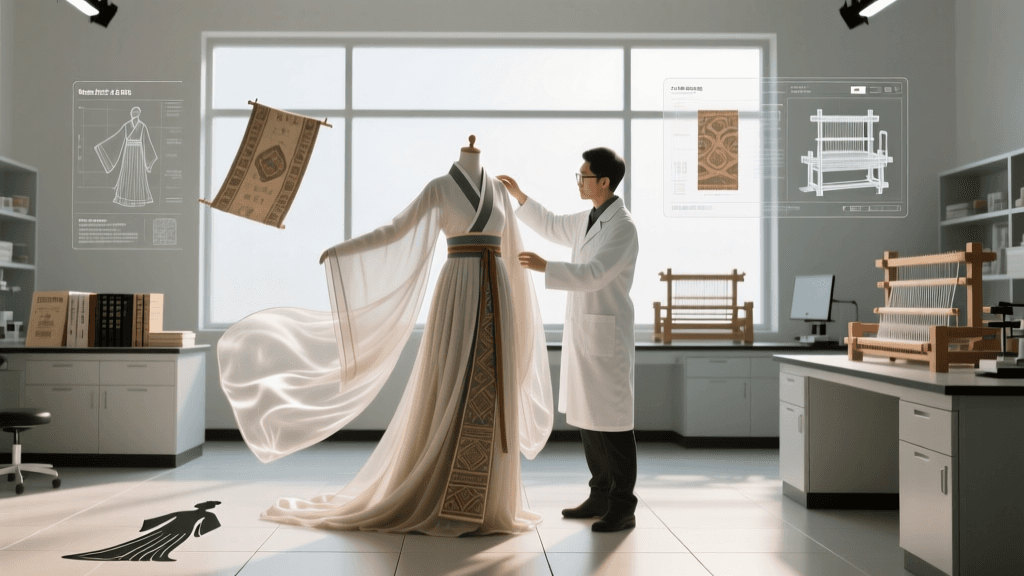
The academic study of traditional Chinese garments has undergone a radical transformation by 2026. No longer confined to static museum displays or purely aesthetic observations, Chinese fashion history is now a rigorous, data-driven discipline. At the intersection of ancient weaving techniques and modern material science, universities and research institutions are pioneering advanced fabric drape analysis to understand how historical Hanfu truly moved, breathed, and functioned. This academic rigor is heavily informing the global Xin Zhongshi (新中式) movement, ensuring that contemporary adaptations are grounded in authentic structural and material realities rather than mere visual pastiche.
For graduate students, textile historians, and fashion technologists, mastering the drape analysis of historical Chinese textiles is now a core competency. The physical properties of silk, ramie, and hemp dictate the iconic silhouettes of the Ming Dynasty Aoqun (jacket and skirt) and the flowing elegance of the Tang Dynasty Banbi (half-sleeve jacket). Understanding these mechanics requires a blend of historical archaeology, physical tensile testing, and cutting-edge 3D digital simulation.
Xin Zhongshi and the Demand for Academic Rigor
The Xin Zhongshi, or 'New Chinese Style,' has dominated international design weeks throughout the mid-2020s. However, the 2026 academic consensus demands a departure from superficial motif appropriation. Leading fashion institutes now require students to conduct empirical drape analysis before reconstructing historical patterns. By analyzing the flexural rigidity and shear stiffness of ancient textiles, researchers can accurately predict how a garment would have draped on the human body in motion. This academic approach bridges the gap between the archaeological record and living heritage, providing a scientific foundation for the next generation of traditional garment makers.
Core Methodologies: Physical Testing and Digital Twins
In 2026, academic research into Hanfu drape relies on a dual-methodology approach: physical evaluation of historically accurate reproduction textiles and the creation of high-fidelity digital twins. The physical properties of a fabric dictate its drape coefficient, which is the measure of how a material folds and falls under its own weight.
Physical Evaluation via KES-FB Systems
The Kawabata Evaluation System for Fabrics (KES-FB) remains the gold standard in university laboratories for measuring the mechanical properties of textiles. Researchers use KES-FB to measure specific parameters critical to Hanfu reconstruction:
- Bending Rigidity (B): Determines how easily a fabric like Song Dynasty Luo gauze folds, crucial for achieving the ethereal, layered look of historical summer garments.
- Shear Stiffness (G): Measures the resistance to trellis deformation, vital for understanding how heavy Ming Dynasty Zhangzhou velvet holds its structured shape.
- Surface Friction (MIU): Analyzes how layers of silk interact with one another, affecting the acoustic and visual rustle of multi-layered Hanfu ensembles.
Digital Simulation and AI-Assisted Draping
Once physical data is gathered, researchers import these parameters into advanced 3D garment simulation software. The 2026 iterations of CLO 3D and Marvelous Designer feature AI-driven material scanners that can instantly translate KES-FB data into hyper-realistic digital avatars. This allows academics to simulate historical garments on diverse body types and in various environmental conditions, such as wind resistance or the kinetic drag of walking, providing insights that static mannequins simply cannot offer.
Comparative Data: Historical Textiles and 2026 Simulation Parameters
The following table outlines the standardized digital simulation parameters used by academic researchers in 2026 when reconstructing specific historical Hanfu textiles. These metrics ensure that digital twins behave identically to their physical counterparts.
| Historical Fabric Type | Primary Era | Bending Rigidity (B) | Shear Stiffness (G) | 2026 Digital Weight (g/m²) |
|---|---|---|---|---|
| Luo Gauze (罗) | Song Dynasty | 0.025 gf·cm²/cm | 0.85 gf/deg | 35 g/m² |
| Zhangzhou Velvet (漳绒) | Ming Dynasty | 0.180 gf·cm²/cm | 4.20 gf/deg | 280 g/m² |
| Plain Weave Ramie (苎麻) | Han Dynasty | 0.095 gf·cm²/cm | 2.15 gf/deg | 140 g/m² |
| Ke-Si Tapestry Silk (缂丝) | Qing Dynasty | 0.150 gf·cm²/cm | 3.80 gf/deg | 210 g/m² |
Leading Institutions in Chinese Fashion History Research
Several prestigious institutions are at the forefront of this academic movement in 2026. Donghua University in Shanghai, home to the Shanghai History of Fashion and Textile Research center, continues to lead in the digital reconstruction of Silk Road textiles. Their laboratories combine archaeological textile fragments with advanced spectroscopy to determine original dye compositions and weave structures. Similarly, the Beijing Institute of Fashion Technology (BIFT) focuses heavily on the ergonomic drape of Northern Dynasties round-collar robes, utilizing motion-capture technology to study how historical tailoring accommodated equestrian lifestyles.
Global institutions are also contributing to this field. The preservation of ancient weaving techniques is deeply tied to intangible cultural heritage. As noted by the UNESCO Intangible Cultural Heritage registry, the traditional sericulture and silk craftsmanship of China provide the foundational material context necessary for accurate drape analysis. Without understanding the micro-structure of the silk filament cultivated through these heritage practices, digital simulations remain fundamentally flawed. Furthermore, comprehensive historical overviews provided by institutions like The Metropolitan Museum of Art offer vital visual and structural documentation of surviving Chinese silk garments, serving as primary references for academic pattern drafting.
Step-by-Step Guide to Conducting Hanfu Drape Research
For graduate students and independent researchers looking to conduct rigorous Hanfu drape analysis in 2026, the following actionable methodology is recommended:
Step 1: Sourcing and Material Authentication
Begin by sourcing historically accurate reproduction fabrics. Avoid modern synthetic blends, as their drape coefficients will skew your research. Partner with heritage weavers in Suzhou or Hangzhou who utilize traditional wooden looms to produce authentic Luo gauze or Song brocade. Document the exact yarn count, twist per meter, and loom tension used during production.
Step 2: Physical Mechanical Testing
Submit your fabric samples to a university textile lab equipped with a KES-FB system or a FAST (Fabric Assurance by Simple Testing) rig. Record the bending, shear, tensile, and surface properties. Ensure the testing environment is strictly climate-controlled at 20°C and 65% relative humidity, as natural fibers like silk and ramie are highly hygroscopic and will alter their drape based on ambient moisture.
Step 3: Digital Twin Calibration
Import your physical test data into your chosen 3D simulation environment. In 2026, utilize the AI-material calibration tools to map the physical data to the digital mesh. Run a standard 'cylinder drape test' within the software and compare the digital folds against a physical photograph of the fabric draped over a real cylinder. Adjust the digital shear and bend parameters until the node count and fold depth match the physical reference within a 2% margin of error.
Step 4: Historical Pattern Application and Kinetic Analysis
Apply your verified digital fabric to historically accurate 2D patterns drafted from archaeological reports. Dress a parametric 3D avatar and run kinetic simulations. Analyze the garment's behavior during specific historical activities, such as the traditional tea ceremony, archery, or formal court walking. Record data on joint restriction, fabric pooling, and layered friction. This kinetic data is invaluable for understanding the ergonomic intent behind ancient Chinese tailoring, such as the placement of gussets or the depth of armholes.
The Future of Academic Garment Research
As we move through 2026, the integration of material science and historical archaeology is redefining Chinese fashion history education. The ability to quantitatively analyze and digitally simulate the drape of ancient textiles allows researchers to experience the tactile and kinetic realities of the past. By grounding the Xin Zhongshi movement in this rigorous academic framework, the global fashion community ensures that the legacy of traditional Chinese garments is preserved not just as static images, but as living, breathing, and moving masterpieces of textile engineering. For students and academics alike, mastering these drape analysis methodologies is no longer optional; it is the essential key to unlocking the true genius of Asian sartorial traditions.