The Hanfu Market Evolution: From Silk Bazaars to E-Commerce
The Historical Silk Markets and Artisan Tailors
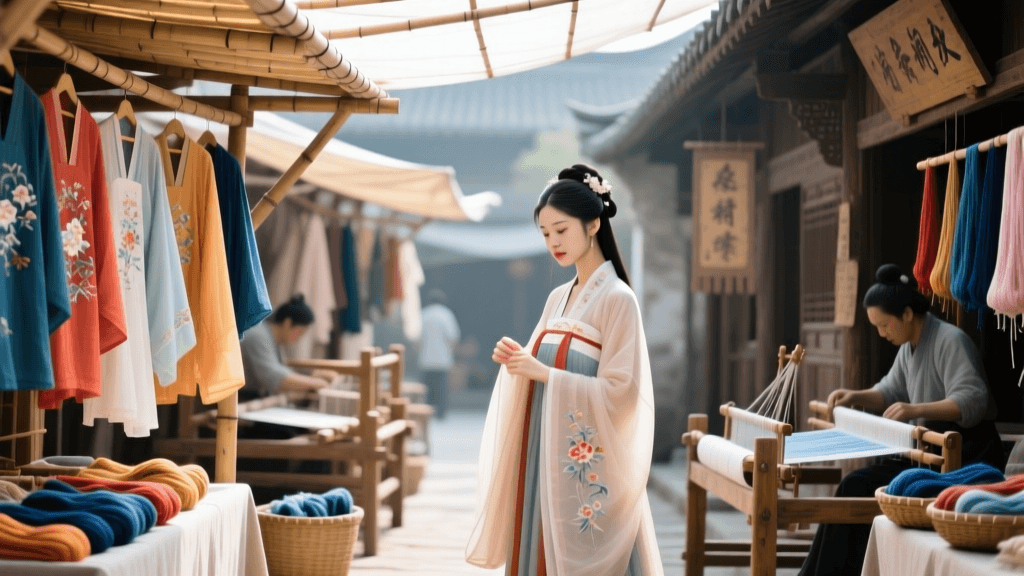
For centuries, acquiring traditional Chinese clothing was an intimate, localized, and highly tactile experience. Before the advent of mass production and global shipping, the procurement of garments like the ruqun (blouse and skirt) or the shenyi (deep robe) required a visit to bustling local markets. In historical silk hubs like Suzhou and Hangzhou, shoppers did not simply buy finished garments off the rack. Instead, the process was a multi-step journey that began with selecting raw textiles.
Buyers would visit specialized silk bazaars to inspect the weight, weave, and luster of the fabric. According to the Victoria and Albert Museum, Chinese silk craftsmanship was historically guarded as a state secret, with regional markets offering distinct weaves such as Hangzhou's lightweight crepes and Suzhou's heavy, ornate brocades. Once the fabric was purchased by the bolt, it was taken to a local tailor or a household seamstress who would measure the client and cut the fabric according to traditional flat-pattern techniques, which minimized waste and respected the integrity of the woven motifs.
This deeply rooted culture of textile production is recognized globally. The traditional methods of raising silkworms and weaving the threads were so vital to Chinese culture and economy that UNESCO inscribed Sericulture and silk craftsmanship of China on the Representative List of the Intangible Cultural Heritage of Humanity. Historically, this meant that owning a high-quality silk garment was a significant investment of both time and capital, reserved largely for the elite, while commoners relied on local markets for hemp, ramie, or cotton.
The Digital Renaissance: Hanfu on E-Commerce Platforms
The modern Hanfu movement, which gained significant momentum in the 2010s, has completely revolutionized how consumers interact with traditional Chinese garments. Today, the tactile experience of the silk bazaar has been largely replaced by the digital storefronts of Taobao, Tmall, and independent brand websites. This e-commerce boom has democratized access to historical fashion, allowing a teenager in Beijing or a cultural enthusiast in New York to purchase a meticulously researched Mamianqun (horse-face skirt) with a few clicks.
Modern Hanfu brands operate much like contemporary fast-fashion or boutique labels, but with a heavy emphasis on historical accuracy, museum collaborations, and community feedback. Platforms like Xiaohongshu (Little Red Book) and Douyin serve as digital lookbooks where buyers share unboxing videos, fabric drape tests, and historical accuracy reviews, effectively replacing the word-of-mouth recommendations of the ancient marketplace.
Comparison Chart: Traditional Sourcing vs. Modern E-Commerce
| Feature | Historical Silk Markets | Modern E-Commerce (Taobao/Tmall) |
|---|---|---|
| Acquisition Time | Weeks to months (weaving, tailoring) | 3 to 60 days (depending on pre-sale status) |
| Customization | Fully bespoke, tailored to the individual | Standardized sizing (S, M, L, XL) with some custom options |
| Fabric Verification | Tactile inspection, burn tests, visual luster | Reliance on seller descriptions, buyer reviews, and detail photos |
| Accessibility | Localized to specific trade cities and towns | Global shipping, accessible from anywhere with internet |
| Cost Structure | High cost for silk; paid separately for fabric and labor | Tiered pricing; bundled garment costs ranging from $20 to $500+ |
Practical Guide: Navigating Online Hanfu Purchases
Transitioning from a physical market to an online cart requires a new set of skills. Buying Hanfu online involves understanding specific e-commerce mechanics unique to the Chinese market, particularly the pre-sale system and precise sizing requirements.
Understanding Pre-Sales (Yushou)
Unlike Western e-commerce where items are usually in stock, premium Hanfu brands frequently utilize a pre-sale model known as yushou. Brands will release digital renders or sample photos of a new collection and open a deposit window.
- Timing: You pay a deposit (usually 10% to 30% of the total cost) to secure your order. The manufacturing period typically takes 45 to 60 days.
- Final Payment: Once the garments are produced, the shop opens a final payment window lasting 3 to 7 days. If you miss this window, you may lose your deposit and your spot in the queue.
- Actionable Advice: Always set calendar reminders for final payment dates. If you are buying from international proxy agents (like Superbuy or Wegobuy), ensure your account is funded before the final payment window opens to avoid delays.
Essential Measurements for Online Sizing
Hanfu sizing does not always align with standard Western sizing charts. Because traditional garments rely on flat cutting and wrapping, certain measurements are far more critical than others. Always keep a soft measuring tape handy and refer to the shop's specific size chart (usually provided in centimeters).
- Bust (Xiongwei): Measure around the fullest part of your chest. Crucial for Qixiong Ruqun (chest-high skirts) and Beizi (jackets).
- Waist (Yaowei): For a Mamianqun (horse-face skirt), measure exactly where you intend the skirt waistband to sit. These skirts have no elastic; they tie in place. A 2cm error can result in the skirt slipping down.
- Skirt Length (Qunchang): Standard online listings usually offer lengths of 100cm, 105cm, or 110cm. Measure from your natural waist down to your ankle bone. A 105cm skirt generally fits heights between 160cm and 168cm (5'3" to 5'6").
- Arm Span / Sleeve Length: Historical garments often feature elongated sleeves. Check the "sleeve length" (measured from the center back of the neck to the cuff) to ensure the sleeves will cover your hands, a traditional requirement for formal styles like the Pipa sleeve.
Authenticating Fabrics and Pricing Tiers
In the historical bazaars, buyers could touch the silk to verify its quality. Today, the Metropolitan Museum of Art notes that silk has historically been a highly prized luxury commodity, and this remains true in the modern market. However, e-commerce listings can be deceptive, using terms like "silk-like" or "ice silk" to describe synthetic polyester blends. To shop like an informed connoisseur, you must understand fabric terminology and pricing tiers.
E-Commerce Fabric and Price Guide
- Polyester / Chiffon (Daily Wear):
Cost: 150 - 300 RMB ($20 - $40 USD).
Details: Highly durable, machine washable, and wrinkle-resistant. Ideal for beginners, travel, and hot summer weather. Look for terms like "anti-wrinkle chiffon" or "peach skin velvet" for winter. - Silk Blends / Tencel (Mid-Tier):
Cost: 400 - 800 RMB ($55 - $110 USD).
Details: Offers a beautiful drape and breathability. Often mixed with cotton or synthetic fibers to improve durability. Check the "Material Component" (caizhi) section of the listing for exact percentages. - Pure Mulberry Silk & Brocade (Formal / Collector):
Cost: 1,000 - 3,000+ RMB ($140 - $420+ USD).
Details: Authentic sangcansi (mulberry silk) or traditional jacquard brocades woven with metallic threads. These require dry cleaning and careful storage. They possess a distinct, rich luster and a heavier drape that synthetic fabrics cannot replicate.
Conclusion
The journey of the Hanfu garment from the vibrant, fragrant silk bazaars of ancient Hangzhou to the algorithm-driven storefronts of modern e-commerce represents a fascinating evolution in cultural consumption. While the tactile romance of haggling over bolts of raw silk has faded, the digital marketplace has achieved something remarkable: it has preserved, scaled, and globalized traditional Chinese clothing. By understanding the mechanics of online pre-sales, mastering historical sizing measurements, and learning to decode digital fabric descriptions, modern enthusiasts can curate a traditional wardrobe that honors the artisan legacy of the past while embracing the convenience of the future.