Decoding Hanfu Styles in Chinese Scroll Paintings
The Sartorial Archive of Chinese Scroll Art
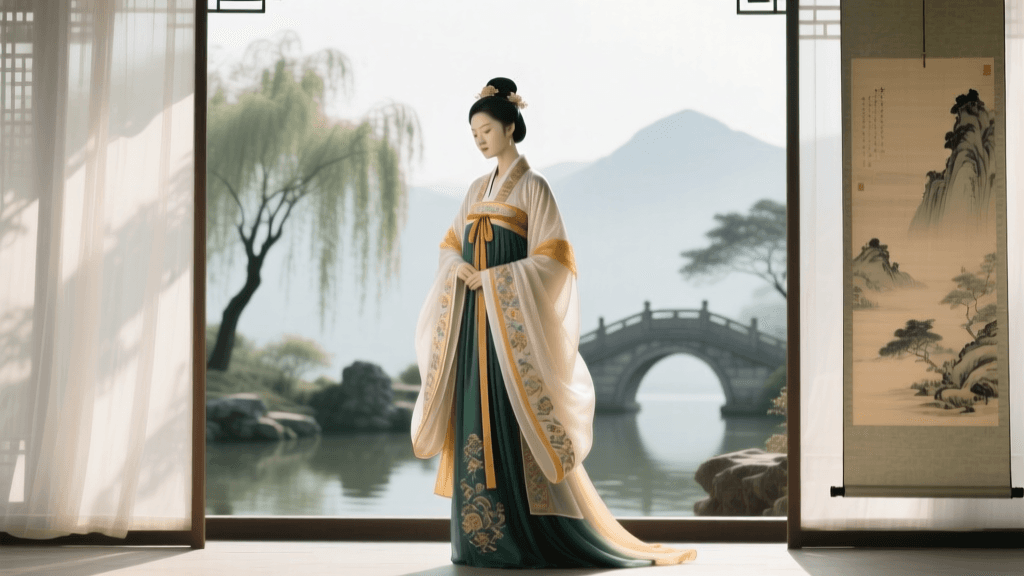
Traditional Chinese scroll paintings are celebrated globally for their masterful landscapes, intricate portraiture, and profound philosophical depth. However, for historians, textile artists, and modern hanfu enthusiasts, these scrolls serve a much more practical purpose: they are meticulously detailed sartorial archives. Long before the advent of photography, court painters and scholars documented the evolution of Asian traditional garments, capturing the drape, weave, and social signaling of historical Chinese clothing. By learning to 'read' these paintings, we can uncover exacting details about historical fabric weights, layering techniques, and seasonal fashion customs that continue to inform modern hanfu reconstruction today.
According to Encyclopedia Britannica's comprehensive guide to Chinese painting, the meticulous gongbi (court-style) painting technique relied on fine, precise brushstrokes and layered mineral pigments. This dedication to realism means that the folds of a silk sleeve or the stiff hem of a linen tunic were not merely artistic flourishes, but deliberate observations of physical textiles. In this guide, we will decode the hanfu styles hidden within China's most famous scroll paintings and provide actionable advice for translating these 2D masterpieces into 3D garments.
Tang Dynasty Opulence: Decoding the 'Court Ladies' Scrolls
The Tang Dynasty (618–907 CE) represents a golden age of Chinese cosmopolitanism, and its fashion was characterized by volume, opulence, and daring silhouettes. The definitive visual record of this era is found in works like Zhou Fang’s Court Ladies Adorning Their Hair with Flowers. In these scrolls, elite women are depicted wearing the qixiong ruqun (chest-high skirt) paired with a pibo (a long, flowing silk shawl).
The brushwork in Tang court paintings reveals crucial information about textile weight and drape. The pibo is consistently painted with deep, U-shaped folds that pool heavily around the elbows before cascading to the floor. This visual cue tells modern makers that the historical shawls were not made of stiff organza, but rather heavy, fluid silks with significant bias stretch.
Actionable Advice for Tang Reconstruction
- Fabric Selection: To replicate the Tang pibo drape seen in Zhou Fang’s scrolls, avoid crisp silks. Instead, source 8 to 12 momme silk chiffon, crepe de chine, or lightweight georgette. These fabrics possess the necessary fluid weight to create the painted U-shaped elbow folds.
- Measurements: The scrolls depict shawls that wrap loosely around the back and drape well past the fingertips. Cut your pibo to a minimum length of 2.8 to 3.2 meters, with a width of 50 to 60 cm, allowing for the dramatic pooling effect at the feet.
- Pigment Matching: Tang painters used cinnabar for vibrant reds and malachite for greens. Modern dyers can reference these mineral hues to achieve historically accurate, highly saturated Tang color palettes, avoiding the pastel tones more common in later eras.
Song Dynasty Realism: Everyday Hanfu in the 'Qingming' Scroll
While Tang art focused on the elite, the Song Dynasty (960–1279 CE) brought a rise in secular, genre paintings that documented everyday life. The undisputed masterpiece of this movement is Zhang Zeduan’s Along the River During the Qingming Festival. This panoramic handscroll features over 800 figures, offering an unparalleled cross-section of 12th-century fashion across different social classes.
In the Qingming scroll, the clothing of scholars and merchants is defined by the beizi (a long, side-slit jacket) and the ruqun with a lower waistline than the Tang era. The brushstrokes used for these garments are notably different from Tang paintings. Artists utilized 'iron wire' lines—stiff, uniform, and unyielding—to depict the clothing of the working class and the outer layers of the elite. This indicates the widespread use of heavily woven silks, ramie, and linen, which hold their shape and resist clinging to the body.
Actionable Advice for Song Reconstruction
- Fabric Selection: The straight, vertical brush lines in Song paintings suggest stiffer fabrics. For an authentic Song beizi, use 16 to 19 momme silk damask, heavy crepe, or high-quality linen blends. The fabric must have enough body to stand away from the wearer's frame.
- Structural Details: The scrolls clearly show deep side slits on the beizi, revealing the contrasting trousers beneath. When drafting your pattern, ensure the side slits begin exactly 30 to 40 cm below the armpit to allow for the mobility depicted in the scroll's bustling market scenes.
- Layering: Unlike the sheer, revealing layers of the Tang, Song figures in the Qingming scroll display modest, structured layering. Always include a visible, contrasting inner collar (zhongyi) measuring 1.5 to 2 cm above the outer jacket's neckline.
Comparison Chart: Tang vs. Song Dynasty Garments in Art
Understanding the shift in artistic representation helps modern designers choose the right textiles for their specific historical era. Below is a structured comparison of how garments were depicted across these two pivotal dynasties.
| Feature | Tang Dynasty (Court Paintings) | Song Dynasty (Genre Paintings) |
|---|---|---|
| Dominant Silhouette | Voluminous, chest-high skirts, wide sleeves | Straight, slender lines, lower waists, side-slits |
| Brushwork Style | Gao gu you si miao (flowing, gossamer threads) | Tie xian miao (stiff, iron-wire lines) |
| Implied Fabric Weight | Lightweight, fluid, sheer (8-12 momme silk) | Structured, heavy, opaque (16-19 momme, linen) |
| Color Palette | Saturated mineral pigments (cinnabar, azurite) | Muted, earthy tones, subtle botanical dyes |
| Key Artwork Reference | Court Ladies Adorning Their Hair with Flowers | Along the River During the Qingming Festival |
Practical Guide: Reading Brushstrokes as Textile Indicators
To accurately reconstruct hanfu from art, one must understand the traditional 'Eighteen Linetypes' (Shiba Miao) used in Chinese figure painting. These brush techniques were specifically developed to render different textures. By identifying the linetype, you can deduce the exact material the historical figure was wearing.
- Cao Yi Shui Xian Miao (Waterweed Line): Characterized by long, flowing, undulating strokes that taper at the ends. Textile Translation: Represents lightweight, flowing silk chiffon or gauze reacting to a breeze. Use this as a reference for summer ruqun skirts.
- Zhan Bi Shui Xian Miao (Cut Brush Line): Features sharp, abrupt stops and angular turns. Textile Translation: Indicates thick, stiff fabrics like heavy winter brocade, felt, or padded cotton garments that do not drape easily.
- Bai Miao (Plain Line Drawing): Relies entirely on unshaded, uniform ink lines without color fills. Textile Translation: Often used for plain linen or unbleached ramie worn by scholars and commoners, emphasizing the cut and structure of the garment rather than its surface sheen.
Where to Study High-Resolution Scroll Art Online
To study the minute details of historical weave patterns and collar overlaps, you need access to ultra-high-resolution scans. Fortunately, major global institutions have digitized their collections, providing free resources for researchers and makers. The Metropolitan Museum of Art's Asian Art Department offers an incredible online database where you can zoom in on the intricate textile patterns of Ming and Qing dynasty court portraits. Similarly, the Smithsonian National Museum of Asian Art provides extensive digital archives of early handscrolls, allowing you to study the evolution of the jiaoling youren (cross-collar, right lapel) across centuries. When studying these archives, always cross-reference the painted garment with surviving archaeological textile fragments to ensure your modern reconstructions are both artistically and structurally faithful to history.