Hanfu Market Evolution: From Silk Bazaars To E-Commerce
The Historical Roots: Silk Road Bazaars and Imperial Markets
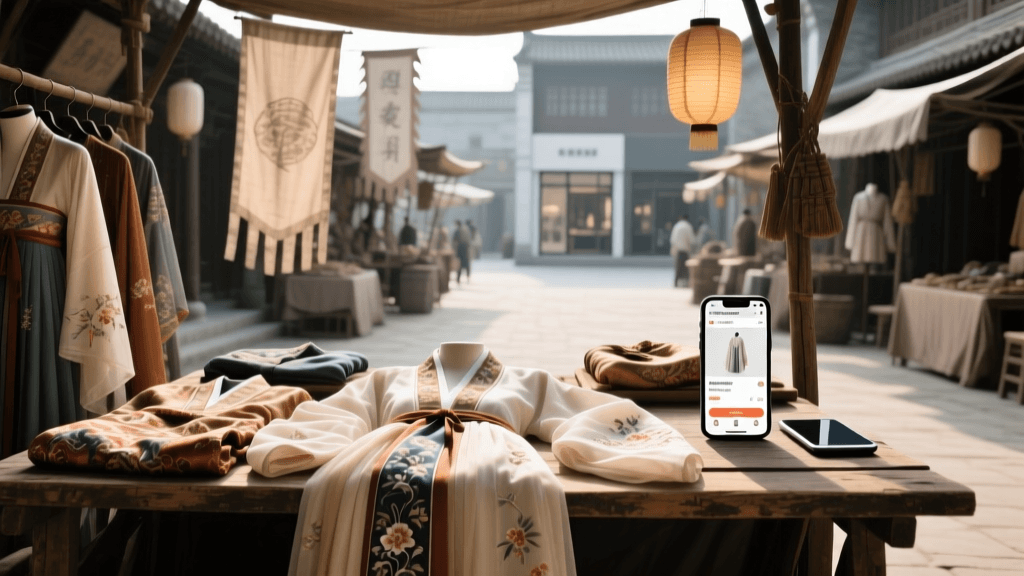
For centuries, the acquisition of traditional Chinese garments was an inherently tactile and localized experience. Before the advent of digital storefronts, the procurement of high-quality Hanfu and its foundational textiles relied heavily on physical markets, imperial weaving bureaus, and the sprawling trade networks of the ancient world. Cities like Suzhou and Hangzhou served as the undisputed epicenters of silk production, where bustling bazaars offered everything from raw mulberry silk threads to intricately embroidered brocades destined for aristocratic wardrobes.
The historical distribution of these luxury textiles was deeply intertwined with the historical Silk Road, a vast network of trade routes that not only exported Chinese silk to the West but also facilitated the cross-pollination of weaving techniques, dyes, and garment motifs across Asia. In these traditional markets, purchasing fabric or commissioning a garment was a multi-step, time-intensive process. Buyers would select raw textiles, negotiate with tailors, and undergo multiple fittings. The cost was prohibitive for the common populace, and the market was heavily regulated by imperial sumptuary laws that dictated who could wear specific colors, patterns, and structural layers.
The Digital Renaissance: Hanfu on Taobao and Independent Brands
Fast forward to the 21st century, and the landscape of traditional Chinese garment commerce has undergone a radical transformation. The modern Hanfu revival movement, which gained significant momentum in the early 2010s, has been almost entirely fueled by e-commerce platforms like Taobao, Tmall, and specialized independent brand websites. What was once a niche hobby requiring physical trips to historical textile hubs or custom tailors is now a multi-billion RMB industry accessible with a few clicks.
E-commerce has democratized access to traditional garments. Digital platforms allow specialized Hanfu brands to reach a global diaspora and a booming domestic youth market. However, this shift from physical bazaars to digital carts has introduced new complexities. Buyers must now navigate a labyrinth of pre-order systems, varying historical accuracies, and digital fabric representations that do not always translate to real-world quality.
"The transition from Suzhou's silk alleys to Taobao's digital storefronts has not just changed how Hanfu is bought; it has fundamentally altered how traditional garments are designed, produced, and consumed by a new generation."
Practical Guide: Sourcing Hanfu in the E-Commerce Era
Navigating the modern Hanfu e-commerce market requires an understanding of brand tiers, fabric expectations, and pricing structures. Whether you are a historian seeking museum-grade accuracy or a beginner looking for festival-ready attire, here is a practical breakdown of the current market landscape.
1. Entry-Level and Fast-Fashion Hanfu ($30 - $80 USD)
Brands in this tier prioritize accessibility, vibrant aesthetics, and rapid shipping over strict historical accuracy. Fabrics are predominantly polyester blends, chiffon, and synthetic jacquards. While breathable options are rare, these garments are excellent for photography, casual wear, and beginners.
- Popular Brands: Lanruotang, Chuan Dai, and various Taobao indie shops.
- Best For: Beginners, cosplay, and short-term festival wear.
- Actionable Tip: Always check the fabric composition list. Look for "cotton-linen blends" (棉麻) if you need breathability for summer wear, avoiding 100% polyester in high heat.
2. Mid-Tier and Designer Collaborations ($80 - $250 USD)
This is the sweet spot for most Hanfu enthusiasts. Brands here invest heavily in original embroidery designs, better structural tailoring, and higher-quality materials like genuine silk blends, premium rayon, and heavy woven jacquards. Many collaborate with museums or historical dramas to create licensed collections.
- Popular Brands: Shisanyu (十三余), Zhongling, and Tingyue Fengming.
- Best For: Daily wear, cultural events, and enthusiasts seeking a balance of aesthetics and quality.
- Actionable Tip: Mid-tier brands frequently utilize the Yushou (预购 - pre-order) model. You may pay a deposit and wait 30 to 45 days for the garment to be manufactured. Factor this timing into your purchasing schedule.
3. High-End and Museum-Grade Replicas ($300 - $1,500+ USD)
At the apex of the market are brands dedicated to rigorous historical reconstruction. These garments utilize traditional weaving techniques, genuine mulberry silk, Song brocade (Songjin), and authentic natural dyes. The structural patterns are drafted directly from archaeological reports and historical artifacts.
- Popular Brands: Ming Huatang (明华堂), Konggui, and Zijingtang.
- Best For: Collectors, formal ceremonies, and historical purists.
- Actionable Tip: When investing in high-end Ming dynasty-style garments, refer to resources like the Metropolitan Museum of Art's Ming Dynasty textile archives to verify the accuracy of the brocade motifs and structural layering before purchasing.
Sizing and Measurements: Navigating Asian E-Commerce Fits
One of the most significant hurdles for international buyers sourcing Hanfu via e-commerce is the sizing system. Unlike Western clothing, which relies on standardized S/M/L charts based on body volume, traditional Hanfu is largely flat-patterned and relies on tie-closures. However, specific measurements are non-negotiable for a proper fit.
All measurements on Taobao and Tmall are listed in centimeters (cm). Keep a measuring tape and a calculator handy.
Critical Hanfu Measurements
- Bust (Xiong Wei - 胸围): Crucial for the upper garment (Shan or Ao). Hanfu upper garments are cut wide and flat. Ensure the garment's flat bust measurement is at least 10-15 cm larger than your actual body bust to allow for proper overlapping and tying.
- Skirt Length (Qun Chang - 裙长): The most vital measurement for a Mamianqun (horse-face skirt). Measure from your natural waist down to your ankle bone. A skirt that is too short will expose the under-layers, breaking the traditional silhouette.
- Arm Span / Sleeve Length (Tong Xiu - 通袖): Measured from wrist to wrist with arms outstretched. Traditional Ming and Song dynasty formal wear features sleeves that extend past the fingertips. A standard modern Tong Xiu is around 160-180 cm, but formal historical replicas can exceed 220 cm.
- Waist (Yao Wei - 腰围): Measured at the narrowest part of your torso. Mamianqun skirts are secured with ties, so the skirt's waistband must match your waist measurement exactly to ensure the pleats align correctly without gaping.
Comparison Chart: Traditional Markets vs. E-Commerce Sourcing
To understand the magnitude of the market shift, consider the practical differences between sourcing garments in historical physical markets versus modern digital platforms.
| Feature | Physical Silk Markets (Suzhou/Hangzhou) | E-Commerce Platforms (Taobao/Tmall) |
|---|---|---|
| Accessibility | Requires physical travel to specific Chinese provinces; language barriers are prominent. | Global access via desktop or mobile; translation tools and proxy agents (like Superbuy) bridge the gap. |
| Price Transparency | Highly variable; requires haggling and deep knowledge of textile grades. | Fixed pricing, transparent customer reviews, and easy price-comparison across dozens of brands. |
| Customization | Bespoke tailoring is standard; buyers select raw fabric and dictate patterns. | Limited to brand-offered sizes; custom tailoring is rare and usually restricted to high-end boutique shops. |
| Historical Accuracy | Traditional markets often sell generic "ancient-style" costumes rather than historically accurate Hanfu. | Niche e-commerce brands specialize in peer-reviewed, archaeologically accurate historical reconstructions. |
| Wait Times | Days to weeks, depending on the tailor's queue and fabric sourcing. | Immediate for in-stock items; 30-60 days for crowd-funded pre-orders (Yushou). |
Authenticating Your Purchase: Avoiding Fast-Fashion "Hanfu"
As the market has exploded, so has the proliferation of "Hanfu-inspired" fast fashion. These garments often borrow the aesthetic of traditional clothing but utilize modern Western tailoring techniques, such as zippers, darts, and elastic waistbands, which fundamentally alter the garment's structure and drape.
When sourcing online, scrutinize the product photography and description for the following markers of authenticity:
- Closure Systems: Authentic Hanfu relies on fabric ties (Ji Dai) and overlapping collars (Jiao Ling You Ren). Avoid garments featuring hidden zippers or buttons on the main body.
- Structural Seams: Traditional garments feature a center-back seam (Zhong Feng) and flat-cut sleeves. If the shoulder features a modern curved set-in sleeve, it is a modern hybrid, not traditional Hanfu.
- Fabric Behavior: Authentic silk brocades and woven jacquards have a distinct weight and stiffness that creates structured pleats. If the fabric in the photos clings or drapes like chiffon, it is likely a cheap synthetic print masquerading as woven brocade.
Strategic Timing: When to Buy
E-commerce operates on its own seasonal calendar. To secure the best prices and ensure your garments arrive in time for cultural festivals, align your purchases with major Chinese shopping holidays. The 6.18 Mid-Year Shopping Festival (June) is ideal for purchasing lightweight summer fabrics like linen and thin silk. The 11.11 Singles' Day (November) is the premier event for securing heavy winter garments, such as wool-lined Ao (jackets) and plush velvet cloaks (Dou Peng), often at a 20% to 40% discount. Finally, purchasing in early December is highly recommended if you need new garments for the Lunar New Year, as factory shutdowns and shipping delays in January will halt all production and logistics.
Conclusion
The evolution of the Hanfu market from the physical silk bazaars of the Silk Road era to the algorithmic storefronts of modern e-commerce represents a fascinating intersection of heritage and technology. While the medium of exchange has changed, the core desire to connect with the artistry, structure, and cultural weight of traditional Chinese garments remains unchanged. By understanding brand tiers, mastering the nuances of flat-pattern measurements, and knowing how to authenticate historical construction, modern buyers can successfully navigate the digital bazaar and build a wardrobe that honors centuries of textile mastery.