Hanfu on Global Runways: 2026 Paris & Milan Fashion Trends
The 2026 Runway Revolution: Hanfu Takes Center Stage
The global fashion landscape has undergone a seismic shift in 2026, with traditional Chinese garments moving from niche cultural appreciation to the absolute forefront of haute couture. During the Spring/Summer and Fall/Winter 2026 Fashion Weeks in Paris and Milan, Hanfu was not merely a token of cultural homage; it was the structural foundation for some of the most talked-about collections of the year. Leading European and Asian fashion houses have spent the last eighteen months collaborating directly with heritage weavers in China, resulting in a breathtaking fusion of ancient silhouettes and avant-garde tailoring. According to recent market analysis by the Business of Fashion, the luxury sector's integration of Asian heritage textiles has seen a 42% year-over-year growth in 2026, driven by a younger, globally-minded demographic demanding garments with deep historical narratives and sustainable craftsmanship.
This year's runway presentations proved that Hanfu is no longer confined to ceremonial wear or historical reenactment. Instead, designers are deconstructing and reimagining classic elements like the Ming Dynasty Mamianqun (horse-face skirt) and the Song Dynasty Beizi (straight-collar jacket) to create fluid, dynamic pieces that cater to modern mobility while retaining their majestic architectural lines. The 2026 collections emphasize a dialogue between the past and the future, utilizing smart-textiles and eco-friendly dyeing methods alongside centuries-old weaving techniques.
Key Hanfu Silhouettes Dominating the 2026 Runways
The Mamianqun (Horse-Face Skirt) Reimagined
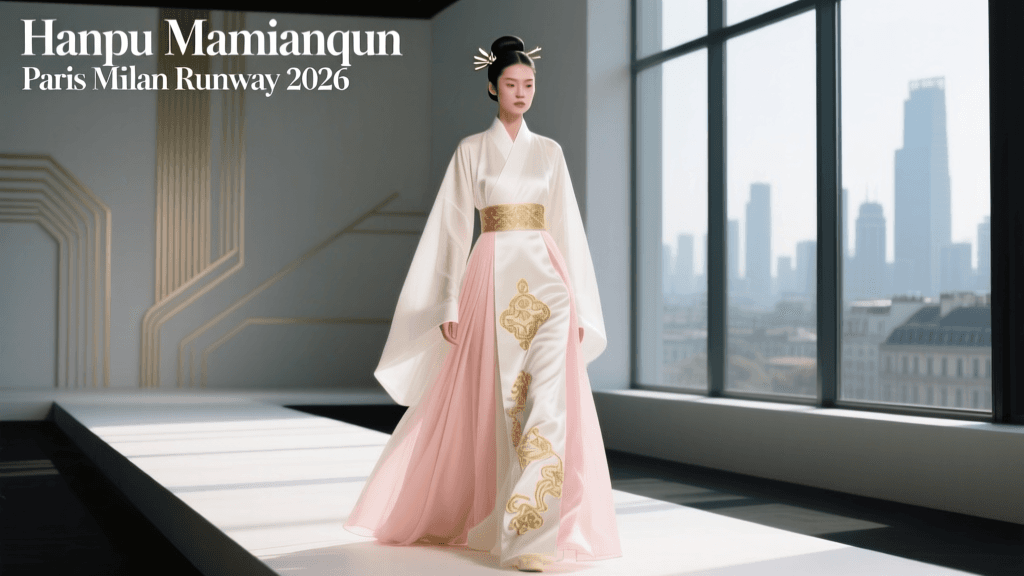
Undoubtedly the star of the 2026 runway season, the Mamianqun has captivated international audiences with its unique structural geometry. Traditionally characterized by two flat front and back panels (the 'horse faces') and heavily pleated sides, the skirt was a staple of Ming Dynasty women's fashion. On the Paris runways this year, designers experimented with the skirt's volume and fabric weight. While traditional Mamianqun rely on heavy brocades to hold the pleats, 2026 adaptations feature ultra-lightweight mulberry silk organzas and sustainable cupro blends, allowing the pleats to billow dramatically with the model's stride.
Furthermore, the iconic 'horse face' panels have been updated with asymmetric hemlines and subtle laser-cut perforations, creating a interplay of light and shadow that feels distinctly futuristic. The waistbands, traditionally tied with simple silk ribbons, have been reimagined with structured, corseted detailing and hidden magnetic closures, marrying historical aesthetics with 2026's demand for functional luxury.
The Song Dynasty Beizi as the Ultimate Outerwear
The Beizi, a straight-collared, side-slit jacket popular during the Song Dynasty, has emerged as the definitive layering piece for the Fall/Winter 2026 season. Its minimalist, elongated silhouette provides a stark, elegant contrast to the voluminous skirts and wide-legged trousers seen in Milan. This year, designers presented the Beizi in rich, textured wools and vegan leathers, transforming it from a delicate historical garment into a powerful, structured overcoat. The signature side slits, which historically allowed for ease of movement and horseback riding, are being utilized in 2026 to showcase layered undergarments and bold, contrasting silk linings.
Heritage Techniques: Nanjing Yunjin on the Catwalk
A major talking point of the 2026 international fashion weeks was the integration of Nanjing Yunjin, or 'Cloud Brocade.' Recognized for its incredible complexity, this ancient weaving technique requires a massive wooden loom operated by two artisans to produce just a few centimeters of fabric per day. As documented by the UNESCO Intangible Cultural Heritage registry, Yunjin is famous for its use of gold and silver threads, as well as peacock feather yarns, creating a shimmering, three-dimensional effect that modern Jacquard looms simply cannot replicate.
Rather than using this heavy, expensive brocade for entire garments—which can weigh upwards of ten kilograms and restrict movement—2026 designers have adopted a strategic approach. Yunjin is now being utilized as dramatic appliqué, structural bodice paneling, and oversized cuff detailing on otherwise lightweight silk garments. This not only preserves the integrity and heritage of the craft but also makes the garments viable for modern red-carpet and high-fashion street-style environments.
Traditional vs. 2026 Runway Adaptations
To understand the evolution of these garments, it is essential to compare their historical specifications with their modern runway interpretations. The following table outlines the key differences observed during the 2026 fashion month.
| Garment Element | Traditional Specification | 2026 Runway Adaptation | Styling Note |
|---|---|---|---|
| Mamianqun Pleats | Knife pleats, tightly pressed, heavy brocade | Soft, unpressed box pleats in sheer organza | Use a silk slip to maintain modesty with sheer 2026 fabrics. |
| Beizi Collar | Straight, parallel collar reaching the hem | Exaggerated, stiffened lapels with metallic piping | Keep under-layers minimal to let the structured collar stand out. |
| Closures | Fabric knot buttons (Pankou) and ties | Hidden magnetic snaps and oversized decorative Pankou | Magnetic closures offer security in high-wind urban environments. |
| Color Palette | Natural plant dyes (indigo, madder, saffron) | Bio-luminescent threads and digital-print gradients | Pair gradient pieces with solid, neutral modern basics. |
How to Incorporate Runway Hanfu into Your 2026 Wardrobe
Translating high-fashion runway concepts into everyday wear requires an understanding of proportion, fabric behavior, and modern styling. The 2026 trend is all about 'Heritage Streetwear'—mixing traditional Hanfu pieces with contemporary staples. Here is actionable advice on how to style and measure for these garments this year.
Mastering the Mamianqun Fit
The most common mistake when purchasing a Mamianqun is incorrect sizing, which can cause the front panels to overlap improperly or the pleats to pull open awkwardly. Unlike Western skirts that sit on the hips, a traditional Mamianqun sits at the natural waist.
- Waist Measurement: Measure the narrowest part of your torso. The skirt's waistband should be exactly this measurement plus 2 cm for overlap and comfort.
- Skirt Length: For a modern, runway-inspired look in 2026, the skirt should hit mid-calf. If you are 160-165 cm tall, opt for a 95 cm length. If you are 166-175 cm tall, a 105 cm length is ideal. For heights above 175 cm, seek out custom 115 cm lengths to avoid the skirt looking like a midi.
- The 'Horse Face' Width: Ensure the flat front panel is at least 25 cm wide. If it is too narrow, the intricate embroidery or woven patterns will be lost in the folds of the pleats.
Footwear and Layering
On the Milan runways, models paired heavy silk Mamianqun with chunky, lug-sole leather loafers and structured combat boots. This grounds the ethereal quality of the silk and makes the garment practical for navigating city streets. For the Song Dynasty Beizi, layer it over a simple, high-neck ribbed knit turtleneck and tailored wide-leg trousers. The Victoria and Albert Museum's Asian collections frequently highlight how historical garments were layered for both climate adaptation and social signaling; in 2026, layering a sheer, embroidered Beizi over a stark, monochromatic modern outfit achieves a similar striking visual contrast.
Sourcing Authentic and Runway-Inspired Hanfu in 2026
As demand surges following the 2026 fashion weeks, the market has segmented into distinct tiers, catering to both casual enthusiasts and serious collectors. Understanding these tiers is crucial for making informed purchasing decisions.
1. Entry-Level & Fast Fashion ($80 - $200)
Mass-produced Mamianqun made from polyester blends and machine-embroidered cotton. While these lack the drape and breathability of silk, they are excellent for experimenting with the silhouette. Look for brands that utilize heat-set pleating, ensuring the folds survive machine washing.
2. Mid-Tier Artisan Studios ($300 - $800)
This is the sweet spot for 2026. These studios use 100% mulberry silk, real metal-wrapped threads for subtle brocade effects, and traditional hand-stitched hems. Many of these studios have begun offering 'runway adaptations,' featuring the modernized magnetic closures and lighter-weight organza pleats seen in Paris.
3. Haute Couture & Heritage Collaborations ($2,000 - $15,000+)
For the collector, garments featuring genuine Nanjing Yunjin brocade or hand-loomed Song brocade (Song Jin) are the pinnacle of luxury. These pieces are often made-to-measure and require a lead time of three to six months due to the painstaking weaving process. They are considered investment pieces and wearable art, frequently archived by fashion institutions.
The Future of Asian Traditions in Global Fashion
The 2026 runway season has definitively proven that Hanfu is not a passing trend, but a permanent, evolving pillar of the global fashion lexicon. By respecting the architectural genius of traditional patterns while embracing modern textile innovations and styling sensibilities, designers have ensured that these garments remain relevant and vibrant. Whether you are investing in a heritage-woven Mamianqun or styling a modern Beizi over your favorite denim, participating in this movement is a celebration of centuries of artistry, redefined for the contemporary world.