Chinese Fashion History Academic Research & Digital Archives 2026
The Renaissance of Chinese Fashion History Education
The year 2026 marks a pivotal moment in Chinese fashion history education and academic research. Driven by the global explosion of the Xin Zhongshi (new Chinese style) movement and a renewed domestic interest in traditional Hanfu, universities and research institutions have transitioned from purely textual analysis to highly technical, interdisciplinary methodologies. Today, the study of ancient Chinese garments is no longer confined to art history departments; it sits at the intersection of textile engineering, digital archaeology, and 3D physics simulation. For scholars, educators, and serious enthusiasts, understanding the rigorous academic frameworks now applied to traditional Asian garments is essential for separating historical fact from modern cinematic fiction.
As of the 2026 academic year, leading institutions have completely overhauled their curricula to integrate digital preservation and material science. Researchers are now utilizing advanced spectrometry to analyze Silk Road textile fragments and employing cutting-edge 3D fabric drape analysis to reconstruct the precise movement of Tang dynasty Banbi (half-sleeve jackets) and Song dynasty Beizi (outer coats). This comprehensive guide explores the current state of Chinese fashion history research, the most valuable digital archives available to scholars, and the academic pathways for aspiring fashion historians.
Pioneering Digital Archives for Textile Researchers
Access to primary sources has historically been the greatest bottleneck in Asian fashion history research. Fragile silk artifacts degrade rapidly when exposed to light, making physical access highly restricted. However, the digitization initiatives completed by major Chinese museums over the last few years have democratized access to high-resolution textile data. These digital vaults are indispensable for academic researchers conducting pattern analysis, weave structure identification, and colorway reconstruction.
| Archive Name | Host Institution | Primary Era Focus | 3D Asset Availability | Access Level |
|---|---|---|---|---|
| China Silk Museum Digital Vault | China Silk Museum (Hangzhou) | Tang & Song Dynasties | High-Res Weave Scans & Loom Setups | Open Access / Academic API |
| Palace Museum Textile Database | The Palace Museum (Beijing) | Ming & Qing Dynasties | Full Garment 3D Models & Embroidery Maps | Institutional License |
| Dunhuang Academy Silk Road Archive | Dunhuang Academy | Han to Tang Eras | Pattern Vectors & Mural Textile Overlays | Researcher Portal |
| BIFT Archaeological Textile Lab | Beijing Institute of Fashion Technology | Pre-Han & Warring States | Microscopic Fiber Analysis Datasets | University Consortium |
When utilizing these archives, researchers frequently cross-reference physical artifacts with historical paintings and funerary figurines. For instance, The Palace Museum provides exhaustive digital catalogs of Qing dynasty imperial robes, allowing scholars to zoom in on the microscopic gold-couching techniques used in dragon robes (longpao). Meanwhile, researchers focusing on earlier periods rely heavily on the Dunhuang Academy's digital mapping of mural paintings, which provides crucial data on how garments were layered and tied during the cosmopolitan Tang era.
3D Fabric Drape Analysis and Virtual Reconstruction
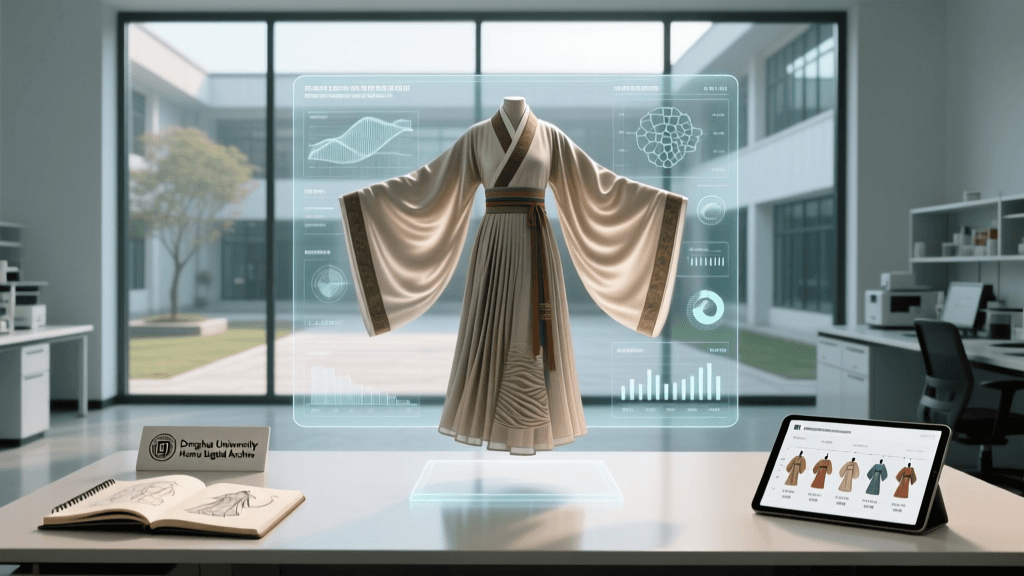
One of the most significant academic breakthroughs in 2026 is the widespread adoption of 3D fabric drape analysis in historical garment reconstruction. Traditional flat-pattern drafting often fails to capture the volumetric reality of ancient Chinese clothing, which relied heavily on the natural drape of the fabric rather than complex tailoring darts and seams. By utilizing advanced physics engines like CLO3D and Marvelous Designer, academic researchers can now simulate the exact behavior of historical textiles.
Simulating Historical Weave Structures
The accuracy of a 3D historical reconstruction depends entirely on the material parameters inputted into the software. Researchers at Donghua University's College of Fashion and Design have spent the last few years building a comprehensive digital material library of ancient Chinese weaves. This includes the precise gram-per-square-meter (GSM) weight, warp and weft tension, and bending stiffness of fabrics like Xiangyunsha (gambiered Canton gauze), Kexi (silk tapestry), and Zhijin (brocade).
- Song Dynasty Luo (Gauze): Characterized by its twisted warp threads creating a breathable, open mesh. In 3D simulations, researchers must adjust the shear and stretch resistance to mimic the fluid, watery drape unique to this summer fabric.
- Tang Dynasty Jin (Brocade): A heavy, weft-faced compound twill. Simulating this requires high stiffness and low stretch parameters to accurately reproduce the structured, sculptural folds seen in Tang dynasty court attire.
- Ming Dynasty Zhuanghua (Makeup Brocade): Features discontinuous supplementary wefts. Researchers use digital embossing maps to simulate the slight raised texture of the motifs, which affects how light interacts with the garment in virtual rendering.
This rigorous approach to digital drape analysis has been instrumental in debunking several modern Hanfu myths. For example, 3D simulations have proven that certain heavily layered ceremonial robes depicted in modern media would have been physically impossible to walk in if made from the heavy brocades claimed, leading scholars to conclude that lighter, plain-weave silks were used for the inner layers to maintain mobility.
Integrating Archaeological Textile Science
Academic research in Chinese fashion history is deeply intertwined with archaeological science. The excavation of tombs along the Silk Road and in the Yangtze River basin has yielded remarkably preserved textiles that require advanced conservation and analysis. According to recent methodologies published in the Textile History journal, modern researchers employ non-destructive techniques such as Raman spectroscopy and high-performance liquid chromatography (HPLC) to identify ancient dyes without damaging the fragile silk fibers.
These scientific analyses have revolutionized our understanding of ancient color palettes. While centuries of oxidation and burial have left many excavated garments looking dull and brownish, chemical analysis reveals that ancient Chinese dyers achieved incredibly vibrant hues using plant-based dyes like madder root (for reds), indigo (for blues), and pagoda tree buds (for yellows). Furthermore, the analysis of metallic threads in Ming and Qing textiles has uncovered complex alloys and spinning techniques that modern artisans are only just beginning to replicate.
The study of Silk Road exchanges also heavily relies on isotopic analysis of textile fibers to determine their geographic origins. By analyzing the strontium isotopes in silk and wool fragments found in Xinjiang, researchers can trace the exact trade routes and pastoral movements of ancient merchants, providing a data-driven map of early Eurasian fashion exchange.
Leading Academic Institutions and 2026 Fellowships
For students and professionals looking to specialize in this field, several institutions stand out in 2026 for their rigorous approach to Chinese fashion history and textile conservation.
Donghua University (Shanghai)
Donghua University remains the premier institution for textile and fashion research in China. Their MA and PhD programs in Fashion History and Theory are renowned for combining deep archival research with practical loom weaving and 3D digital reconstruction. The university's historical textile museum houses thousands of fragments, providing students with unparalleled hands-on access to primary sources.
Beijing Institute of Fashion Technology (BIFT)
BIFT excels in the intersection of traditional craftsmanship and modern design. Their research labs focus heavily on the intangible cultural heritage of Chinese embroidery and weaving techniques. BIFT frequently collaborates with The Metropolitan Museum of Art's Asian Art Department on international conservation projects and cross-cultural exhibition research, making it an excellent hub for global academic networking.
Tsinghua University Academy of Arts & Design
Tsinghua's approach is highly theoretical and aesthetic, focusing on the philosophy of Chinese dress, the semiotics of color and motif, and the sociological impact of the Xin Zhongshi movement. Their fellowships often attract international scholars looking to explore the cultural implications of traditional dress in contemporary society.
A Roadmap for Aspiring Fashion Historians
Entering the academic field of Chinese fashion history requires a unique blend of humanities knowledge and technical skills. If you are aiming to conduct serious research or enroll in a graduate program in 2026, follow this actionable roadmap:
- Master Classical Chinese (Wenyanwen): Primary sources, including sumptuary laws, court records, and historical encyclopedias like the Tiangong Kaiwu (The Exploitation of the Works of Nature), are written in Classical Chinese. Relying solely on modern translations will severely limit your research depth.
- Learn Digital Reconstruction Software: Proficiency in CLO3D or Marvelous Designer is now expected in top-tier academic programs. Build a portfolio demonstrating your ability to translate 2D historical patterns into accurate 3D simulations using correct material physics.
- Study Textile Conservation Basics: Familiarize yourself with the chemical properties of protein fibers (silk) and cellulose fibers (ramie, hemp, cotton). Understanding how these fibers degrade is crucial when analyzing archaeological reports and museum condition assessments.
- Engage with the Academic Community: Attend international symposiums on Asian textiles, such as those hosted by the Textile Society of America or the European Association for Southeast Asian Archaeologists. Networking with curators and conservationists is often the key to gaining access to restricted archival materials.
The academic study of Chinese fashion history has never been more dynamic or technologically advanced. By embracing digital archives, 3D physics simulations, and rigorous material science, the researchers of 2026 are ensuring that the profound legacy of Asian sartorial traditions is preserved, understood, and respected for generations to come.