Hanfu for Extreme Climates 2026: Desert, Cold & Tropics
The Global Rise of Hanfu in Extreme Environments
As the global Hanfu movement continues to expand in 2026, enthusiasts are no longer confined to temperate spring days or climate-controlled indoor photoshoots. From the sweltering humidity of Southeast Asian metropolises to the arid expanses of the Gobi Desert and the biting sub-zero winters of Harbin, traditional Chinese clothing is being rigorously tested against extreme climates. The modern Hanfu community has masterfully bridged the gap between historical authenticity and survival in harsh environments, utilizing both ancient layering techniques and cutting-edge 2026 textile innovations.
Historically, Chinese garments were designed with specific regional climates in mind. As noted by the Victoria and Albert Museum's extensive Asian textile archives, the diversity of Chinese dress was heavily influenced by the vast geographical and climatic variations of the region. Today, adapting these historical silhouettes for modern extreme weather requires a deep understanding of fabric science, historical cuts, and strategic layering. This comprehensive guide explores how to comfortably and authentically wear Hanfu in tropical, desert, and freezing climates in 2026.
The Tropical Challenge: Humidity and Breathability
Tropical climates present a dual challenge for traditional dress: oppressive heat and suffocating humidity. Heavy silks and synthetic brocades quickly become unwearable, trapping sweat and causing discomfort. In 2026, the focus for tropical Hanfu is on maximizing airflow and utilizing naturally antimicrobial, moisture-wicking fibers.
Garment Selection: Banbi and Qixiong Ruqun
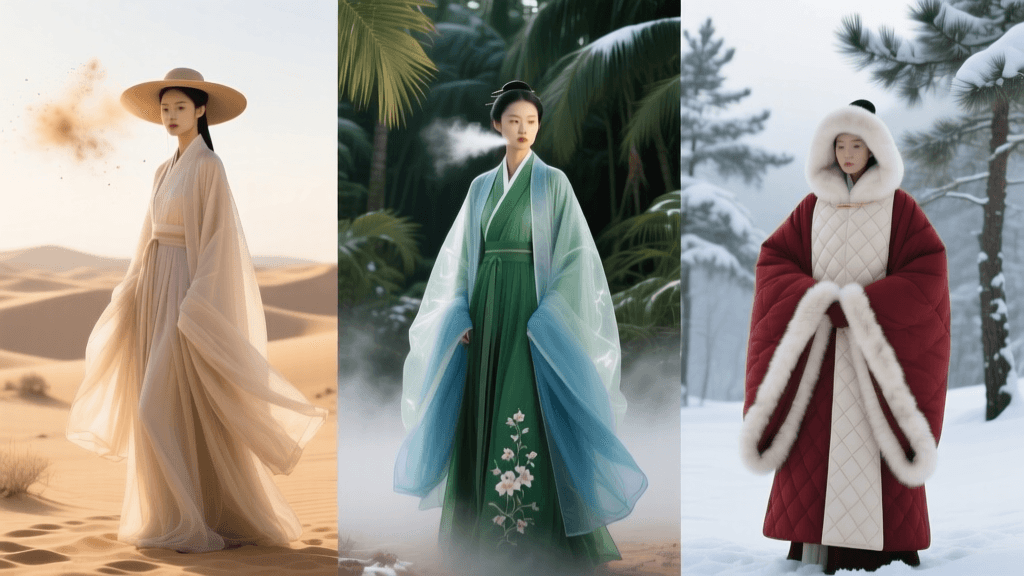
For tropical wear, the Banbi (half-sleeve jacket) paired with a lightweight Qixiong Ruqun (chest-high pleated skirt) is the optimal choice. The Banbi provides modesty and UV protection for the shoulders while allowing maximum ventilation to the underarms. The chest-high skirt, when made from ultra-lightweight materials, creates a chimney effect, allowing air to circulate freely up the body and escape through the wide neckline.
Fabric Innovations: Xiangyunsha and Bamboo-Silk Blends
The undisputed champion of tropical Hanfu is Xiangyunsha (gambiered Guangdong silk). This intangible cultural heritage fabric is dyed with yam juice and coated with river mud, resulting in a textile that is naturally cool to the touch, quick-drying, and highly resistant to mold and bacteria. In 2026, textile manufacturers have introduced Tencel-Xiangyunsha blends, which maintain the historical aesthetic and antimicrobial properties of the original silk but offer superior drape and sweat-wicking capabilities for high-humidity environments.
- Pro Tip: Avoid synthetic linings in tropical Hanfu. Ensure your Ru (top) is unlined or lined with 100% organic ramie mesh to prevent sweat accumulation.
- Color Palette: Opt for historically accurate light-reflecting colors like celadon, pale lotus pink, and unbleached ivory to minimize heat absorption.
Desert Heat: UV Protection and Moisture Management
Desert environments demand rigorous protection from intense UV radiation, extreme diurnal temperature shifts, and blowing sand. Unlike tropical climates where exposing skin aids cooling, desert survival requires covering the skin to prevent rapid moisture loss and sunburn.
Garment Selection: Daxiushan and Weimao
The Tang dynasty Daxiushan (large-sleeved robe) is experiencing a massive revival among desert travelers in 2026. The exceptionally wide sleeves—often measuring 60 to 80 centimeters in circumference—create a shaded microclimate around the arms, promoting evaporative cooling without exposing the skin to direct sunlight. To protect the face and neck from harsh desert winds and UV rays, the Weimao (a wide-brimmed hat with a trailing veil) has been reintroduced. Historically used by Tang dynasty noblewomen on horseback, the modern 2026 iteration features UPF 50+ nano-mesh veiling that blocks harmful rays while maintaining clear visibility.
Fabric Innovations: Washed Ramie and UV-Blocking Linens
According to the Metropolitan Museum of Art's historical overview of Chinese silk, ancient travelers often relied on specific weaves to endure long journeys. Today, heavily washed ramie and high-density linen are preferred for desert Hanfu. Ramie fibers are naturally hollow, providing excellent insulation against external heat while wicking moisture away from the body. Modern 2026 desert-specific Hanfu lines treat these natural fibers with eco-friendly, plant-based UV inhibitors, boosting their sun-protection factor without compromising the fabric's historical drape or breathability.
"The genius of the Daxiushan in arid climates lies in its volumetric design. The trapped air within the wide sleeves acts as a thermal buffer against the scorching desert sun, a principle of passive cooling that modern outdoor apparel is only just beginning to replicate."
Freezing Cold: Historical Layering Meets 2026 Smart Textiles
Surviving sub-zero temperatures in Hanfu requires mastering the art of historical layering, augmented by 2026's smart textile innovations. The goal is to trap body heat while maintaining the elegant, flowing silhouettes characteristic of traditional Chinese dress.
Garment Selection: Aoqun, Mamianqun, and Doupeng
The Ming dynasty Aoqun (lined jacket and skirt) system is the ultimate cold-weather solution. The Ao (jacket) features a stand-up collar and tight-fitting sleeve cuffs that seal in warmth, while the Mamianqun (horse-face skirt) is uniquely suited for winter. The flat front and back panels of the Mamianqun, combined with deep side pleats, allow wearers to layer thick, aerogel-insulated thermal leggings underneath without disrupting the skirt's structural drape. For outerwear, the Doupeng (a sleeveless, hooded cloak) provides full-body wind protection and can be draped elegantly over multiple inner layers.
Fabric Innovations: Graphene-Heated Bijia and Thermal Silk
The most significant breakthrough for winter Hanfu in 2026 is the integration of graphene heating technology into the Bijia (a traditional sleeveless vest). As researched by institutions like NC State University's Wilson College of Textiles, graphene provides rapid, even heat distribution with minimal bulk. Modern Bijia vests feature ultra-thin graphene pads in the core zones (lower back and abdomen), powered by discreet, pocket-sized portable power banks. This allows wearers to maintain a core body temperature of 37°C (98.6°F) even in -15°C (5°F) weather, all while wearing historically accurate silk damask outer layers.
- Layering Strategy: Base layer (merino wool thermal) -> Mid layer (fleece-lined Zhongyi inner garment) -> Insulating layer (graphene Bijia) -> Outer layer (silk brocade Ao and Mamianqun).
- Accessories: Utilize a Zhaojun (traditional fur-lined hood) or a modern shearling-lined Wotu (leather hat) to prevent critical heat loss from the head.
2026 Climate-Specific Hanfu Wardrobe Matrix
To help you build a versatile and climate-resilient Hanfu wardrobe, refer to the matrix below detailing the optimal garment, fabric, and accessory combinations for various extreme environments.
| Climate Zone | Primary Garment | Recommended 2026 Fabric | Key Accessory |
|---|---|---|---|
| Tropical (High Humidity) | Banbi & Qixiong Ruqun | Tencel-Xiangyunsha Blend | Woven Rattan Hand Fan |
| Arid Desert (High UV/Heat) | Daxiushan & Shenyi | UV-Treated Washed Ramie | Weimao (UPF 50+ Veil Hat) |
| Sub-Zero Cold (Freezing) | Aoqun & Doupeng | Graphene-Lined Silk Brocade | Shearling-Lined Zhaojun Hood |
| Coastal Wind (High Gusts) | Yuanlingpao (Round Collar) | Heavyweight Washed Linen | Weighted Jade Belt Pendants |
Sourcing and Care for Extreme Weather Hanfu
Investing in climate-specific Hanfu requires proper maintenance to ensure longevity, especially when dealing with advanced 2026 textiles. Xiangyunsha should never be machine washed; it requires gentle hand-washing in cool water with a pH-neutral silk detergent and must be dried in the shade to preserve its mud-dyed patina. Graphene-heated Bijia vests must have their electronic components removed before dry cleaning, though most 2026 models feature washable, waterproof graphene pads that can withstand gentle machine cycles on cold settings.
When sourcing extreme-climate Hanfu, prioritize makers who specialize in functional historical dress. Many boutique studios in Hangzhou and Guangzhou now offer 'expedition-grade' Hanfu lines, featuring reinforced stitching, hidden moisture-wicking panels, and sustainable, cruelty-free winter insulation. By respecting the historical engineering of these garments and embracing modern material science, enthusiasts can confidently wear Hanfu anywhere on the globe, proving that traditional Asian fashion is as resilient as it is beautiful.