Hanfu for Ji Li and Guan Li Milestones: 2026 Guide
The Resurgence of Traditional Coming-of-Age Rites in 2026
In 2026, the revival of traditional Chinese clothing has evolved far beyond casual streetwear and festival fashion. A profound cultural shift has brought the ancient coming-of-age ceremonies—the Ji Li (笄礼, hairpin ceremony for young women) and the Guan Li (冠礼, capping ceremony for young men)—back into the mainstream. Rooted in the Zhu Zi Jia Li (Zhu Xi's Family Rituals), these milestones mark the transition from childhood innocence to adult responsibility. According to cultural anthropologists, the modern iteration of these rites emphasizes strict historical accuracy in garment layering, fabric weight, and ritual symbolism, distinguishing ceremonial Hanfu from everyday Xin Zhongshi (New Chinese Style) fashion.
For families and cultural organizations planning these profound milestones, understanding the precise sartorial requirements is essential. This guide details the authentic garment progressions, 2026 textile standards, and ceremonial protocols required to execute a flawless Ji Li or Guan Li.
The San Jia (Three Additions) Protocol
The core of both the Ji Li and Guan Li is the San Jia, or 'Three Additions.' The celebrant changes garments three times during the ceremony, with each layer representing a deeper level of societal responsibility, maturity, and virtue.
The Ji Li (Hairpin Ceremony) Garment Progression
Traditionally held for women at the age of 15 (or upon engagement in ancient times, but standardized to ages 18-20 in modern 2026 practice), the Ji Li requires three distinct silhouettes:
- First Addition (Chu Jia): The celebrant wears a simple, brightly colored Ruqun (blouse and skirt) or Caiyi. The hair is styled in a simple youthful bun. This symbolizes the innocence, playfulness, and sheltered nature of childhood.
- Second Addition (Er Jia): The celebrant changes into a more structured Qunshan or a refined Beizi (long outer coat) over a pleated skirt. The hair is partially pinned. This represents the blooming of youth, the cultivation of inner elegance, and the beginning of moral education.
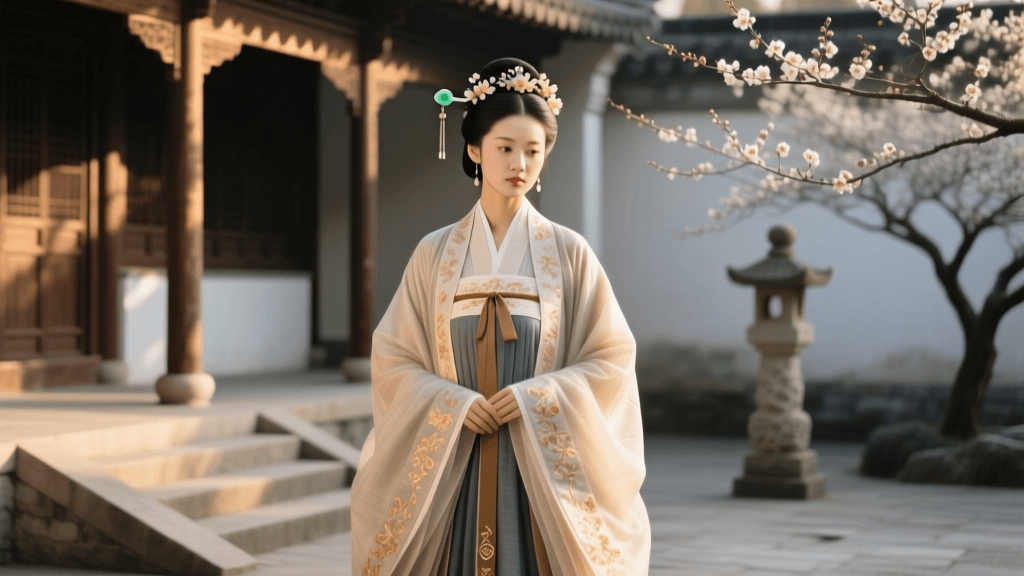
- Third Addition (San Jia): The final and most formal change involves the Da Xiu Shan (large-sleeved gown) or a formal court-style dress with intricate embroidery. The hair is fully styled into a mature updo and secured with the ceremonial Ji (hairpin). This symbolizes the assumption of full adult responsibilities, including the right to participate in ancestral worship and community governance.
The Guan Li (Capping Ceremony) Garment Progression
Held for men at the age of 20, the Guan Li is a solemn affirmation of filial piety, loyalty, and civic duty.
- First Addition: The young man dons a Shenyi (deep robe, linking the upper and lower garments to symbolize the unity of heaven and earth) paired with a simple Yinyang cap. This represents the foundation of learning and respect for elders.
- Second Addition: He changes into darker, more structured garments, often a Lanshan or formal round-collar robe, accompanied by a Pibian (leather or stiffened silk cap). This signifies the duty to serve the community, pursue a career, and protect the state.
- Third Addition: The final capping features the Juebian (formal ceremonial cap) worn with the Xuan Duan (the highest formal sacrificial dress, characterized by its straight, square-cut sleeves and dark colors). This represents the ultimate responsibility to honor ancestors and uphold societal laws.
2026 Fabric Standards and Sourcing
The 2026 Hanfu market has largely abandoned the cheap, synthetic blends that plagued the early years of the revival. For life milestone ceremonies, authenticity and drape are paramount. Ceremonial garments must possess the correct structural weight to ensure the sleeves and hems fall precisely as dictated by historical texts. As noted by The Metropolitan Museum of Art's archives on historical Chinese dress, the silhouette of formal Hanfu relies entirely on the interplay between the fabric's natural stiffness and its fluid movement.
Below is a comparison of the premier heritage textiles used for ceremonial Hanfu in 2026, including estimated costs for bespoke tailoring.
| Textile | Origin / Heritage Style | Best Season | 2026 Custom Tailoring Cost (RMB) | Drape & Structure |
|---|---|---|---|---|
| Xiangyunsha | Guangdong (Gambiered Canton Gauze) | Summer | 3,500 - 6,000 | Crisp, cooling, structured, water-resistant |
| Song Brocade | Jiangsu / Zhejiang | Autumn / Winter | 4,000 - 8,000 | Heavy, ornate, highly formal, holds shape |
| Zhangzhou Velvet | Fujian | Winter | 2,800 - 5,000 | Plush, warm, dignified, absorbs light |
| Luo Gauze | Zhejiang | Spring / Summer | 2,000 - 4,500 | Sheer, breathable, ideal for layering |
Essential Accessories and Ritual Props
A ceremonial Hanfu ensemble is incomplete without its accompanying ritual props. In 2026, sourcing authentic accessories has become easier thanks to specialized heritage artisans.
- The Hairpin (Ji) and Caps (Guan): For the Ji Li, the third addition requires a hairpin carved from Hetian jade, sandalwood, or gold filigree. For the Guan Li, caps must be constructed with rigid inner frames (often bamboo or stiffened hemp) covered in black silk or leather to maintain their architectural shape throughout the multi-hour ceremony.
- Jade Pendants (Yu Pei): Suspended from the waist belt, these intricate jade assemblies are not merely decorative. According to Encyclopædia Britannica's overview of traditional Chinese dress codes, jade pendants were historically used to regulate the wearer's gait. The rhythmic clinking of the jade pieces ensures the celebrant walks with the slow, deliberate, and measured steps required of a dignified adult.
- Footwear: Men wear black silk boots with thick white layered-cotton soles (Xuezi), while women wear embroidered Yunjian (cloud shoes) or formal silk slippers with upturned toes, ensuring the hem of the gown glides smoothly without catching.
Step-by-Step Ceremony Flow
Executing the rite requires meticulous timing and a dedicated team, including a 'Guest of Honor' (usually a respected elder or scholar), a 'Zan Li' (assistant/usher), and musicians playing traditional Guqin or Se instruments.
- Welcoming the Guest of Honor (Zheng Bin): The host family formally greets the elder at the venue entrance, offering tea and escorting them to the main altar.
- The Washing Ritual (Guan Xi): The celebrant washes their hands in a bronze basin, symbolizing the purification of the mind and body before taking on adult burdens.
- The First Addition (Chu Jia): The celebrant enters in childhood attire, kneels before the Guest of Honor, and receives the first blessing and garment change.
- The Second Addition (Er Jia): The process repeats with the youth garments and the second capping/pinning.
- The Third Addition (San Jia): The final, most formal garments are donned. The Guest of Honor places the final cap or hairpin.
- The Sweet Wine Offering (Li Li): The celebrant is offered a cup of sweet rice wine, symbolizing the bitterness and sweetness of adult life.
- The Reading of the Blessing (Zi Ci): The Guest of Honor bestows a 'Courtesy Name' (Zi) upon the celebrant, alongside a scroll containing moral instructions and familial expectations.
- Bowing to Parents and Ancestors: The newly minted adult performs three deep, formal bows (Kotow) to their parents, the Guest of Honor, and the ancestral tablets, concluding the rite.
Modern Venue Adaptations and Xin Zhongshi Influences
While the outer layers of the Ji Li and Guan Li remain strictly bound by historical precedent, the 2026 Xin Zhongshi (New Chinese Style) movement has introduced vital ergonomic innovations to the inner layers. Modern ceremonies often take place in botanical gardens, cultural heritage centers, or luxury banquet halls. To prevent the celebrant from overheating or tripping during the three-hour ritual, contemporary tailors utilize moisture-wicking silk-cupro blends for the Zhongyi (innermost garments).
Furthermore, while the Da Xiu Shan sleeves historically measured up to 180 centimeters in wingspan, 2026 ceremonial tailors often incorporate discreet, internal silk loops (known as Shouju) that allow the celebrant to elegantly secure the excess fabric during the wine offering and bowing segments. This ensures the profound gravitas of the ancient rite is preserved without compromising the safety and comfort of the young adult stepping into their future.