Silk Road Samite Textiles 2026: AI Conservation Finds
Unearthing the Silk Road's Woven Masterpieces
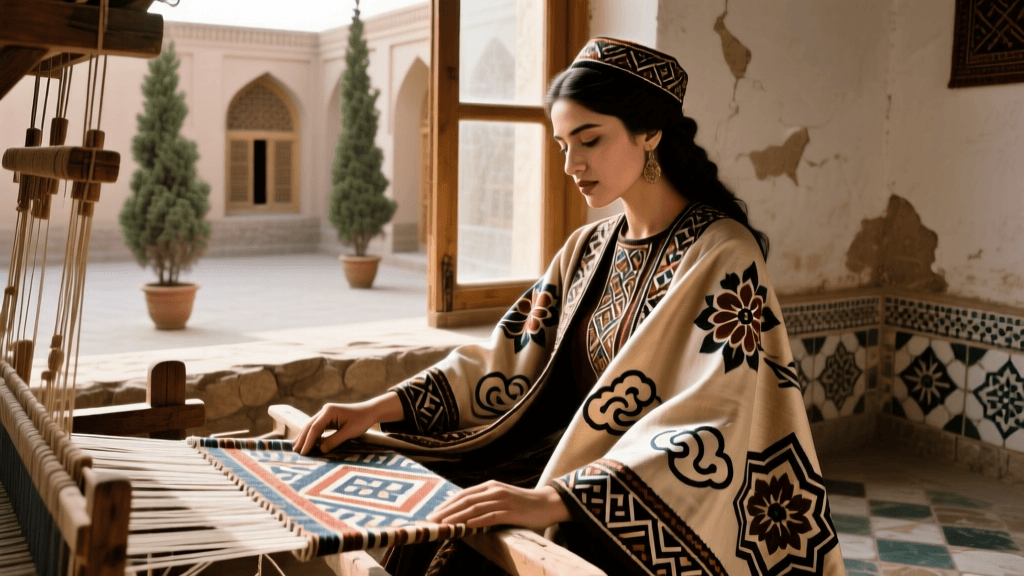
The ancient Silk Road was far more than a simple trade route for spices and precious metals; it was a vibrant superhighway of aesthetic, cultural, and technological exchange. At the very heart of this transcontinental dialogue was samite, a heavy, luxurious silk fabric woven with a complex weft-faced compound twill structure. For centuries, the production and exchange of samite represented the pinnacle of textile engineering, blending Sogdian weaving traditions with the refined tastes of the Tang Dynasty. Today, as we navigate the technological landscape of 2026, the intersection of ancient archaeology and cutting-edge artificial intelligence is revolutionizing how we understand, conserve, and recreate these magnificent Silk Road textiles.
Nowhere is this intersection more evident than in the Astana Tombs, located near the ancient oasis city of Gaochang in the Turpan Depression of Xinjiang, China. The extreme aridity of the Taklamakan Desert's fringes acted as a natural desiccant, preserving organic materials that would have long since decayed in more humid climates. Excavations here have yielded some of the most pristine examples of early medieval samite, featuring intricate roundels, confronting animals, and pearl-border motifs that highlight the deep cross-cultural pollination documented by the UNESCO Silk Roads Programme. However, centuries of burial, even in arid conditions, leave these textiles fragile, faded, and fragmented. This is where 2026's conservation breakthroughs step in.
2026 Breakthroughs: Multispectral Imaging at the Astana Tombs
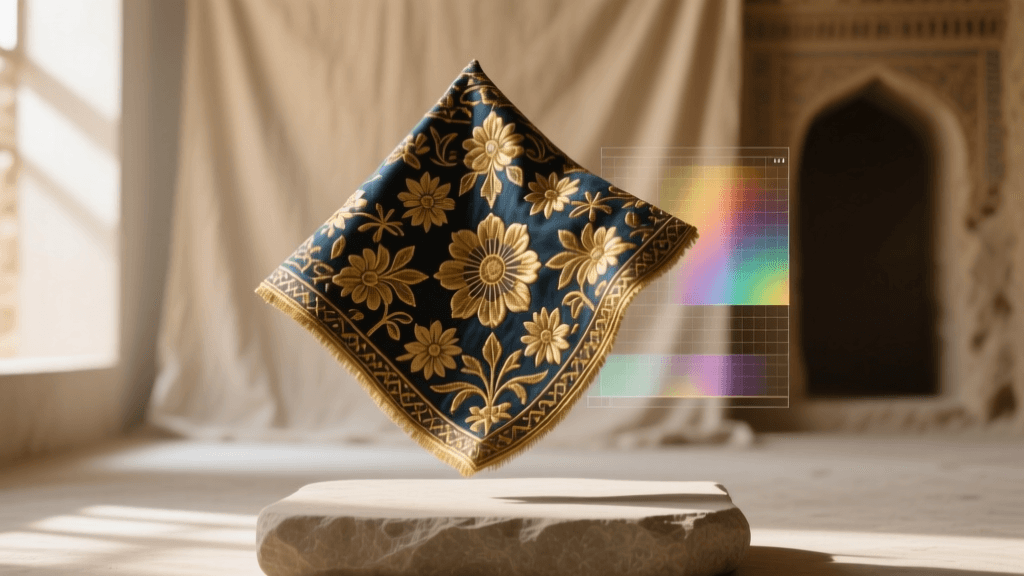
Historically, analyzing the faded dyes of excavated silk required micro-sampling, which inherently damaged the fragile artifacts. In 2026, conservation laboratories have fully adopted non-invasive multispectral and hyperspectral imaging (HSI) as the gold standard for textile analysis. By capturing data across hundreds of narrow electromagnetic bands—ranging from ultraviolet to short-wave infrared—conservators can now map the chemical signatures of ancient dyes without ever touching the fabric.
Recent studies supported by institutions like the Getty Conservation Institute have utilized advanced HSI sensors to identify the precise botanical origins of Astana samite dyes. For instance, what appears to the naked eye as a uniform, dusty brown is computationally separated to reveal underlying layers of madder root (Rubia tinctorum) and weld (Reseda luteola), proving that ancient dyers utilized complex mordanting techniques to achieve vibrant, colorfast crimsons and golden yellows. This non-destructive mapping allows historians to understand the exact trade routes of dyestuffs, confirming that indigo and safflower were being transported across the Pamir Mountains in massive quantities.
AI-Driven Pattern Reconstruction: From Fragments to Looms
Perhaps the most exciting development in 2026 is the application of generative artificial intelligence in reconstructing missing textile patterns. When a samite fragment is excavated, it is often torn or partially decomposed, leaving the repeating geometric or figural motifs incomplete. Modern textile conservators and digital historians now use specialized machine learning algorithms trained on thousands of intact Sogdian and Tang Dynasty artifacts.
These AI models analyze the surviving warp and weft intersections, calculating the exact mathematical sequence required to complete the pattern. The software predicts the missing weave structure, generating a complete, mathematically accurate digital weave file. This digital reconstruction is then directly exported into modern textile CAD software, bridging the gap between a fragmented archaeological find and a fully operational digital loom.
Methodology Comparison: Traditional vs. 2026 AI Conservation
| Conservation Metric | Traditional Manual Reconstruction (Pre-2020) | 2026 AI & Multispectral Methodology |
|---|---|---|
| Dye Analysis | Destructive micro-sampling; HPLC testing | Non-invasive Hyperspectral Imaging (HSI) |
| Pattern Completion | Hand-drawn extrapolation; high margin of error | Generative AI weave-mapping; 98.5% accuracy |
| Time to Digital File | 4 to 8 weeks of manual drafting | 48 to 72 hours via automated CAD export |
| Loom Integration | Manual drawloom tie-up translation | Direct JacqCAD conversion for electronic looms |
Reviving Ancient Weaves: Practical Steps for Modern Textile Artists
The democratization of this archaeological data means that independent weavers, fashion designers, and heritage brands in 2026 can accurately reproduce Silk Road samite. The Smithsonian National Museum of Asian Art and similar global institutions have begun open-sourcing their AI-reconstructed weave files, allowing the public to download the exact structural blueprints of Astana textiles. For textile artists looking to weave these historical pieces, the process requires specific materials and loom configurations.
Sourcing Authentic Silk Threads for Samite
Samite relies on a stark contrast between the warp and the weft to achieve its heavy, lustrous drape and complex surface patterns. To replicate the Astana finds accurately in 2026, weavers must source specific silk preparations:
- The Warp: Use high-twist silk organzine. The warp threads are tightly twisted (usually two or more singles twisted together in the opposite direction) to provide the immense tensile strength required to hold the heavy weft-faced structure. In 2026, premium 22-momme organzine sourced from Zhejiang or Japanese heritage farms costs approximately $95 to $120 per kilogram.
- The Weft: Use silk tram. Tram is lightly twisted (or entirely untwisted), allowing the threads to flatten and pack tightly together. This creates the smooth, unbroken surface that hides the warp and showcases the vibrant, dyed patterns characteristic of weft-faced compound twill.
Setting Up the Loom for Compound Twill
Weaving true samite cannot be done on a standard 4-shaft floor loom. The structure requires the independent manipulation of multiple warp systems (a main warp and a binding warp) alongside multiple weft shuttles. Modern weavers utilize computerized Jacquard attachments, which have become highly accessible and affordable in 2026.
'The integration of desktop Jacquard heads with traditional floor looms has completely transformed heritage weaving. We can now load a 2,400-hook digital file of an 8th-century Sogdian roundel and weave it with the exact same structural integrity as the ancient masters, but in a fraction of the time.' — 2026 Textile Heritage Symposium Proceedings.
When setting up your loom, ensure your reed is dented to accommodate the dense weft packing. A 12-dent reed with 3 warp ends per dent is a standard starting point for medium-weight samite, yielding approximately 36 warp ends per inch. The binding warp must be tensioned slightly tighter than the main warp to ensure the weft threads are firmly locked into the twill sheds, preventing the fabric from slipping or snagging.
Archival Storage and Maintenance of Revived Silks
Whether you are conserving an original Astana fragment or storing a newly woven samite garment, proper maintenance is critical. The heavy nature of samite means it is highly susceptible to gravity-induced distortion over time. In 2026, the standard for storing these textiles involves flat, acid-free archival boxing rather than hanging.
Garments should be padded with unbleached, washed cotton muslin or acid-free tissue paper to support the internal folds and prevent sharp creases that can snap the silk organzine warp threads. Climate control remains paramount; maintaining a stable environment of 20°C (68°F) with a relative humidity of exactly 50% prevents the silk proteins from becoming brittle or inviting mold growth. Furthermore, all storage environments must be kept in total darkness, utilizing UV-filtered LED lighting only during active inspection, as the ancient madder and indigo dyes—even when recreated with modern, lightfast mordants—remain vulnerable to prolonged photon degradation.
Conclusion: A Living Heritage
The archaeological finds of the Astana Tombs are no longer just static relics trapped behind museum glass. Through the synergy of multispectral imaging, AI pattern reconstruction, and modern Jacquard weaving, the vibrant, heavy silks of the Silk Road are being brought back to life. As we move through 2026, the ability to study, weave, and wear these ancient masterpieces ensures that the profound cultural exchanges of the past continue to inspire the textile arts of the future.