Hanfu Coming of Age Ceremonies 2026: Ji Li & Guan Li Guide
The Renaissance of Traditional Milestones in 2026
As we navigate through 2026, the global appreciation for Asian traditional garments has evolved from a niche hobby into a profound cultural renaissance. Among the most significant expressions of this movement is the revival of ancient life milestone rites—specifically the Ji Li (笄礼, Hairpin Ceremony) for young women and the Guan Li (冠礼, Capping Ceremony) for young men. Once considered relics of the imperial past, these coming-of-age ceremonies are now being embraced by families and cultural organizations worldwide as a meaningful way to mark the transition into adulthood.
At The Garment Atlas, we recognize that planning a historically grounded yet logistically feasible ceremony requires meticulous attention to textile drape, historical accuracy, and modern sourcing. This comprehensive 2026 guide provides actionable advice on garment selection, the ritualistic 'Three Additions,' and the precise execution of these monumental life milestones.
Understanding Ji Li and Guan Li
Rooted in Confucian philosophy, the coming-of-age rites signify a shift from the sheltered life of a child to the moral and societal responsibilities of an adult. According to historical texts curated by institutions like the National Museum of China, the Ji Li was traditionally performed for women around the age of 15 (or upon engagement), while the Guan Li was conducted for men at age 20. In 2026, modern practitioners often adapt these ages to align with high school or university graduations, typically between the ages of 18 and 22.
The core of both ceremonies revolves around the physical transformation of the initiate's appearance: hair is pinned up, and a series of increasingly formal garments are bestowed, symbolizing the layered acquisition of virtue, knowledge, and societal duty.
The Core Ritual: The Three Additions (San Jia)
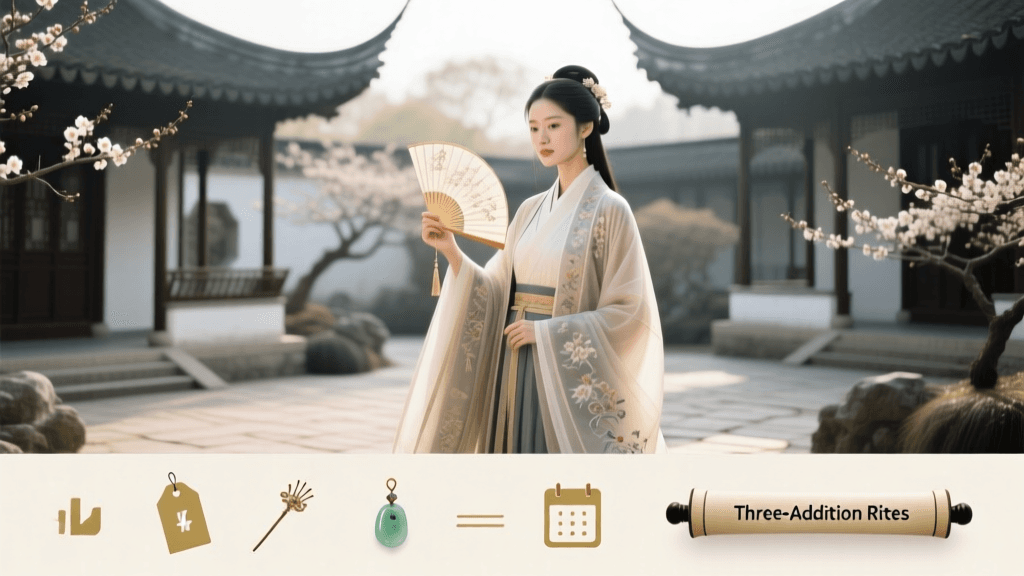
The most visually and symbolically striking element of the ceremony is the San Jia (Three Additions). The initiate changes garments three times, with each layer representing a deeper level of maturity. The Zhengbin (main officiant) presents the garments while reciting blessings. Below is a structured breakdown of the three additions, tailored for 2026 ceremonial planning.
| Addition Stage | Recommended Garment Type | Symbolic Meaning | 2026 Estimated Cost (RMB) | Fabric & Drape Profile |
|---|---|---|---|---|
| First (Chu Jia) | Simple Ruqun / Zhongyi | Purity, childhood roots, and foundational virtue | 800 - 1,500 | Lightweight cotton or linen; crisp drape, breathable for movement. |
| Second (Er Jia) | Beizi / Shenqi / Lanshan | Transition to youth, academic pursuit, and responsibility | 1,500 - 3,200 | Silk-cotton blends or light jacquard; fluid drape, structured shoulders. |
| Third (San Jia) | Ming Aoqun / Daopao / Shenyi | Full adulthood, societal duty, and formal elegance | 3,500 - 8,000+ | Heavy Zhuanghua brocade or mulberry silk; weighted hem, majestic silhouette. |
Fabric Drape Analysis for the Third Addition
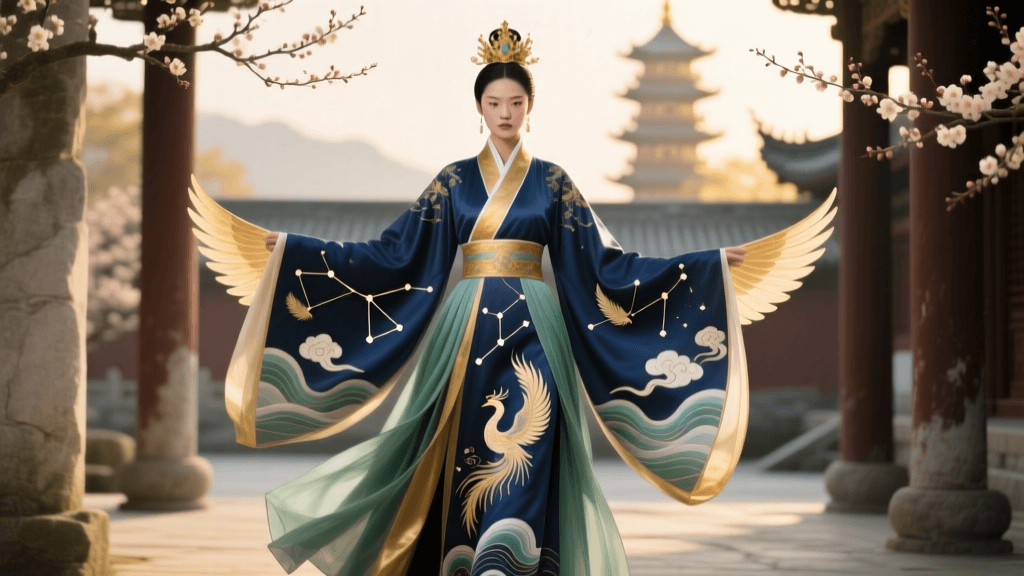
The final garment is the centerpiece of the ceremony. For a woman's Ji Li, a Ming Dynasty-style Aoqun (jacket and pleated skirt) is currently the gold standard in 2026. The skirt, often a Mamianqun (horse-face skirt), requires a heavy silk brocade to ensure the pleats hang perfectly straight and swing with a weighted, pendulum-like grace during the ceremonial bows. For a man's Guan Li, the Daopao (Taoist robe) or a formal Shenyi (deep robe) provides a sweeping, dignified silhouette. The fabric must possess enough structural integrity to hold the wide sleeves without collapsing, a hallmark of high-end 2026 Hanfu tailoring.
2026 Garment Sourcing: Brands and Bespoke Tailoring
The Hanfu market in 2026 is highly stratified. While mass-market brands offer affordable options for everyday wear, milestone ceremonies demand museum-grade accuracy and premium textiles. Leading heritage brands such as Minghuatang and Shisanyu continue to dominate the high-end ceremonial space.
For the San Jia garments, families are increasingly turning to bespoke tailors in Hangzhou and Suzhou. Custom commissions allow for the integration of family crests or specific auspicious motifs—such as the white crane for longevity or the peony for honor—woven directly into the jacquard loom. As reported by cultural analysts at Sixth Tone, the modern consumer's demand for hyper-authenticity has pushed the 2026 market toward traditional wooden loom weaving techniques, significantly elevating both the quality and the price of ceremonial wear.
Selecting the Officiants and Venue
A successful ceremony relies heavily on the individuals guiding the ritual. The roles are strictly defined:
- Zhengbin (Main Officiant): Typically a highly respected elder, teacher, or community leader. They are responsible for placing the hairpin (Ji) or cap (Guan) and reciting the primary blessings.
- Zanli (Assistant): A peer or older sibling who assists the initiate with garment changes and guides them through the physical movements of the rite.
- Yuebing (Musician): In 2026, many ceremonies incorporate live Guqin or Xiao players to provide a meditative, traditional acoustic backdrop, replacing pre-recorded tracks for a more immersive experience.
Venue Selection: While private gardens and ancestral halls remain ideal, the 2026 trend leans toward renting spaces in Confucian temples, university cultural centers, or botanical gardens with traditional architecture. Ensure the venue has a private, climate-controlled anteroom for the initiate to change garments between the three additions, as heavy silks can be cumbersome to manage in public spaces.
Accessories: Hairpins, Caps, and Modern Alternatives
The physical act of pinning the hair is the climax of the rite. For the Ji Li, the hairpin (Ji) transitions from a simple wooden or jade stick in the first addition to an elaborate gold or silver-plated hairpin in the third. In 2026, we see a surge in the use of ethically sourced nephrite jade and lab-grown pearls, blending ecological consciousness with historical aesthetics.
For the Guan Li, the cap (Guan) must fit the initiate's head circumference precisely. The traditional Shidao Guan or Wusha Mao requires a snug fit to remain stable during deep bows. Modern 2026 artisans often use 3D-scanning technology during the bespoke fitting process to ensure the inner bamboo or resin frame of the cap matches the initiate's cranial measurements perfectly, eliminating the discomfort historically associated with rigid headwear.
Step-by-Step Ceremony Timeline
To ensure a seamless flow, adhere to this structured timeline, which typically spans 90 to 120 minutes:
- Welcoming the Guests (15 mins): The host family welcomes guests and the Zhengbin. Traditional tea is served.
- The First Addition (20 mins): The initiate enters in simple children's clothing. The Zhengbin washes their hands, combs the initiate's hair, and adds the first pin/cap. The initiate retreats to change into the first formal Hanfu.
- The Second Addition (20 mins): The initiate returns in the youth garment. The Zhengbin offers a blessing regarding academic and personal growth, then adds the second, more ornate pin/cap.
- The Third Addition (25 mins): The initiate emerges in the grand ceremonial Hanfu. The final, most elaborate pin/cap is placed. The Zhengbin recites the ultimate blessing of adulthood and societal contribution.
- The Bows and Naming (15 mins): The initiate performs deep, formal bows to the heavens, the earth, the parents, and the Zhengbin. The parents then bestow the initiate's 'adult name' (Zi).
- Closing and Photography (20 mins): Formal group portraits and a celebratory banquet.
Final Thoughts on Preserving Heritage
Executing a Ji Li or Guan Li in 2026 is more than an aesthetic endeavor; it is a profound reconnection with Asian philosophical heritage. By carefully selecting historically accurate garments, respecting the ritualistic cadence of the Three Additions, and involving the broader community, families can create a milestone event that resonates deeply across generations. As the Hanfu movement continues to mature, these rites of passage stand as a testament to the enduring power of traditional garments to mark the most vital transitions in human life.
'The clothing we wear during our most vital transitions does not merely cover us; it shapes our posture, our mindset, and our understanding of the duties we are about to assume.' — Journal of Asian Textile History, 2026 Edition.
For further reading on the historical evolution of these garments, we recommend exploring the digital archives of China Daily's Culture Section, which frequently documents the modern integration of these ancient rites into contemporary society.