Decoding Hanfu Garments in Classical Chinese Scroll Paintings
The Canvas of History: Reading Garments in Scroll Art
Chinese scroll paintings are not merely aesthetic masterpieces; they are vital historical archives that capture the evolution of traditional clothing, textile technology, and social customs. For modern Hanfu enthusiasts, historical reenactors, and costume designers, these scrolls offer an unparalleled visual database of how garments were actually worn, draped, and layered in daily life and courtly settings. Unlike static museum mannequins, scroll paintings depict clothing in motion, revealing the fluid dynamics of silk, the structural rigidity of brocade, and the intricate layering protocols of ancient Chinese society.
According to art historians and experts at the Encyclopædia Britannica, the horizontal handscroll format was specifically designed to guide the viewer through a continuous narrative, often revealing intimate details of domestic life, market bustling, and courtly rituals. This narrative progression allows us to observe how garments behaved across different activities—from the sweeping trains of court ladies to the practical, hiked-up tunics of merchants and laborers.
Iconic Scrolls and Their Sartorial Secrets
To accurately recreate historical Hanfu, one must study the specific visual cues left by master painters across different dynasties. Each era brought distinct shifts in silhouette, fabric preference, and tailoring techniques.
Tang Dynasty: Volume, Translucency, and the Pibo
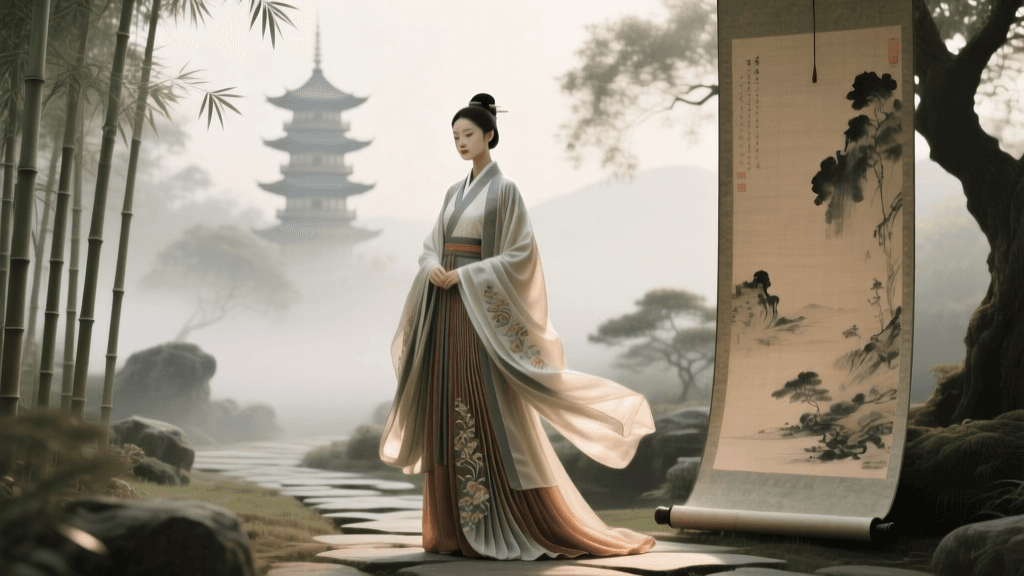
The Tang dynasty (618–907 CE) is renowned for its cosmopolitan flair and opulent fashion. In Zhou Fang’s famous scroll Court Ladies Adorning Their Hair with Flowers, we see the epitome of Tang aristocratic style: the qixiong ruqun (high-waisted chest skirt) paired with voluminous, wide-sleeved tops. The most critical detail for modern recreation is the pibo (silk shawl). Painters used incredibly fine, diluted ink washes to depict the sheer, translucent nature of the pibo draped over the arms and shoulders.
Actionable Advice: To replicate the Tang dynasty drape, avoid heavy modern polyester chiffons. Instead, source 8mm or 10mm pure silk chiffon or silk organza. The pibo should measure at least 2.5 meters in length and 60 centimeters in width to achieve the cascading, pooled effect at the elbows seen in the paintings. For the skirt, use a 4-panel construction to achieve the bell-like silhouette, ensuring the hem pools slightly at the feet.
Song Dynasty: Pragmatism, Elegance, and the Beizi
The Song dynasty (960–1279 CE) marked a shift toward understated elegance and intellectual refinement. The masterpiece Along the River During the Qingming Festival by Zhang Zeduan provides a sprawling, detailed census of Song-era clothing across all social classes. The Palace Museum in Beijing, which houses the original iteration of this scroll, highlights how the painting captures the transition from the flowing robes of the elite to the practical, trousers-and-tunic combinations of the working class.
For the elite, the defining garment is the beizi (a side-slit, long jacket). In scroll depictions, the beizi hangs straight and rigid, contrasting with the softer drapes of the Tang era. The side slits (kaicha) are shown beginning high on the hip, allowing for ease of movement while maintaining a modest, columnar silhouette.
Actionable Advice: When tailoring a Song-style beizi, structure is key. Use a mid-weight fabric like 150 GSM ramie or a linen-cotton blend for the outer shell, and line it with 120 GSM silk or fine cotton. The side slits should begin exactly at the iliac crest (hip bone). The collar must feature the traditional jiaoling youren (left over right) alignment, with a precise 2-centimeter overlap at the sternum to prevent gaping.
Ming Dynasty: Structure, Pleats, and Heavy Brocade
Ming dynasty (1368–1644 CE) court paintings and processional scrolls showcase a return to structured, heavily ornamented garments. The mamianqun (horse-face skirt) and the ao (lined jacket) dominate these visual records. The paintings reveal deep, structured pleats that hold their shape even in motion, indicating the use of heavy, stiffened silks and complex pleating mathematics.
Actionable Advice: A historically accurate Ming mamianqun requires significant fabric volume. Use a 6-meter fabric circumference, folded into 12 pairs of knife pleats. Each pleat should measure 4 to 5 centimeters wide at the waistband. To achieve the painted stiffness, opt for heavy silk brocade or Jacquard-woven textiles with a high metallic thread count, and apply a light, flexible interfacing to the waistband to support the skirt's weight.
Comparison Chart: Scroll Depictions vs. Modern Tailoring
The following table translates visual evidence from classical scrolls into actionable specifications for modern Hanfu makers and buyers.
| Historical Era / Scroll Reference | Garment Type | Modern Fabric Recommendation | Tailoring Specifications | Estimated Cost (USD) |
|---|---|---|---|---|
| Tang / Court Ladies Adorning Their Hair | Qixiong Ruqun & Pibo | 10mm Silk Chiffon & Mulberry Silk Brocade | Skirt length 1.2x height; Pibo 2.5m long | $180 - $280 |
| Song / Qingming Festival | Beizi & Song Trousers | 150 GSM Ramie or Linen-Cotton Blend | Side slits at hip bone; 2cm collar overlap | $90 - $150 |
| Ming / Emperor's Procession Scrolls | Mamianqun & Ao Jacket | Heavy Silk Brocade (Jacquard woven) | 6m circumference; 12 pairs of 4cm knife pleats | $250 - $450 |
Sourcing, Costs, and Timing for Authentic Recreations
Recreating the garments seen in classical scrolls requires an understanding of traditional textile production. Institutions like the Metropolitan Museum of Art's Asian Art Department emphasize that studying painted textiles is only half the battle; understanding the material culture and the physical degradation of surviving artifacts is crucial for accurate color and texture matching.
- Fabric Sourcing: For Ming and Tang brocades, seek out Jacquard-woven silks from heritage weaving centers in Suzhou or Hangzhou. Authentic Song-style ramie can be sourced from specialty linen suppliers focusing on Asian heritage textiles.
- Timing: If you are commissioning custom-woven brocade to match a specific scroll's motif (such as the intricate cloud-and-dragon patterns seen in Ming court portraits), expect a lead time of 4 to 8 weeks for loom setup and weaving.
- Natural Dyeing: Scroll paintings often feature vermilion, indigo, and ochre. To replicate these historically accurate hues, look for artisans using plant-based dyes (e.g., madder root for red, indigofera for blue). Naturally dyed fabrics will cost a premium, typically adding $50 to $100 to the final garment price.
- Ready-to-Wear vs. Custom: High-quality, scroll-accurate ready-to-wear Hanfu from reputable brands ranges from $120 to $300. Custom-tailored pieces using authentic silks and hand-finished seams will range from $350 to over $800, depending on the complexity of the embroidery.
Preserving the Thread of Intangible Heritage
The intersection of classical Chinese painting and traditional garment making is a living bridge to the past. When modern enthusiasts use scrolls as blueprints for their clothing, they are not merely engaging in cosplay; they are participating in the preservation of intangible cultural heritage. The meticulous study of brushstrokes that define a silk fold, the careful selection of historically accurate GSMs, and the adherence to ancient tailoring mathematics all serve to keep the material culture of China alive.
By treating scroll paintings as both art and technical manual, we ensure that the elegance of the Tang courts, the refined pragmatism of the Song scholars, and the structured majesty of the Ming emperors continue to walk among us today. Whether you are a collector, a tailor, or a historian, the scrolls remain an open book, waiting to be worn.