Decoding Hanfu Styles in Classic Chinese Scroll Art
The Intersection of Art and Sartorial History
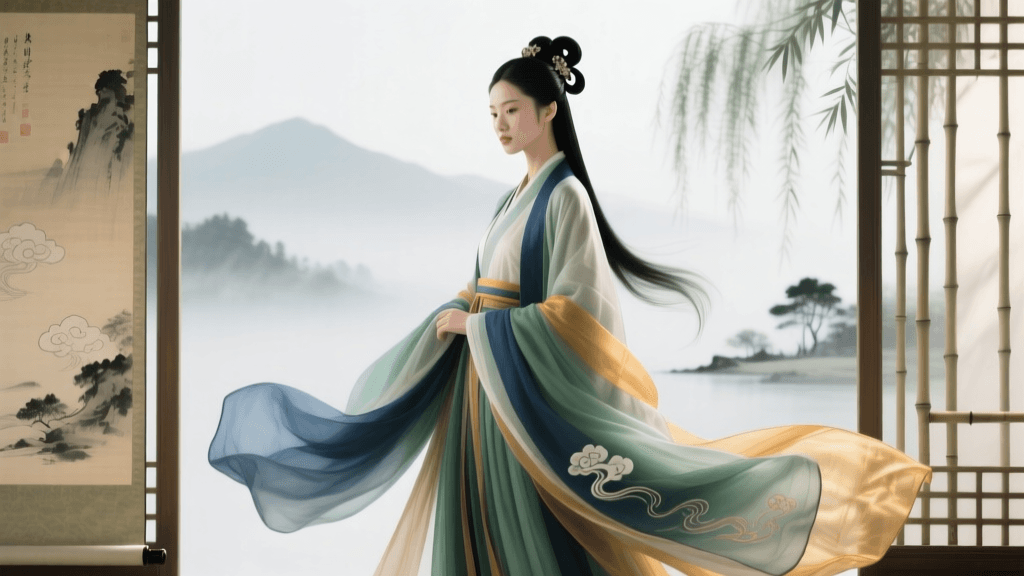
Chinese scroll paintings are celebrated worldwide for their masterful use of ink, breathtaking landscapes, and intricate depictions of daily life. However, for historians, costume designers, and modern Hanfu enthusiasts, these masterpieces serve a dual purpose: they are meticulous sartorial archives. Long before the advent of photography, court painters and literati artists documented the evolution of traditional Chinese clothing with astonishing precision. By studying the drape of a silk sleeve, the pleating of a skirt, and the layering of seasonal garments, we can decode the fashion of ancient dynasties and accurately recreate them today.
Unlike Western portraiture, which often relied on heavy chiaroscuro and static posing, Chinese scroll art utilized a continuous narrative format and a unique scattered perspective known as san dian tou. This allowed artists to capture figures in motion, revealing how fabrics behaved dynamically during court rituals, musical performances, and bustling market days. For the modern practitioner of traditional Asian garments, these scrolls are not merely art to be admired; they are actionable blueprints for historical reconstruction, fabric sourcing, and aesthetic styling.
Three Masterpieces: A Visual Guide to Dynastic Fashion
Tang Dynasty Opulence: Court Ladies Adorning Their Hair with Flowers
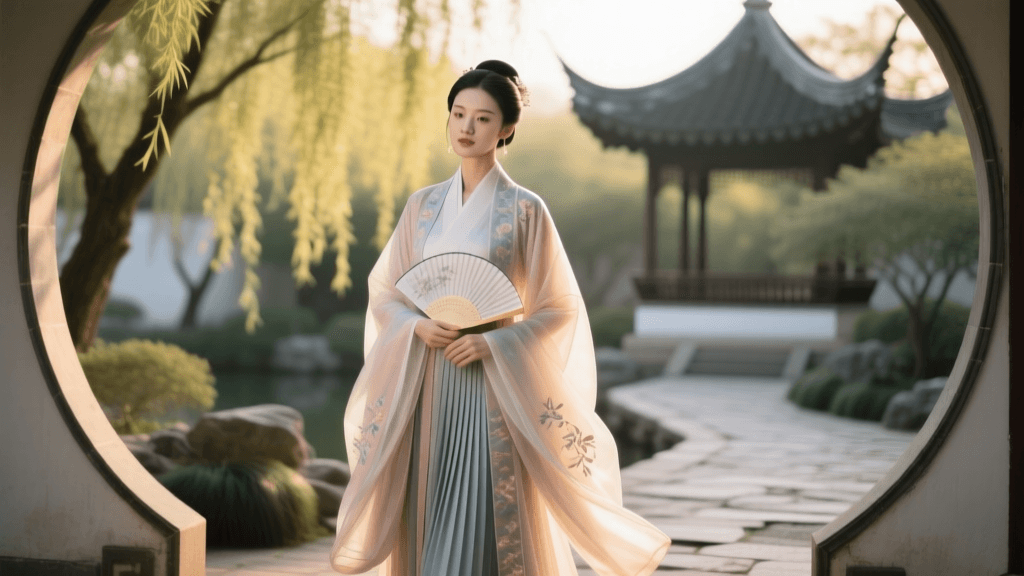
Attributed to the 8th-century master Zhou Fang, this iconic silk handscroll captures the zenith of Tang Dynasty aristocratic fashion. The painting depicts noblewomen in the palace gardens, adorned in the Qixiong Ruqun (chest-high skirt ensemble). The most striking sartorial element in the scroll is the Pibo, a long, sheer silk shawl draped loosely over the arms and shoulders. The artist meticulously rendered the translucency of the silk, allowing the vibrant floral motifs of the underlying skirts to show through the sheer layers.
Actionable Recreation Guide: To recreate the Tang silhouette seen in this scroll, modern enthusiasts should avoid stiff cottons or heavy brocades for the outer layers. Instead, source 8mm or 10mm silk chiffon for the Pibo. The scroll indicates that the shawl should be exceptionally long; aim for a minimum length of 3 meters and a width of 60 centimeters to achieve the dramatic, sweeping drape that pools gracefully at the elbows. For the chest-high skirt, use 16mm silk charmeuse or a high-quality matte satin, measuring the waistband to exactly 1.5 times the wearer's upper bust circumference to allow for a secure, overlapping wrap without excessive bulk.
Five Dynasties Elegance: Night Revels of Han Xizai
Painted by Gu Hongzhong in the 10th century, this masterpiece offers an intimate, voyeuristic look into the private life of the minister Han Xizai. The scroll is divided into five distinct scenes, featuring musicians, dancers, and scholars. The fashion here marks a subtle transition from the bold, expansive silhouettes of the Tang to the more refined, structured elegance of the Five Dynasties and early Song periods. The dancers are depicted in heavily pleated skirts that flare out dynamically during movement, while the seated noblewomen wear early iterations of the Beizi (an open-front, long-sleeved jacket) over their inner garments.
Actionable Recreation Guide: The knife pleats seen on the dancers in the scroll require precise mathematical calculations to replicate accurately. The painting suggests a high-density pleat that maintains its structure even during vigorous movement. To recreate a skirt with 20 distinct knife pleats, each measuring 3 centimeters in width on the exterior, you will need a fabric width of at least 180 centimeters (allowing for a 3x fullness ratio). Use a lightweight silk crepe or a high-twist poly-silk blend, and ensure each pleat is heat-set and edge-stitched at the waistband to prevent the pleats from blooming open prematurely when seated.
Song Dynasty Pragmatism: Along the River During the Qingming Festival
Zhang Zeduan’s 12th-century panoramic scroll is arguably the most famous Chinese painting in existence. Unlike court paintings that focused on the elite, the Qingming scroll captures the bustling life of the capital city, Bianjing, featuring merchants, laborers, scholars, and monks. The clothing depicted is highly practical, reflecting the rise of Neo-Confucianism, which favored modesty, restraint, and functional design. The scroll prominently features the cross-collared Ru (jacket) and Duanhe (short work jackets) made from plant-based fibers rather than expensive silks.
Actionable Recreation Guide: For everyday Song-style Hanfu inspired by the working and middle-class figures in the scroll, abandon silk in favor of authentic plant fibers. Source pure ramie or a linen-cotton blend (typically costing between $15 to $25 per yard from specialized Asian textile suppliers). The sleeves depicted on the scholars and merchants are notably narrower than in previous dynasties, designed to prevent interference with daily tasks. Keep cuff widths between 40 and 50 centimeters, and ensure the jacket length hits precisely at the mid-hip to allow for ease of movement when walking or riding.
Comparative Chart: Scroll Art Garment Analysis
The following table synthesizes the visual data from these three masterpieces, providing a quick-reference guide for modern Hanfu makers and collectors looking to align their wardrobes with specific historical aesthetics.
| Dynasty | Scroll Reference | Primary Garment | Historical Fabric | Modern Actionable Substitute | Key Measurement Detail |
|---|---|---|---|---|---|
| Tang | Court Ladies Adorning Their Hair | Qixiong Ruqun with Pibo | Heavy Silk Brocade & Gauze | 16mm Silk Charmeuse & 8mm Chiffon | Pibo length: 300cm minimum |
| Five Dynasties | Night Revels of Han Xizai | Pleated Skirts & Early Beizi | Lightweight Silk Crepe | High-Twist Poly-Silk Blend | Skirt fullness: 3x waist measurement |
| Song | Along the River (Qingming) | Cross-Collar Ru & Duanhe | Ramie, Hemp, & Raw Cotton | Linen-Cotton Blend or Pure Ramie | Cuff width: 40cm - 50cm (narrow) |
Actionable Guide: Recreating Scroll-Inspired Hanfu Today
Color Extraction and Natural Dyeing
One of the most valuable aspects of studying digital archives of scroll paintings is the ability to extract precise color palettes. Museums like the Metropolitan Museum of Art and the Palace Museum provide ultra-high-resolution scans where the mineral pigments—such as cinnabar red, malachite green, and azurite blue—remain remarkably vibrant. Modern artisans can use digital color-picking tools to extract the exact HEX codes from these scans and translate them into natural dye recipes.
For instance, the muted, earthy reds seen in the scholars' garments of the Qingming scroll can be replicated using madder root (Rubia tinctorum) mordanted with alum. To achieve the deep, oxidized blues worn by the river boatmen, natural indigo vats should be dipped multiple times, allowing for oxidation between each layer to build a rich, multi-dimensional color that mimics the layered ink washes of the original painting. According to research on historical textile conservation by the Victoria and Albert Museum, understanding the original mineral and botanical dyes is crucial for accurate historical reproduction, as synthetic dyes often lack the subtle depth and light-refracting qualities of traditional pigments.
Photography and Posing: Mimicking the Scroll Aesthetic
For Hanfu photographers and influencers, capturing the essence of scroll art requires moving beyond standard portrait techniques. Chinese scroll paintings do not use linear perspective; instead, they employ a shifting focal point that keeps the foreground and background in relatively equal focus, emphasizing the 2D surface pattern of the garments.
- Lens Selection: Avoid wide-angle lenses (24mm-35mm) which distort proportions and exaggerate depth. Instead, use an 85mm or 105mm prime lens. This compresses the background, flattening the image and mimicking the layered, two-dimensional aesthetic of a painted scroll.
- Aperture Settings: While modern portraiture often favors f/1.8 for extreme bokeh, scroll art requires detail. Shoot at f/4 to f/5.6 to ensure the intricate embroidery, pleats, and fabric textures of the Hanfu remain razor-sharp from collar to hem.
- Aspect Ratio and Stitching: To truly evoke the handscroll format, shoot in a vertical orientation and stitch multiple images together in post-processing to create an ultra-wide panoramic canvas (such as a 3:1 or 4:1 ratio). This allows the subject to be placed off-center, interacting with negative space just as figures do in traditional ink wash landscapes.
Sourcing Authentic Textiles
The foundation of any scroll-accurate garment is the textile. The Metropolitan Museum of Art's Heilbrunn Timeline of Art History notes that the evolution of Chinese silk weaving techniques directly influenced the drape and silhouette seen in court paintings. When sourcing fabrics for Tang and Five Dynasties recreations, seek out suppliers who specialize in traditional Jacquard loom weaves. For Song dynasty commoner garments, look for heritage ramie weavers. The UNESCO Intangible Cultural Heritage registry highlights the enduring legacy of Chinese sericulture, reminding modern makers that supporting traditional artisans who use wooden looms and natural degumming processes is essential for achieving the exact luster and weight depicted in ancient art.
Conclusion
Chinese scroll paintings are far more than decorative masterpieces; they are vital, living documents of Asian sartorial history. By closely analyzing the brushstrokes that define a pleated hem, the wash of color that indicates sheer silk, and the practical cuts of everyday linen, modern Hanfu enthusiasts can bridge the gap between historical artifact and wearable art. Whether you are calculating the precise yardage for a Tang dynasty Pibo, dyeing ramie to match a Song dynasty merchant's tunic, or setting up a photoshoot to mimic the scattered perspective of a 12th-century masterpiece, these scrolls provide an endless well of inspiration and technical guidance. Through careful study and respectful recreation, we ensure that the fashion of ancient dynasties continues to move, breathe, and flow in the modern world.