Decoding Hanfu History Through Classic Chinese Scroll Art
The Canvas as a Historical Archive
For centuries, traditional Chinese scroll paintings have served as far more than mere aesthetic expressions; they are meticulous historical archives. For modern Hanfu enthusiasts, historical reenactors, and costume designers, these masterpieces offer a direct, visual window into the sartorial realities of ancient China. Unlike textual records, which often leave the drape, texture, and exact layering of garments to the imagination, scroll paintings capture the fluid movement of silk, the structured elegance of court attire, and the pragmatic weaves of commoner clothing. By studying these artworks, we can decode the evolution of traditional Chinese clothing and translate two-dimensional art into accurate, three-dimensional historical reconstructions.
Decoding the Tang Dynasty: Opulence and Drape
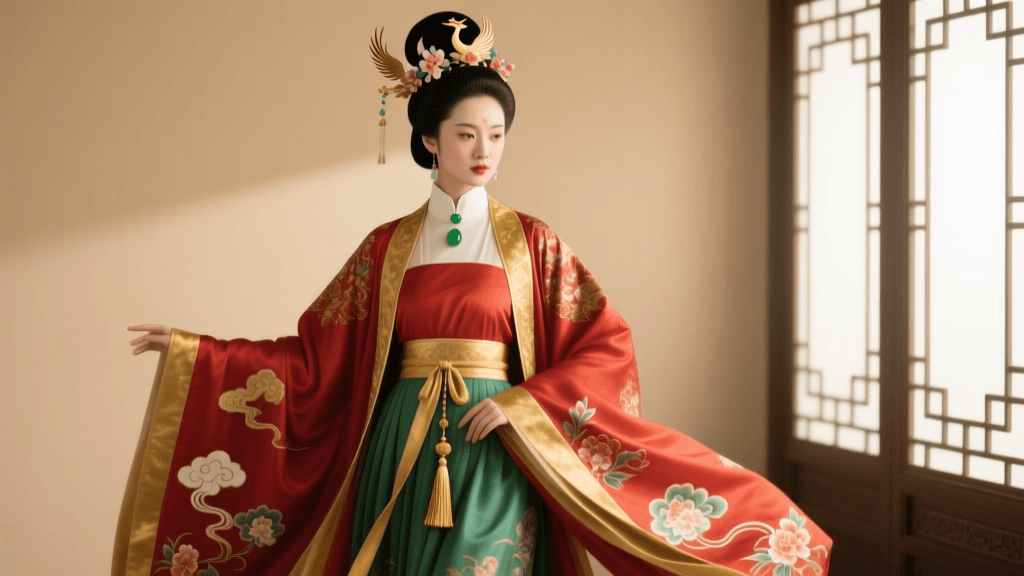
The Tang Dynasty (618–907 CE) is globally renowned for its cosmopolitan culture, expansive trade routes, and lavish textiles. In Zhou Fang's masterpiece, Court Ladies Adorning Their Hair with Flowers, we see the quintessential Qixiong Ruqun (chest-high skirt). The painting illustrates a silhouette that is voluminous, high-waisted, and heavily draped. The skirts pool gracefully at the feet, indicating an immense amount of fabric.
According to The Metropolitan Museum of Art's Heilbrunn Timeline of Art History, the Tang era was a period of immense cultural exchange, which heavily influenced textile patterns and garment structures. To accurately replicate the drape seen in these scrolls, modern reconstructors must avoid stiff cottons or synthetic blends. Instead, opt for 100% mulberry silk charmeuse or heavy silk crepe. Achieving the scroll-accurate 'pooling' effect requires a hem circumference of at least 3.5 to 4 meters, demanding approximately 4 to 5 meters of fabric per skirt.
The Five Dynasties Period: Intimacy and Layering
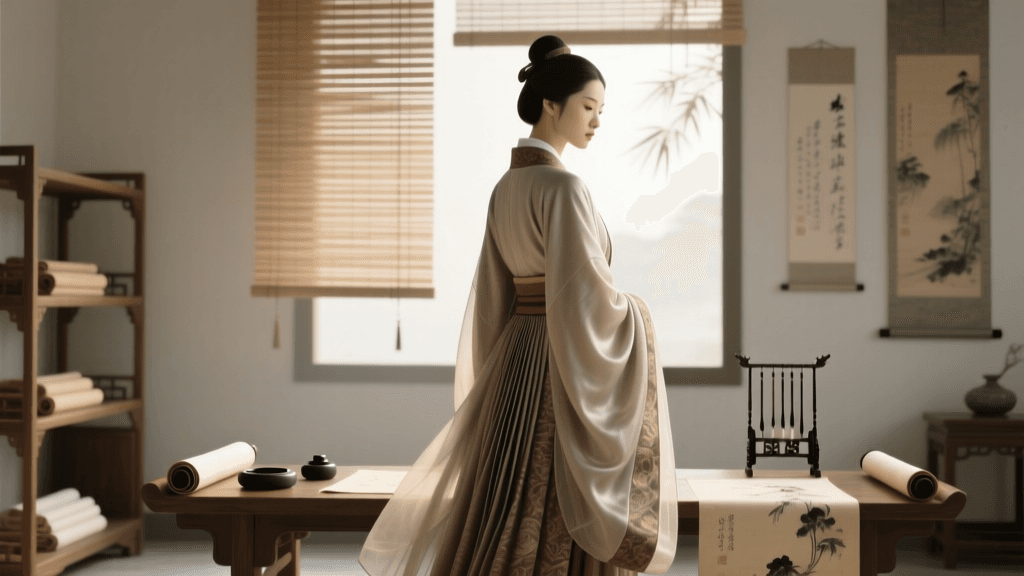
Moving into the Five Dynasties and Ten Kingdoms period, Gu Hongzhong's The Night Revels of Han Xizai provides an unprecedented look into the private life and relaxed attire of the scholar-official class. The scroll is a masterclass in layering, prominently featuring the Banbi (half-sleeve jacket) worn over long-sleeved under-robes, and the iconic Pibo (silk shawl).
The Pibo in these paintings is depicted as ethereal and nearly translucent, wrapping around the arms and trailing behind the wearer to create elongated vertical lines. For historical accuracy, the Pibo should be crafted from lightweight silk gauze (approximately 8 to 12 momme weight) and must measure at least 2.5 meters in length to allow for the dynamic wrapping techniques depicted in the artwork.
The Song Dynasty: Pragmatism and the Commoner's Wardrobe
While court paintings focus heavily on elites, Zhang Zeduan's sprawling panoramic scroll, Along the River During the Qingming Festival, captures the bustling daily life of the Song Dynasty (960–1279 CE) capital. This artwork is an invaluable resource for understanding commoner wear, specifically the Beizi (long vests) and practical, narrow-sleeved Ru (jackets).
The garments depicted here prioritize mobility and modesty. The silhouettes are straighter, and the fabrics lack the heavy, pooling drape of the Tang era. For everyday Song-style reconstructions, historical accuracy dictates the use of linen, ramie, or linen-cotton blends (around 120 to 150 GSM). These plant-based fibers provide the necessary breathability and structural stiffness seen in the scroll's depictions of merchants, boatmen, and scholars.
Comparative Data: Garment Evolution Across Dynastic Scrolls
The following table breaks down the key sartorial elements observed in major historical scrolls, providing a quick reference guide for designers and historians.
| Dynasty | Scroll Reference | Key Garment | Silhouette Profile | Recommended Fabric & Weight |
|---|---|---|---|---|
| Tang | Court Ladies Adorning Their Hair with Flowers | Qixiong Ruqun (Chest-high skirt) | Voluminous, high-waisted, pooling at feet | Heavy Silk Crepe or Charmeuse (19-22 momme) |
| Five Dynasties | The Night Revels of Han Xizai | Banbi & Pibo (Shawl) | Relaxed, layered, elongated vertical lines | Silk Gauze for Pibo (8-12 momme), Brocade for Banbi |
| Song | Along the River During the Qingming Festival | Beizi (Long Vest) & Ru | Straight, narrow sleeves, practical and modest | Linen-Cotton Blends or Raw Silk (120-150 GSM) |
| Ming | Portrait of a Ming Official (Various Court Paintings) | Daopao (Taoist Robe) | Structured, wide sleeves, dignified A-line | Heavy Silk Brocade or Woven Damask (25+ momme) |
Actionable Guide: Translating 2D Art into 3D Garments
Recreating historical clothing from flat paintings requires a deep understanding of both artistic conventions and textile physics. Here is a practical guide for modern makers.
1. Adjusting for Artistic Proportions
Traditional Chinese figure painting often employs a stylized proportion system where the human head is roughly one-sixth or one-seventh of the total body height, unlike the modern Western standard of one-eighth. If you measure a sleeve length directly from a scroll based on head-size ratios, the resulting garment may be too short. Actionable Advice: Always map the garment's proportions to the wearer's actual skeletal measurements (e.g., wrist-to-wrist span, shoulder-to-floor) rather than scaling up directly from the painting's visual ratios.
2. Compensating for Pigment Fading
The mineral and plant-based pigments used in ancient scrolls degrade over centuries. Azurite (blue) and malachite (green) can darken or oxidize, while organic reds may fade to pale pink. Actionable Advice: When extracting color palettes via digital eyedropper tools from high-resolution museum scans, increase the saturation and brightness by 15-20% to approximate the original, vibrant dyes. For authentic Tang dynasty reds, look for fabrics dyed with safflower or madder root equivalents, rather than relying on the muted, aged tones visible in the scans today.
3. Sourcing and Budgeting for Authenticity
As noted in The Victoria and Albert Museum's comprehensive guide on Chinese Silk, the evolution of silk weaving techniques—from plain weaves to complex damasks and brocades—dictated how garments moved and caught the light. To replicate this:
- Mulberry Silk Charmeuse: Ideal for Tang dynasty skirts. Budget $45 to $85 per yard. You will need 5 yards for a full skirt and top.
- Silk Gauze (Luo): Essential for the translucent Pibo shawls. Budget $30 to $50 per yard. 3 yards is sufficient.
- Ramie and Linen: The historically accurate choice for Song dynasty commoners. Budget $15 to $25 per yard. 4 yards will cover a vest and jacket set.
- Custom Embroidery: Scrolls often depict intricate Baoxiang flower or cloud motifs. Commissioning digital or hand embroidery to replicate these patterns typically costs between $150 and $300, with a turnaround time of 4 to 8 weeks.
Total Estimated Cost: A museum-quality, scroll-accurate Tang dynasty reconstruction will generally cost between $400 and $650 when factoring in premium silks, custom dyeing, and specialized tailoring.
Conclusion
Chinese scroll paintings are indispensable blueprints for the revival of traditional Hanfu. By looking beyond the surface beauty of these masterpieces and analyzing the structural, textile, and proportional data they contain, modern designers and historians can bridge the gap between ancient art and living heritage. Whether you are sourcing heavy silk crepe to mimic a Tang court lady's drape, or selecting breathable ramie for a Song scholar's vest, the scrolls remain our most vibrant and reliable guides to the sartorial soul of historical China.