Hanfu on Global Runways: Top 2026 Fashion Week Trends
The 2026 Runway Renaissance: Hanfu Meets Haute Couture
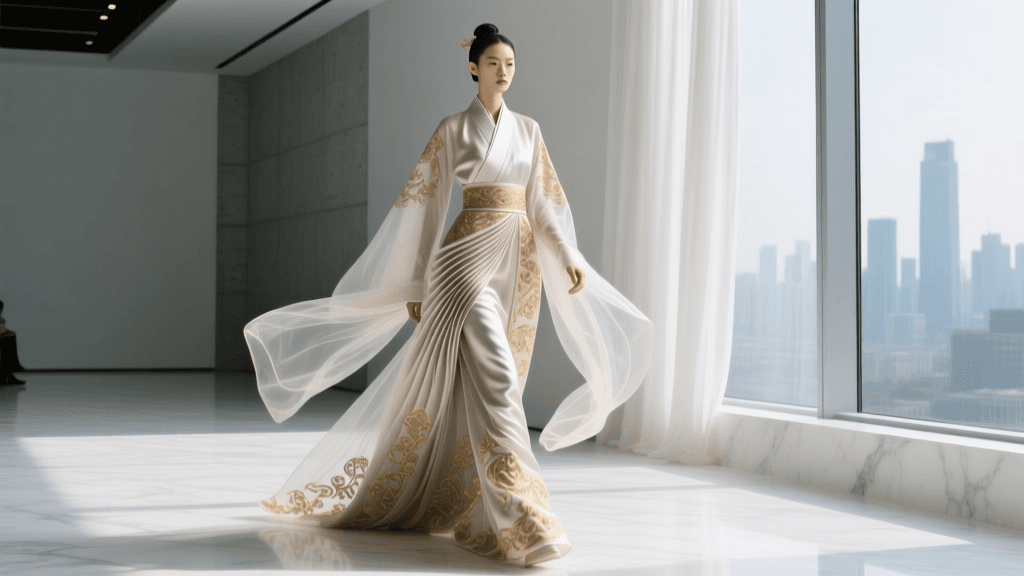
The global fashion landscape has undergone a seismic shift as we navigate the Spring/Summer and Autumn/Winter 2026 Fashion Weeks. No longer confined to niche subcultures, historical reenactments, or regional street style, Hanfu—the traditional clothing of the Han Chinese—has firmly established itself as a structural and aesthetic foundation for international haute couture. From the grand salons of Paris to the industrial lofts of Milan, top-tier design houses and emerging Chinese couturiers are moving past superficial "Orientalist" motifs. Instead, they are deeply integrating authentic Hanfu construction techniques, historical silhouettes, and heritage textiles into modern luxury garments.
According to market analysis and cultural tracking by The Business of Fashion, the global appetite for non-Western historical garments has matured significantly by 2026. Consumers and critics alike are demanding structural authenticity. This means the 2026 runways are defined by the precise geometry of the Jiaoling Youren (cross-collar right lapel), the mathematical pleating of the Mamianqun (horse-face skirt), and the architectural drape of the Shenyi (deep robe). Designers are treating these ancient patterns not as mere inspiration, but as sophisticated engineering marvels that offer sustainable, zero-waste alternatives to modern Western tailoring.
Key Hanfu Silhouettes Dominating the 2026 Runways
To understand the current haute couture landscape, one must understand how historical garments are being adapted for the modern runway. The translation from ancient daily wear to 2026 high fashion requires a delicate balance of preserving cultural integrity while pushing the boundaries of contemporary textile manipulation.
| Traditional Element | Historical Function | 2026 Runway Adaptation | Key Couture Application |
|---|---|---|---|
| Mamianqun (Horse-face skirt) | Equestrian and daily wear for women (Ming Dynasty) | Asymmetrical pleating, metallic jacquard weaves, and floor-sweeping lengths | Structured evening gowns with corsetry hidden beneath the flat front panels |
| Jiaoling Youren (Cross-collar) | Standard collar alignment for inner and outer robes | Exaggerated lapels, sheer silk organza overlays, and deconstructed layering | Avant-garde outerwear and tailored wool coats featuring the right-over-left closure |
| Yunjian (Cloud shoulder) | Ceremonial detachable collar/capelet | 3D-printed bioplastic frameworks, laser-cut leather, and bead-embroidered mantles | Statement shoulder pieces worn over minimalist silk slip dresses |
| Piling (Hooded cloak) | Winter travel and wind protection | Oversized, floor-length cashmere and Xiangyunsha silk blends with hidden magnetic closures | Luxury resort wear and high-end streetwear outer layers |
Fabric Innovation and Sustainable Dyeing on the Global Stage
A major catalyst for Hanfu’s integration into the 2026 European fashion circuit is the industry's strict pivot toward sustainability. With the European Union’s digital product passport and circular textile mandates fully in effect this year, luxury houses are scrambling for eco-friendly, biodegradable materials. Traditional Chinese textile arts have provided a vital blueprint.
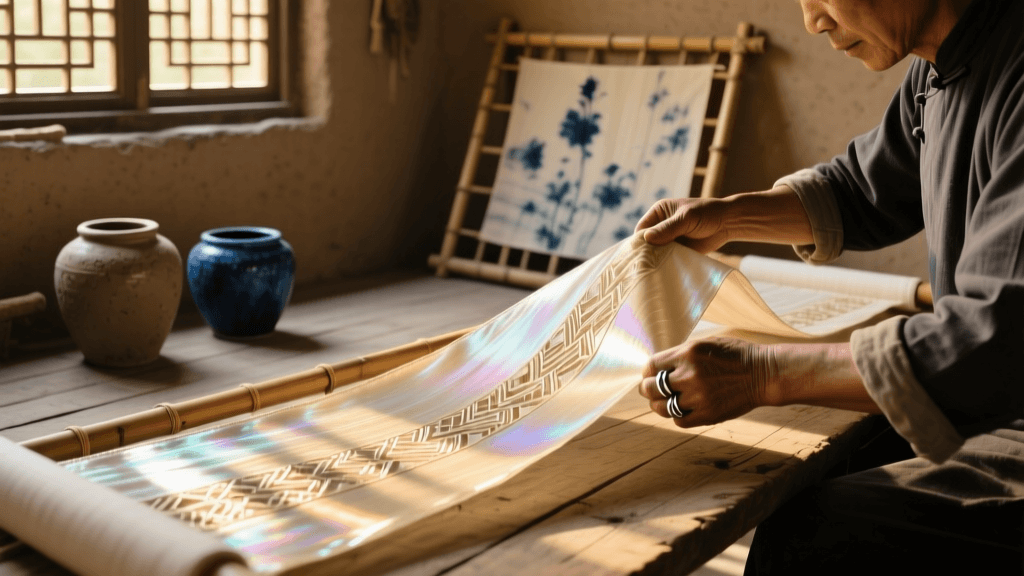
Xiangyunsha (Gambiered Silk): Often referred to as "soft gold," this centuries-old dyeing technique from Guangdong province has become a darling of the Paris runways. The process involves dyeing silk with the juice of the Dioscorea cirrhosa (Shoulang) tuber and coating it with iron-rich river mud. The result is a dark, lustrous, water-resistant fabric that is 100% biodegradable. In 2026, couture houses are utilizing Xiangyunsha for tailored trench coats and structured trousers, prized for its unique crackled texture and acoustic "rustle" when the wearer moves.
Song Brocade (Songjin): Recognized for its intricate, multi-colored weft patterns, Song Brocade is being reimagined using regenerated cellulose fibers and organic cotton blends to meet 2026 eco-standards without sacrificing the opulent, raised textures that make it ideal for evening bodices and structured handbags. As documented in the historical textile archives of institutions like the Metropolitan Museum of Art, the complexity of Chinese silk weaving has always rivaled the finest European jacquards, and modern technology is finally allowing these heritage weaves to scale sustainably.
Designer Spotlights: Who is Leading the Hanfu Couture Movement?
While legends like Guo Pei continue to set the standard for imperial-inspired grandeur, the 2026 season belongs to a new wave of designers who are merging Hanfu patterns with minimalist and avant-garde aesthetics. Brands like Shang Xia (backed by Hermès) continue to refine the intersection of Chinese craftsmanship and Parisian luxury. Meanwhile, emerging labels showcased at Vogue Runway's global hubs are experimenting with "Cyber-Hanfu"—integrating smart textiles, fiber-optic threading into traditional Song brocade patterns, and modular garments that can be disassembled and reworn in multiple configurations.
"We are no longer borrowing from the East; we are returning to the root of sartorial engineering. The zero-waste cutting techniques of the Ming Dynasty Shenyi are exactly what the 2026 sustainable luxury market demands."
— Lead Textile Historian, Global Heritage Fashion Institute, Paris Fashion Week 2026
How to Incorporate Runway Hanfu Trends into Your 2026 Wardrobe
You do not need a haute couture budget or an invitation to Milan Fashion Week to participate in this global sartorial shift. The "New Chinese Style" (Xin Zhongshi) has heavily influenced mainstream luxury and accessible designer markets this year. Here is an actionable guide to integrating runway-grade Hanfu elements into a modern, cosmopolitan wardrobe.
1. The Modern Mamianqun Styling Formula
The horse-face skirt is the most versatile entry point into Hanfu fashion. For a 2026 office-to-evening look, pair a mid-calf, solid-colored Mamianqun with a structured, oversized Western blazer.
- Measurements: Ensure the skirt sits at your natural waist. A standard runway-grade Mamianqun requires 4.5 to 6 meters of heavy silk or wool-blend brocade to achieve the correct kinetic swing.
- Footwear: Ditch the traditional cloth shoes. Pair the skirt with pointed-toe leather ankle boots or sleek, minimalist loafers to ground the historical volume with modern sharpness.
- Cost: Authentic, high-quality daily-wear Mamianqun from reputable heritage brands currently range from $150 to $450 in 2026, while couture-tier, hand-woven silk versions can exceed $2,500.
2. Layering with the Beizi (Slip Dress/Coat)
The Beizi, a straight-cut, side-slit coat popular in the Song Dynasty, is the ultimate 2026 layering piece. Its straight silhouette and side vents make it function similarly to a modern duster or lightweight trench coat.
- Styling Tip: Wear a sheer, organza Beizi over a simple silk camisole and tailored wide-leg trousers. The side slits (extending from the underarm to the hem) allow for incredible ease of movement and a striking visual layering effect.
- Closure: Opt for Beizi with subtle, hidden snap closures or traditional fabric ties (Zi Mu Kou) that have been modernized with matte metal hardware.
3. Accessorizing with Cloud Shoulder Motifs
If a full garment feels too bold, the Yunjian (cloud shoulder) motif is being heavily utilized in 2026 accessory design. Look for structured leather handbags, embroidered silk scarves, or even statement jewelry that mimics the four-directional symmetry of the traditional cloud shoulder. This provides a nod to the architectural beauty of Hanfu without requiring a full wardrobe change.
The Cultural Impact and Future of Hanfu in High Fashion
The presence of Hanfu on the 2026 global runways represents a profound cultural reclamation. For decades, Asian fashion on the international stage was filtered through a Western lens, often reduced to stereotypical dragon motifs, mandarin collars, and qipao silhouettes. The current Hanfu movement, driven by a highly educated, digitally native generation of Chinese consumers and designers, demands historical accuracy and respect for the garment's philosophical roots.
The concept of Tian Ren He Yi (the unity of heaven and humanity) is woven into the very fabric of Hanfu. The generous use of material, the lack of restrictive tailoring (like Western darts and corsetry), and the reliance on the natural drape of the fabric reflect a philosophy of harmony with nature. As the global fashion industry grapples with its environmental footprint and the ethical implications of fast fashion, the ancient wisdom embedded in Hanfu construction offers a compelling, sustainable path forward.
As we look toward the remainder of 2026 and the upcoming 2027 resort collections, it is clear that Hanfu is not a passing trend. It is a permanent, vital pillar of the global fashion lexicon, proving that true luxury lies in the preservation, innovation, and respectful evolution of our shared human heritage.