Extreme Climate Hanfu: Tropical, Desert & Cold Guide 2026
As the Hanfu movement continues its unprecedented global expansion in 2026, enthusiasts are no longer confined to the temperate, four-season climates of East Asia. Today, traditional Chinese garments are worn in the sweltering humidity of Southeast Asian metropolises, the arid, sun-baked dunes of the Middle Eastern deserts, and the biting, sub-zero winters of Northern Europe and North America. Adapting Hanfu for extreme climates requires a delicate balance: honoring the historical silhouettes and construction methods while embracing modern textile science and strategic layering.
According to historical textile archives at The Metropolitan Museum of Art, ancient Chinese dress was inherently adaptable, evolving significantly across different dynasties to suit varying regional climates and trade routes. In 2026, the global Hanfu community leverages this historical versatility, combining ancient wisdom with contemporary weather-resistant fabrics. This comprehensive guide explores how to authentically and comfortably wear Hanfu in tropical, desert, and freezing environments.
Tropical Climates: Beating the Humidity with Song Dynasty Minimalism
Tropical environments present a unique challenge for traditional dress: extreme heat coupled with oppressive humidity. Heavy silks and dense layering quickly become unbearable. For 2026, the consensus among tropical Hanfu enthusiasts is to look toward the Song Dynasty (960–1279 CE), an era celebrated for its minimalist, lightweight, and breathable silhouettes.
Fabric Innovations: Ramie and Cooling Blends
The undisputed champion of tropical Hanfu is ramie, a bast fiber native to East Asia that has been used for thousands of years. Ramie is highly absorbent, dries quickly, and possesses a natural stiffness that keeps the fabric away from the skin, promoting airflow. In 2026, textile manufacturers have introduced 'cryo-ramie' and enzyme-washed linen blends that retain the historical drape of traditional Hanfu while offering a soft, cool-to-the-touch finish. Avoid heavy mulberry silks or synthetic polyesters, which trap heat and moisture against the body.
Key Garments: Beizi and Song Trousers
The Beizi (an open-front, parallel-collar jacket) is the ultimate tropical staple. Worn over a lightweight Moxiong (tube top) or a sheer short-sleeved inner shirt, the Beizi allows for maximum ventilation. Pair this with Song-style wide-leg trousers made from sheer linen. For skirts, opt for a short, single-piece Baidiequn (pleated skirt) that ends at the calf, preventing the hem from dragging in wet or muddy tropical conditions. Light, reflective colors such as celadon, pearl white, and pale lotus pink are highly recommended to deflect solar radiation.
Desert Climates: UV Protection and Thermal Shifts
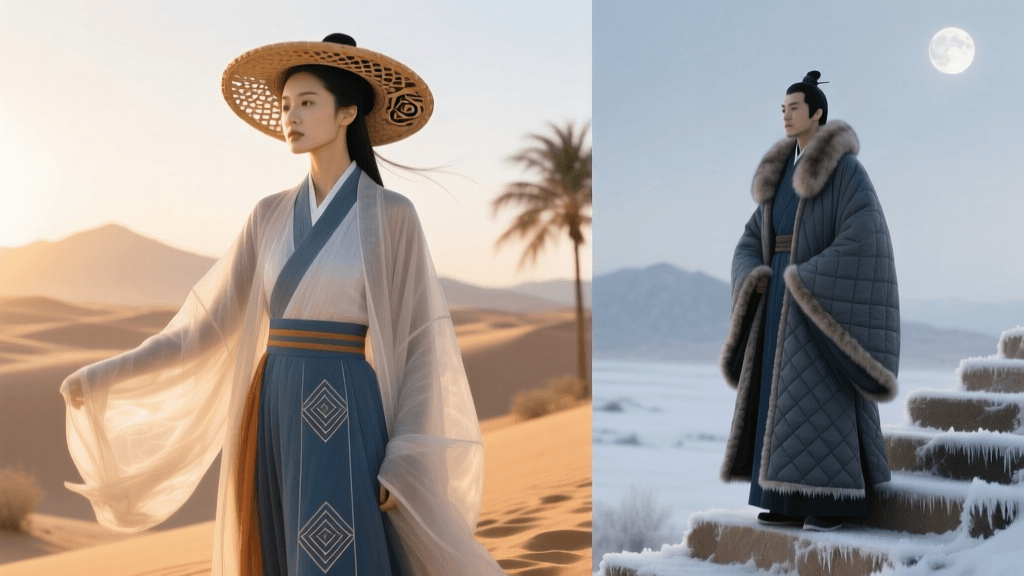
Desert climates are defined by extremes: blistering, high-UV days and surprisingly freezing nights. Furthermore, windblown sand and dust require garments that offer full-body coverage without causing overheating. The historical inspiration for desert Hanfu in 2026 is drawn heavily from the Tang Dynasty (618–907 CE) and the Silk Road trade routes, where cultural exchange led to practical, protective travel wear.
The Silk Road Legacy: Tang and Ming Influences
As documented by the Victoria and Albert Museum, the Silk Road facilitated not just the trade of goods, but the exchange of sartorial technologies designed for harsh, arid transit. To replicate this in 2026, desert-dwelling enthusiasts utilize mid-weight raw silks and tightly woven cottons. These fabrics provide an excellent Ultraviolet Protection Factor (UPF) while remaining remarkably breathable in dry heat.
Key Garments: Yuanlingpao and Pifeng
For daytime desert wear, the Yuanlingpao (round-collar robe) is highly effective. Its high collar protects the neck from sunburn, while the wide, flowing sleeves create a microclimate of circulating air around the arms. To combat the sudden temperature drops at night, layering is essential. The Pifeng (a long, open-front cloak) from the late Ming era is perfect for desert evenings. Worn over the base robe, a wool-blend Pifeng traps body heat when the sun sets. Additionally, wide-brimmed traditional hats or modern adaptations of the Weimao (a veil-like hood) are increasingly popular in 2026 for shielding the face and hair from abrasive sandstorms.
Cold Regions: Surviving the Freeze with Ming Dynasty Insulation
Wearing Hanfu in sub-zero temperatures requires abandoning the delicate, flowing layers of the Tang and Song eras in favor of the structured, insulated, and opulent styles of the Ming Dynasty (1368–1644 CE). The Ming era saw the perfection of padded garments and the integration of fur and heavy brocades to combat the harsh winters of Northern China.
Heavy Brocades and Modern Thermal Layering
According to Encyclopedia Britannica, the Ming dynasty established strict sumptuary laws and highly developed weaving techniques that resulted in dense, heavy fabrics like Zhijin (gold-woven brocade) and thick wools. In 2026, cold-weather Hanfu utilizes modern thermal linings—such as fleece-backed cotton and aerogel-infused interlinings—hidden beneath historically accurate outer shells of heavy jacquard or wool-blend brocade. This provides the insulation of a modern winter parka while maintaining the elegant Ming silhouette.
Key Garments: Aoqun and Fur Collars
The cornerstone of winter Hanfu is the Aoqun, consisting of a lined or padded cross-collar jacket (Ao) and a heavy Mamianqun (horse-face skirt). In 2026, the Mamianqun is often tailored from heavy melton wool to block biting winds. The Ao features tight, narrow sleeves (often with hidden inner cuffs) to prevent heat escape, contrasting with the wide sleeves of warmer seasons. To protect the neck and face from frostbite, the Weiling (a detachable fur or faux-fur collar) is an absolute necessity. Paired with insulated, traditional cloth boots lined with shearling, the Ming winter ensemble is both a fashion statement and a survival tool in freezing climates.
2026 Climate Adaptation Comparison Chart
| Climate Zone | Historical Inspiration | Recommended 2026 Fabrics | Key Garments & Accessories |
|---|---|---|---|
| Tropical (Hot/Humid) | Song Dynasty Minimalism | Enzyme-washed Ramie, Linen, Cryo-Silk | Beizi, Song Trousers, Short Baidiequn, Bamboo Fans |
| Desert (High UV/Cold Night) | Tang Silk Road Travel Wear | Raw Silk, Tightly Woven Cotton, Lightweight Wool | Yuanlingpao, Pifeng (Cloak), Weimao (Veil/Hood) |
| Cold (Sub-Zero/Snow) | Ming Dynasty Winter Wear | Wool Brocade, Fleece-lined Cotton, Aerogel Interlining | Padded Aoqun, Mamianqun (Wool), Weiling (Fur Collar) |
Care and Maintenance for Extreme Weather Hanfu
Wearing traditional garments in extreme environments takes a toll on the fabrics. In tropical climates, the combination of sweat and high humidity can lead to mildew on natural fibers like ramie and linen. In 2026, experts recommend storing tropical Hanfu with silica gel desiccant packets and utilizing UV-protective garment bags. Hand-washing with pH-neutral, enzyme-based detergents is crucial to breaking down organic sweat stains without degrading the delicate bast fibers.
Desert environments introduce fine, abrasive sand that can grind into the weave of raw silk and cotton, causing premature fraying. After a day in the dunes, it is essential to shake out garments thoroughly and use a soft-bristled brush to remove dust from the seams. For cold-region Hanfu, the heavy wool and brocade materials should never be machine-washed. Dry cleaning or professional textile steaming is required to maintain the structural integrity of the padded interlinings and the plush texture of the faux-fur Weiling collars. Proper maintenance ensures these specialized garments survive the harshest conditions year after year.
Conclusion: Tradition Meets Environmental Reality
The beauty of Hanfu lies in its deep historical roots and its inherent adaptability. As we navigate the diverse and often extreme climates of 2026, the global Hanfu community proves that traditional dress is not a static museum relic, but a living, breathing wardrobe. By understanding the historical context of regional garments and pairing them with modern, climate-appropriate textiles, enthusiasts can honor their cultural heritage comfortably—whether they are walking through a humid tropical rainforest, traversing a sun-scorched desert, or braving a snowy northern winter.