Hanfu Etiquette: Greeting Rituals and Dress Code Rules
The Resurgence of Hanfu and the Importance of Etiquette
The global revival of Hanfu, the traditional clothing of the Han Chinese, is more than just a fashion trend; it is a profound reconnection with centuries of cultural philosophy, aesthetics, and social etiquette. As noted by NPR, millions of young people are embracing these garments not merely as costumes, but as a living expression of identity and historical continuity. However, wearing Hanfu authentically requires an understanding of the deep-seated etiquette and dress codes that governed its use for over three millennia.
In traditional Chinese culture, clothing was never just about protection from the elements. It was a visual language that communicated one's social status, moral cultivation, and respect for the cosmic order. The BBC Travel highlights that the modern Hanfu movement places a heavy emphasis on reviving these lost rituals, from the way a collar is folded to the precise angle of a greeting bow. To wear Hanfu without understanding its etiquette is to read a book without understanding its language. This guide will walk you through the foundational dress code rules, occasion-based layering, and the intricate greeting rituals that bring the garment to life.
The Golden Rule: Jiaoling Youren (Left Over Right)
The most critical and non-negotiable rule of Hanfu dress code is the concept of Jiaoling Youren (交领右衽), which translates to 'intersecting collar, right lapel.' This means that the left side of the collar must always cross over the right side, forming a 'y' shape at the neckline.
This rule is deeply rooted in traditional Chinese philosophy, specifically the concepts of Yin and Yang. The left side is associated with Yang (life, vitality, and the sun), while the right side is associated with Yin (death, the moon, and the underworld). Therefore, wrapping the left over the right symbolizes the triumph of life and order over death and chaos. Conversely, wrapping the right lapel over the left (Zuoren) is strictly reserved for dressing the deceased for burial. Wearing your Hanfu right-over-left in daily life is considered highly inauspicious and deeply offensive to traditional sensibilities. Always double-check your collar alignment in a mirror before stepping out.
Occasion-Based Hanfu Dress Codes
Just as modern Western fashion distinguishes between casual wear, business formal, and black-tie attire, traditional Chinese society had strict dress codes dictated by the occasion, the season, and the wearer's social standing. Below is a structured matrix to help you choose the appropriate Hanfu style for your event.
| Dress Code Category | Traditional Occasion | Garment Type | Recommended Fabric | Sleeve Style |
|---|---|---|---|---|
| Changfu (Casual) | Daily chores, market visits, informal gatherings | Ruqun (blouse and skirt), Duanda (short tunic and trousers) | Linen, Cotton, Light Ramie | Narrow sleeves (Zhixiu) for mobility |
| Lifu (Formal) | Festivals, hosting guests, academic ceremonies | Aoqun (lined jacket and skirt), Shenyi (deep robe) | Silk blends, Brocade, Damask | Wide sleeves (Guangxiu) or Pipa sleeves |
| Jifu (Ceremonial) | Weddings, ancestral worship, coming-of-age rites | Daxiushan (large-sleeved robe), Mianfu (court dress) | Heavy Silk, Gold-woven Brocade | Extra-long, sweeping sleeves (Daxiu) |
When attending modern cultural festivals or temple fairs, Lifu is generally the most appropriate and visually striking choice. For everyday street wear or casual photography, Changfu offers comfort without sacrificing historical accuracy. It is also vital to align your fabric choices with the seasons: breathable ramie and thin silks for the sweltering summer, and layered, fleece-lined Aoqun for the winter.
Traditional Greeting Rituals in Hanfu
The physical posture and greeting rituals associated with Hanfu are designed to complement the flow and structure of the garment. Wide sleeves and long skirts dictate a slower, more deliberate way of moving. The three primary greeting rituals you must master are Gongshou, Zuoyi, and Wanfu.
1. Gongshou Li (Cupped Hands Greeting)
This is the most common, everyday greeting, suitable for both casual and semi-formal encounters. It involves clasping the hands in front of the chest.
- For Men: Form a fist with your right hand, and wrap your left hand over the right fist. The left hand represents peace and scholarship, covering the right hand, which historically represents martial prowess and weaponry.
- For Women: The traditional female variation involves placing the right hand over the left fist, or simply pressing the palms together with fingers aligned and slightly bowed. In many modern Hanfu communities, women also adopt the left-over-right fist rule for simplicity, though historically, female greetings were more varied.
When performing Gongshou, keep your back straight, lower your head slightly, and hold the pose for one to two seconds. The hands should be positioned at chest level, never below the waist.
2. Zuoyi Li (The Formal Bow)
Zuoyi is a deeper, more formal greeting used to show profound respect to elders, teachers, or during ceremonial events.
To execute a proper Zuoyi, the greeter clasps their hands (left over right for men) and extends their arms forward and slightly downward. The torso is then bent at the waist. The depth of the bow communicates the level of respect:
- 15 to 30 degrees: Standard respect for peers and slight elders.
- 45 degrees: Deep respect for teachers, senior elders, or formal apologies.
- 90 degrees: Reserved exclusively for ancestral worship, mourning, or the most extreme displays of reverence.
When wearing wide-sleeved Hanfu, the Zuoyi allows the sleeves to drape elegantly forward, creating a beautiful, flowing silhouette that is iconic in classical Chinese art.
3. Wanfu Li (Ten Thousand Blessings)
Historically popularized during the Song and Ming dynasties, the Wanfu Li is an elegant, distinctly feminine greeting. It is highly favored in modern Hanfu circles for its grace and photogenic qualities.
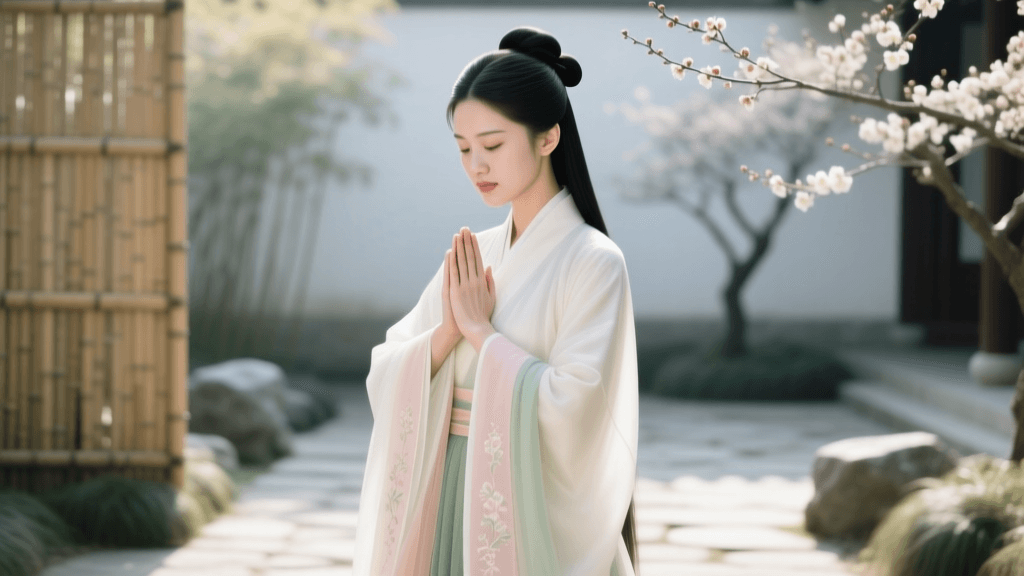
To perform the Wanfu Li, a woman places her right hand over her left hand and rests them slightly to the left of her waist or hip. She then bends her knees slightly into a shallow curtsy while bowing her head. The name 'Wanfu' translates to 'ten thousand blessings,' and it was traditionally accompanied by the verbal greeting 'Wanfu jintian' (May you have ten thousand blessings today). This greeting is best performed while wearing a Mamianqun (horse-face skirt) or a flowing Ruqun, as the slight bend in the knees causes the pleats of the skirt to flare beautifully.
Rites of Passage: The Guan and Ji Ceremonies
Hanfu etiquette extends deeply into life's major milestones, most notably the coming-of-age ceremonies. According to historical records covered by China Daily, modern revivals of these ancient rites are becoming increasingly popular among university students and cultural societies.
'Clothing and etiquette are the outward manifestations of inner virtue. To don the robes of adulthood is to accept the responsibilities of society.' — Adapted from the Book of Rites (Liji)
The Guan Li (Capping Ceremony): Performed for men at the age of 20. The young man is dressed in three progressively more formal layers of Hanfu, culminating in the placement of a traditional cap (Guan). This signifies his transition from a boy to a man capable of taking on societal and familial duties.
The Ji Li (Hairpin Ceremony): Performed for women at the age of 15. The young woman's hair, previously worn in childhood braids or buns, is pinned up using a traditional hairpin (Ji). She is dressed in a formal, elegant Ruqun or Aoqun, signifying her readiness for marriage and her entry into adult womanhood.
Modern Application and Practical Tips
Adapting these ancient rules for the 21st century requires a balance of historical reverence and modern practicality. If you are attending a Hanfu festival, a traditional tea ceremony, or a cultural exhibition, keep these actionable tips in mind:
- Posture is Paramount: Hanfu is unforgiving of slouching. Keep your shoulders back and your spine straight. The garments are cut to drape perfectly only when the wearer maintains an upright, dignified posture.
- Managing Long Skirts: When wearing a Mamianqun or a floor-length Ruqun, practice walking with small, measured steps. When climbing stairs, elegantly gather the front pleats of your skirt with one hand to prevent tripping.
- Sleeve Etiquette: When eating or drinking tea in wide-sleeved Hanfu, use your non-dominant hand to gently hold back the sleeve of your dominant arm. This prevents the silk from dipping into your food and shows refined manners.
- Footwear: While traditional cloth boots or embroidered shoes (Xiqiao) are ideal, modern wearers often substitute them with clean, minimalist leather loafers or plain canvas shoes that can be easily hidden beneath long skirts.
Mastering Hanfu etiquette is a journey of continuous learning. By respecting the dress codes and practicing the greeting rituals, you do more than just wear a beautiful garment; you become an active participant in the preservation and celebration of Asian cultural heritage.