Best Hanfu for Extreme Climates: Tropical, Desert & Cold 2026
The 2026 Global Hanfu Renaissance: Beyond Mild Weather
The global Hanfu movement has evolved dramatically by 2026, transitioning from a niche historical appreciation society into a mainstream, worldwide fashion phenomenon. No longer confined to the mild spring days of Suzhou or the crisp autumn photoshoots in Beijing, traditional Chinese clothing is now being worn in some of the most unforgiving environments on Earth. From the sweltering, high-humidity streets of Singapore and Miami to the arid, sun-baked dunes of Dubai and the freezing, wind-swept winters of Harbin and Montreal, enthusiasts are demanding garments that honor historical accuracy while providing extreme climate adaptation.
As highlighted in recent cultural reports by the South China Morning Post, the modern Hanfu movement is increasingly defined by its integration with advanced textile sciences and global lifestyle needs. In 2026, the intersection of ancient weaving techniques and modern climate-control technology has birthed a new era of functional traditional wear. This comprehensive guide explores how to select, layer, and care for Hanfu across tropical, desert, and freezing environments without sacrificing the elegant drape and cultural integrity that define these garments.
Tropical and Humid Climates: Mastering the Sweat Challenge
Wearing multiple layers of traditional silk in 35°C (95°F) heat with 90% humidity is a recipe for heat exhaustion and ruined textiles. The primary challenge in tropical climates is moisture management, breathability, and preventing the fabric from clinging uncomfortably to the skin. In 2026, the solution lies in specific heritage fabrics and structurally open silhouettes.
The Miracle of Xiangyunsha (Gambiered Silk)
For tropical Hanfu, no fabric is more revered than Xiangyunsha, or gambiered Guangdong silk. Recognized for its unique production process, this fabric is dyed using the juice of the Dioscorea cirrhosa (shoulang) tuber and coated with iron-rich river mud, then baked in the sun. The traditional craftsmanship of silk, recognized by UNESCO's Intangible Cultural Heritage list, has been adapted by 2026 textile innovators to enhance its natural properties. The resulting fabric is naturally antibacterial, highly breathable, and famously does not stick to the skin when wet. Modern 2026 iterations of Xiangyunsha feature micro-porous weaves that increase airflow by 30% compared to historical variants, making it the ultimate luxury choice for tropical Ruqun (blouse and skirt ensembles).
Structural Choices and Ramie Blends
Beyond silk, high-grade ramie and 2026 bio-engineered bamboo-linen blends are essential for tropical Hanfu. Ramie, historically used for summer garments in ancient China, offers exceptional moisture-wicking properties. For silhouettes, the Tang dynasty Qixiong Ruqun (chest-high skirt) remains highly popular, but modern tropical adaptations utilize single-layer, unlined Beizi (long coats) from the Song dynasty, worn open over lightweight inner layers. The wide, flowing sleeves of the Daxiushan act as natural bellows, pumping cool air against the body as the wearer moves.
Arid and Desert Climates: Sun, Sand, and Wind Protection
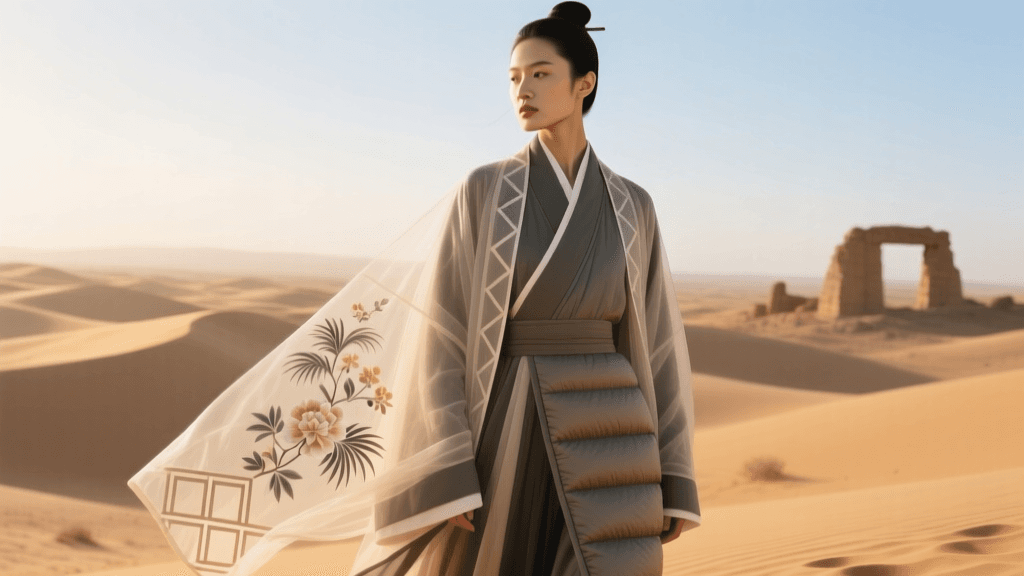
Desert environments present a triad of challenges: intense ultraviolet (UV) radiation, extreme diurnal temperature shifts, and abrasive, wind-blown sand. The goal in arid climates is not just to stay cool, but to create a microclimate that retains moisture and blocks external aggressors.
UV-Blocking Weaves and the Return of the Weimao
In 2026, tightly woven Tencel and high-density cotton-linen blends are the standard for desert Hanfu. These fabrics are engineered at the yarn level to offer UPF 50+ protection without the need for heavy chemical coatings, which can degrade in intense sun. Light colors—such as ivory, pale celadon, and sand—are heavily favored to reflect solar radiation. To protect the face and neck from harsh desert winds and UV exposure, the Weimao (a traditional wide-brimmed hat with a sheer veil) has seen a massive resurgence. Originally popular during the Tang dynasty for women riding horses, the 2026 Weimao features sheer, UV-treated organza veils that provide unparalleled sun protection while maintaining historical elegance and unobstructed visibility.
Sand-Deflecting Silhouettes
When navigating sandy environments, the hemline is critical. Floor-dragging skirts are impractical. Instead, enthusiasts opt for the Ming dynasty Mamianqun (horse-face skirt) tailored to ankle-length. The flat, unpleated front and back panels of the Mamianqun are structurally advantageous in high winds; unlike fully gathered skirts that balloon and catch sand, the structured pleats of the horse-face skirt remain relatively stable and shed dust easily when brushed. Paired with a tightly fitted Ao (jacket) with narrow Pipa-shaped sleeves, this silhouette minimizes sand intrusion at the cuffs and collar.
Freezing and Cold Regions: Thermal Retention Without Bulk
Winter Hanfu requires a delicate balance: achieving the voluminous, majestic silhouette of traditional cold-weather dress without resorting to the shapeless bulk of modern puffer coats. Historical precedents for cold-weather layering can be seen in the Metropolitan Museum of Art's Ming dynasty robe collections, which showcase the intricate, insulated layering systems utilized by nobility in freezing northern capitals.
Graphene-Infused Brocades and Ming Layering
The most significant breakthrough in 2026 cold-weather Hanfu is the integration of graphene-infused thermal interlinings. Graphene, a nanomaterial known for its exceptional thermal conductivity and lightweight properties, is now quilted between the outer brocade and the inner lining of Ming-style Dahu (sleeveless vests) and Pifeng (cloaks). This technology traps body heat and distributes it evenly across the garment, allowing the outer silk to remain at a thickness of just 2 millimeters while providing the warmth of heavy wool.
Modern Underlayers for Historical Accuracy
The foundation of winter Hanfu is the Zhongyi (inner garment). In 2026, traditional white cotton Zhongyi has been largely replaced by ultra-fine, 15-micron merino wool and thermal-regulating modal blends that mimic the exact drape and collar stiffness of historical cotton but offer superior heat retention. The layering order is strictly maintained for both warmth and aesthetics: a thermal Zhongyi base, followed by a lined Ao (jacket), a quilted Dahu vest, and finally, a sweeping, fur-collared Pifeng cloak that shields the entire ensemble from biting winds and snow.
2026 Hanfu Climate Adaptation Matrix
To help you navigate your wardrobe choices, refer to this quick-reference matrix designed for the modern global enthusiast.
| Climate Zone | Primary Challenge | Recommended 2026 Fabric | Ideal Garment Style | Key Accessory |
|---|---|---|---|---|
| Tropical / Humid | Sweat, High Heat, Clinging | Gambiered Silk (Xiangyunsha), Ramie | Tang Qixiong Ruqun, Open Song Beizi | Woven Rattan Fan, Bamboo Hairpins |
| Arid / Desert | UV Rays, Sand Intrusion, Wind | High-Density Tencel, UPF Linen | Ankle-length Mamianqun, Narrow-sleeve Ao | Weimao (Veil Hat), Silk Arm Cuffs |
| Freezing / Cold | Heat Loss, Wind Chill, Bulk | Graphene-lined Brocade, Merino Wool | Ming Dahu, Pifeng (Cloak), Lined Ao | Fur-lined Hand Muff, Thermal Zhongyi |
Sourcing, Tailoring, and Garment Care in 2026
The Hanfu market in 2026 is highly sophisticated, with AI-driven custom tailoring now standard for climate-specific garments. When ordering from major hubs like Hangzhou or Guangzhou, buyers can input their local climate data (average humidity, temperature extremes, and UV index) into brand applications. The AI then recommends specific weave densities, lining materials, and structural reinforcements tailored to that exact environment.
Care for these extreme-weather garments requires specialized attention. Xiangyunsha must never be machine washed or exposed to alkaline detergents; it requires a gentle, pH-neutral soak and shade-drying to maintain its mud-dyed patina. Desert garments treated with UV-blocking agents should be hand-washed in cold water to preserve the fiber coatings. Meanwhile, graphene-lined winter brocades and heavy wool Mamianqun should be professionally dry-cleaned using 2026's eco-friendly liquid silicone solvents, which clean deep into the pleats without stripping the natural oils from the silk or causing the thermal interlinings to degrade.
Conclusion
The adaptation of Hanfu for extreme climates is a testament to the living, breathing nature of traditional Chinese culture. By respecting historical silhouettes and embracing 2026's textile innovations, enthusiasts can confidently wear their heritage anywhere on the globe. Whether you are navigating the humid monsoons of Southeast Asia, the scorching sands of the Middle East, or the freezing snows of the Northern Hemisphere, there is a historically grounded, technologically advanced Hanfu ensemble designed to keep you comfortable, protected, and undeniably elegant.