Digital Hanfu Study: 2026 Academic 3D Reconstruction Tools
The Evolution of Digital Textile Pedagogy in 2026
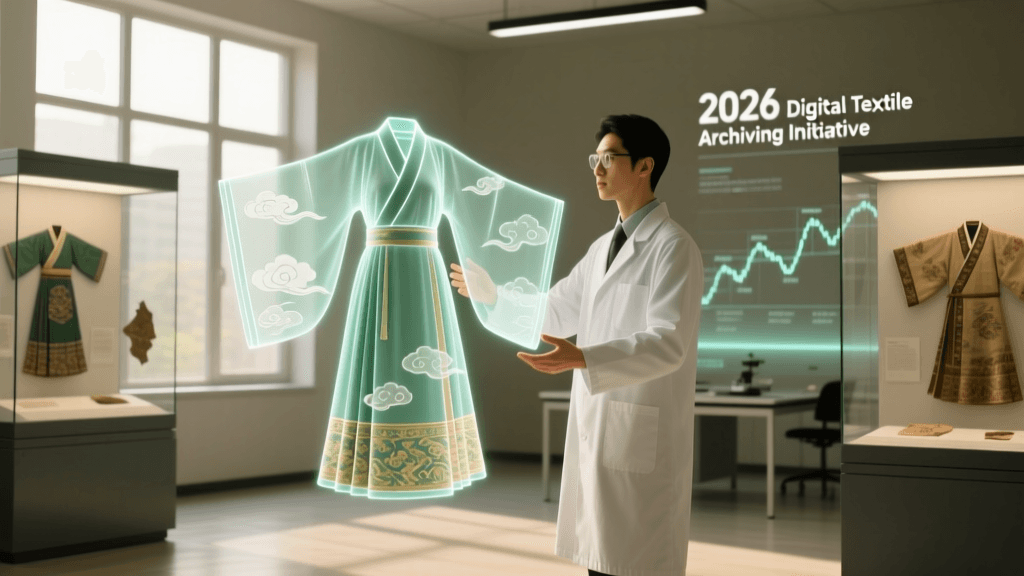
The academic study of Chinese fashion history has undergone a radical transformation by the 2026 academic year. Gone are the days when graduate students relied solely on two-dimensional rubbings, fragmented archaeological sketches, and physical muslin toiles to understand the complex drapery of ancient garments. Today, the intersection of historical textile research and advanced 3D simulation software has birthed a new pedagogical framework. Universities across Asia, particularly institutions like Donghua University and the Beijing Institute of Fashion Technology, are now mandating digital twin creation as a core component of their fashion history curricula.
This shift is largely driven by the explosive growth of the Xin Zhongshi (New Chinese Style) movement, which demands rigorous historical accuracy from contemporary designers. To meet this demand, academic researchers are utilizing physics-based garment simulation to decode the structural secrets of historical dress. By digitizing unearthed textiles and analyzing the drape coefficients of ancient weaves, scholars can now visualize how a Tang dynasty round-collar robe moved in real-time, providing unprecedented insights into the sartorial culture of ancient China.
Core Software and Hardware for Academic Garment Reconstruction
At the heart of this academic revolution is CLO Virtual Fashion, alongside specialized photogrammetry hardware. In 2026, the enterprise and academic tiers of CLO3D feature enhanced fabric physics engines capable of simulating the unique properties of traditional Chinese textiles, such as Luo (gauze) and Songjin (Song brocade). The software's ability to calculate warp and weft tension at a micro-level allows researchers to input exact thread counts derived from museum artifacts.
Hardware advancements have equally revolutionized the data-gathering phase. Academic labs now utilize portable LiDAR scanners and macro-photogrammetry rigs to capture the topographical displacement of surviving historical textiles. When physical artifacts are too fragile to handle, researchers turn to AI-driven pattern extraction tools that analyze high-resolution scans of Dunhuang murals and ancient scroll paintings, translating 2D artistic representations into mathematically viable 2D pattern pieces ready for 3D simulation.
Comparative Analysis of 3D Draping Software for Historical Textiles
| Software Platform | Physics Engine Type | 2026 Academic License Cost | Best Application in Chinese Fashion History |
|---|---|---|---|
| CLO3D (Academic) | Advanced Particle & Yarn-Level | $450 / year | Accurate drape simulation of Hanfu and complex layering systems. |
| Marvelous Designer | Standard Particle | $380 / year | Rapid prototyping of theatrical and performance-based historical costumes. |
| Blender (with Cloth Sim) | Vertex-Based Mass-Spring | Free (Open Source) | Integration of historical garments into VR museum environments and murals. |
Case Study: Reconstructing the Tang Dynasty Round-Collar Robe
To understand the practical application of these tools, we must examine a standard 2026 graduate thesis project: the digital reconstruction of the Tang dynasty Yuanlingpao (round-collar robe). This garment is notorious for its complex internal tying systems and the specific way the collar folds and overlaps, which varies significantly based on the wearer's posture and the fabric's weight.
Step 1: Photogrammetry and AI Pattern Extraction
Researchers begin by accessing the digital archives of institutions like China Silk Museum. Using AI-assisted edge detection, students isolate the seam lines of the Yuanlingpao from high-resolution photographs of unearthed garments from the Astana Cemetery. The AI extrapolates the missing geometric data, generating a base 2D pattern that accounts for the traditional flat-cutting (pingmian jiancai) methods of the era, where sleeves and body panels were cut from continuous lengths of narrow-loom silk.
Step 2: Physics-Based Fabric Simulation
The true academic rigor emerges in the fabric simulation phase. Historical Chinese silks behave vastly differently from modern textiles. For instance, when simulating the lightweight, breathable Luo gauze used for summer court dress, researchers in 2026 set the CLO3D bending stiffness to precisely 0.02 cN·cm² and the shear stiffness to 0.05 N/m. This specific parameterization replicates the fluid, almost liquid drape seen in historical texts.
Conversely, reconstructing the heavy, structured Zhuanghua brocades of the Ming dynasty requires drastically different inputs. Researchers must increase the fabric thickness to 0.8mm and push the bending stiffness beyond 1.5 cN·cm² to capture the structural rigidity and distinct acoustic rustle of the jacquard weaves. By running dynamic simulations—such as a virtual avatar walking up a flight of stairs or bowing in a court setting—students can analyze the stress points on the seams and the exact volume of fabric required to achieve the historically accurate silhouette.
Essential Academic Resources and Databases
A successful digital reconstruction relies heavily on primary source verification. In 2026, the most vital resource for international scholars remains The Metropolitan Museum of Art's Asian Art Department, which offers open-access, ultra-high-resolution imagery of Qing dynasty court robes and Han dynasty textile fragments. These images are crucial for creating accurate displacement and normal maps, which give 3D garments their tactile surface realism.
Furthermore, academic researchers are now integrating metadata standards specifically designed for digital heritage. When exporting a finalized 3D Hanfu model, students are taught to embed EXIF-style historical data directly into the file's metadata. This includes the dynasty, the specific archaeological site of the reference artifact, the loom width used in the original construction, and the botanical sources of the natural dyes (such as Rubia cordifolia for madder red or Polygonum tinctorium for indigo). This ensures that the digital twin remains a viable academic resource for future historians.
Curriculum Integration: A 2026 Syllabus Framework
For educators looking to update their Asian fashion history syllabi, the 2026 framework emphasizes a tripartite approach:
- Material Archaeology: Understanding the physical limitations of ancient looms (typically 45-55 cm wide) and how this dictated the zero-waste, geometric pattern-cutting of traditional Hanfu.
- Digital Draping & Physics: Mastering the translation of physical textile testing data (like the Kawabata Evaluation System for Fabrics) into 3D software parameters.
- Cultural Contextualization: Analyzing how the digital drape informs our understanding of ancient etiquette, movement restrictions, and social hierarchy dictated by sumptuary laws.
Future Trajectories in Textile Heritage Research
As we move through 2026, the boundary between physical conservation and digital resurrection continues to blur. The integration of haptic feedback gloves into academic labs now allows students to "feel" the simulated friction of raw silk versus polished damask while manipulating 3D patterns in virtual space. This multi-sensory approach to Chinese fashion history education not only preserves the tangible heritage of the Silk Road but also equips a new generation of designers with the empirical data needed to propel the Xin Zhongshi movement into the future with uncompromising historical integrity.
"Digital reconstruction is no longer merely a visualization tool; it is an empirical testing ground for historical hypotheses regarding ancient Chinese textile engineering and sartorial kinetics." — Journal of Asian Textile Heritage, 2026