Decoding Hanfu: Fashion in Traditional Chinese Scroll Art
The Canvas as a Historical Wardrobe
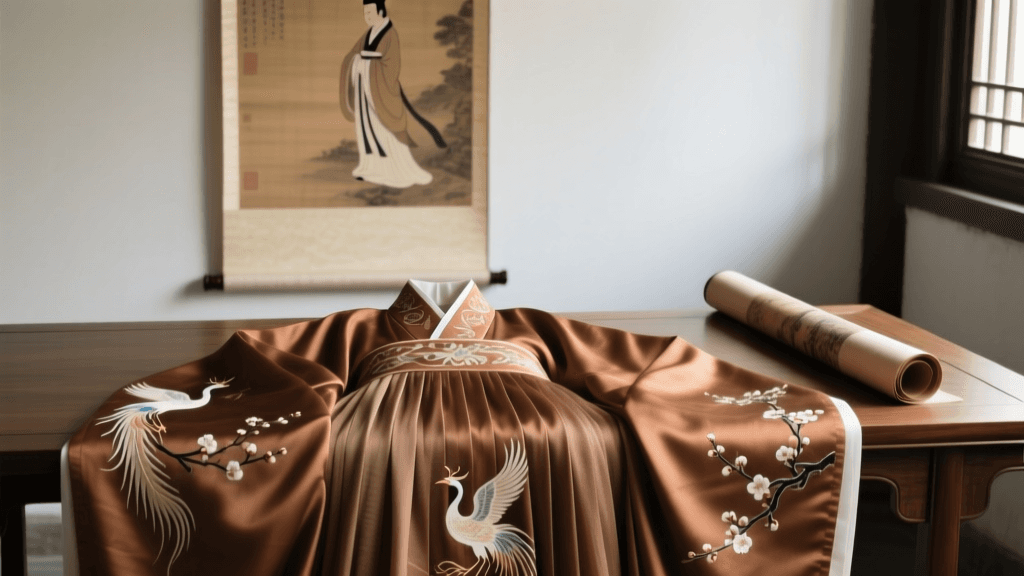
The study of traditional Chinese clothing, or hanfu, relies heavily on archaeological finds, tomb murals, and textual records. However, visual arts—specifically handscrolls and hanging scrolls—provide the most vibrant and contextual evidence of how these garments actually moved, draped, and interacted with the human body. For modern hanfu enthusiasts, historical reenactors, and textile designers, Chinese scroll paintings are not merely aesthetic masterpieces; they are vital blueprints. By analyzing the brushwork, pigment choices, and compositional proportions in these scrolls, we can extract actionable data for reconstructing historical wardrobes with striking accuracy.
Unlike static portraiture in Western oil paintings, Chinese handscrolls unfold narratively, revealing figures in motion, engaging in daily tasks, court rituals, or leisurely pursuits. This kinetic representation is crucial for understanding the structural engineering of historical garments. A static portrait might hide the weight of a silk skirt, but a scroll depicting a woman stepping over a threshold reveals the fabric's tension, the swing of the pleats, and the layering of undergarments. According to the Metropolitan Museum of Art's Heilbrunn Timeline of Art History, the Tang dynasty (618–907) was a period of immense cosmopolitan exchange, a fact vividly mirrored in the voluminous, flowing textiles depicted in the era's court paintings.
Decoding Three Masterpieces: A Dynasty Comparison
To understand the evolution of hanfu, we must examine specific masterpieces that serve as temporal anchors for fashion historians. Below is an analysis of three pivotal eras as captured by master painters.
Tang Dynasty: Court Ladies Adorning Their Hair with Flowers
Attributed to Zhou Fang (active late 8th century), this scroll is the definitive visual text for Tang court fashion. The figures are depicted in qixiong ruqun (chest-high skirts) paired with sheer, wide-sleeved daxiushan (large-sleeved robes) and pibo (draped stoles). The actionable takeaway for modern makers is the manipulation of volume. The artist uses sweeping, continuous brushstrokes to indicate heavy, high-momme silk that pools at the feet. The stoles are painted with lighter, more erratic lines, suggesting a lightweight silk gauze or leno weave that catches the breeze and floats independently of the body.
Song Dynasty: Along the River During the Qingming Festival
Zhang Zeduan’s 12th-century masterpiece shifts the focus from the imperial court to the bustling streets of Bianjing. Here, we see the democratization of fashion and the rise of the beizi (a parallel-collar, side-slit jacket). The silhouettes are markedly narrower and more modest than the Tang era. The brushwork reveals stiffer fabrics, likely ramie or heavily sized linen, which hold their shape rather than draping fluidly. For modern reconstruction, this scroll provides exact visual evidence of how commoners tied their sashes, secured their collars, and layered their trousers beneath knee-length skirts for urban mobility.
Ming Dynasty: Spring Morning in the Han Palace
Painted by Qiu Ying in the 16th century, this work, while depicting an earlier era, is heavily influenced by Ming dynasty sartorial norms. It is a masterclass in the aoqun (jacket and skirt) ensemble, specifically highlighting the early iterations of the mamianqun (horse-face skirt). The rigid, geometric pleats of the skirts contrast with the standing collars and structured sleeves of the jackets. The Metropolitan Museum of Art notes that Ming dynasty textiles were characterized by complex weaves and heavy brocades, which Qiu Ying meticulously renders through dense, repetitive patterns on the fabric surfaces, indicating the use of specialized drawlooms.
Data Table: Silhouette and Fabric Analysis Across Dynasties
| Dynasty | Reference Painting | Key Garment | Silhouette & Drape | Recommended Modern Fabric |
|---|---|---|---|---|
| Tang (618–907) | Court Ladies Adorning Their Hair | Qixiong Ruqun & Pibo | Voluminous, fluid, floor-pooling | 12-16 momme silk charmeuse, silk chiffon |
| Song (960–1279) | Along the River During Qingming | Beizi & Trousers | Narrow, structured, modest, crisp | Medium-weight ramie, 40-count linen |
| Ming (1368–1644) | Spring Morning in the Han Palace | Aoqun & Mamianqun | Architectural, pleated, tailored collars | 19-22 momme silk satin, woven brocade |
Practical Guide: Reconstructing Hanfu from Scroll Art
Translating a 2D painting into a 3D garment requires a methodical approach. Here is a practical framework for designers and hobbyists looking to recreate scroll-accurate hanfu.
1. Proportional Scaling Using the Head-Count Method
Traditional Chinese figure painting often employs a specific head-to-body ratio, typically ranging from 1:6 to 1:8 depending on the era and the subject's social status. To determine the exact length of a skirt or the drop of a sleeve, measure the painted figure's face from chin to hairline. If the face is 2 centimeters on your reference print, and the skirt measures 12 centimeters, the skirt is six times the length of the face. Apply this ratio to a real human model to calculate the required yardage. For a modern adult with a 22cm face length, a 6-head skirt would require a drop of approximately 132cm, dictating the exact cut of the fabric and the placement of the waistband.
2. Fabric Weight and Drape Selection
The behavior of the fabric in the painting dictates your textile choice. Selecting the wrong weight will ruin the historical silhouette, regardless of how accurate the pattern is.
- Tang Dynasty Stoles: Require 8 to 12 momme silk chiffon or habotai to achieve the floating, translucent effect seen in Zhou Fang’s work. Heavier silks will drag and fail to catch the air.
- Song Dynasty Beizi: Require medium-weight ramie or linen to replicate the crisp, structured lines and side-slits that do not collapse when the wearer stands still. The side slits must hang perfectly straight, which requires a fabric with high tensile strength and low drape.
- Ming Dynasty Mamianqun: Require heavy 19 to 22 momme silk satin or woven brocade. The sharp, knife-like pleats depicted in Ming scrolls cannot be achieved with lightweight fabrics; they require heavy materials, precise folding, and high-heat steam setting to maintain their architectural rigidity.
3. Pigment-to-Dye Translation
Scroll painters used mineral and botanical pigments that directly correlate to historical dye vats. Cinnabar and vermilion pigments translate to madder root or safflower dyes. Azurite and malachite blues and greens translate to indigo and pagoda tree bud dyes. When sourcing fabric, avoid neon or synthetic chemical colors; instead, seek out artisan-dyed textiles that replicate the slightly muted, organic depth of mineral pigments. Look for fabrics that exhibit slight color variations, a hallmark of traditional vat dyeing.
Where to Study Authentic Scroll Art Today
To conduct primary research, enthusiasts should utilize the digital archives of major institutions. The National Palace Museum in Taipei offers an exceptional open-access digital database where users can zoom in on high-resolution scans of handscrolls, allowing for the examination of individual weave patterns and embroidery stitches. Similarly, the Palace Museum in Beijing and the Metropolitan Museum of Art in New York provide extensive online collections with detailed curatorial notes.
When viewing these scrolls digitally, zoom in to at least 400% to study the hemlines and collar intersections. Look for the subtle shadows painted beneath the hems—these indicate the weight of the fabric and the presence of hidden structural layers, such as the stiffening linings used in Ming dynasty standing collars. Pay attention to how the artist renders folds at the joints; sharp, angular folds indicate starched linen or ramie, while soft, rounded folds indicate heavy, unstarched silk.
Conclusion
Chinese scroll paintings are far more than decorative art; they are meticulous historical records of Asian traditions and sartorial evolution. By learning to read the brushstrokes, analyze the proportions, and understand the material science implied by the ink and pigment, modern hanfu practitioners can bridge the gap between ancient aesthetics and contemporary reconstruction. Whether you are drafting a pattern for a Tang dynasty pibo or pleating a Ming dynasty mamianqun, the masters of the scroll remain your most reliable, enduring tailoring guides.