Decoding Hanfu: Traditional Garments in Chinese Scroll Art
The Canvas of History: Reading Garments in Scroll Art
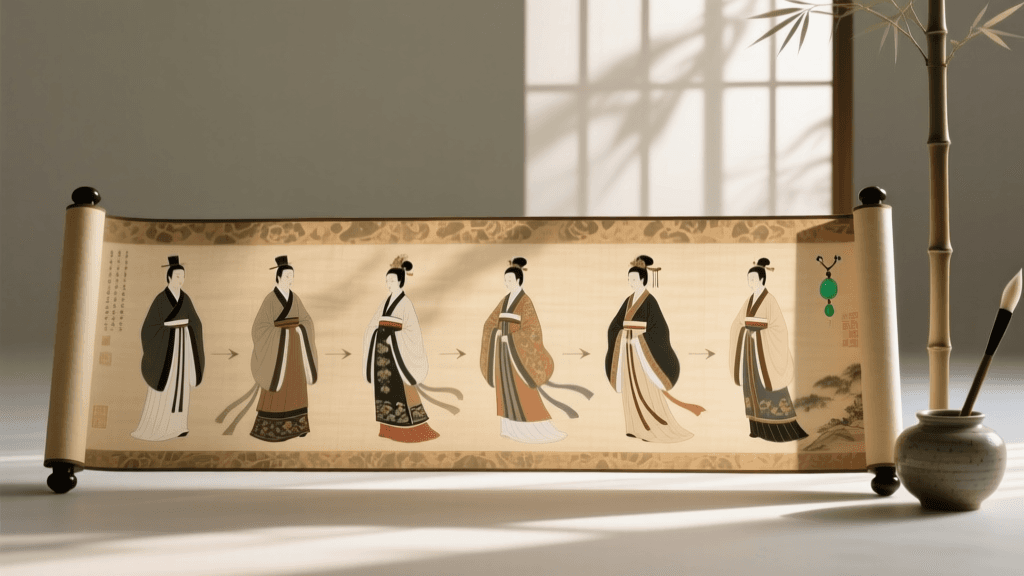
Chinese scroll paintings are not merely masterpieces of ink, mineral pigment, and silk; they are meticulous historical archives that capture the sartorial soul of their respective eras. For historians, textile conservators, and modern hanfu enthusiasts, these horizontal and vertical scrolls offer an unparalleled window into the evolution of traditional Chinese clothing. Unlike Western portraiture, which often focused on the individual, Chinese genre paintings and court scrolls emphasized the social fabric, depicting figures in dynamic interaction with their environment, their garments flowing in ways that reveal the weight, drape, and weave of historical textiles.
Through the meticulous gongbi (fine-line) brushwork technique, court painters documented everything from the sheer, gossamer silks of the Tang dynasty to the structured, heavy brocades of the Ming. By studying these masterpieces, we can decode the complex layering, dyeing techniques, and sumptuary laws that governed traditional Asian fashion.
Key Masterpieces and Their Sartorial Secrets
Tang Dynasty Opulence: Court Ladies Adorning Their Hair with Flowers
Attributed to the 8th-century painter Zhou Fang, this iconic horizontal scroll is a masterclass in depicting Tang dynasty court fashion. The painting features aristocratic women adorned in the qixiong ruqun (high-waisted chest skirt) and the pibo (a long, flowing silk stole). What makes this scroll invaluable to textile historians is the artist's ability to render transparency. Using diluted ink and faint mineral pigments, Zhou Fang captured the sheer nature of the silk pibo as it draped over the women's shoulders, revealing the intricate floral embroidery on the opaque under-layers. The voluminous silhouettes and bold, contrasting colors reflect the cosmopolitan confidence of the era, heavily influenced by Silk Road trade.
Song Dynasty Elegance: Along the River During the Qingming Festival
Zhang Zeduan's 12th-century masterpiece, Qingming Shanghe Tu, shifts the focus from the imperial court to the bustling streets of the Song capital, Bianjing. Featuring over 800 figures, this scroll is a sociological goldmine for everyday traditional clothing. Here, we see the transition from Tang exuberance to Song Neo-Confucian modesty. The garments are more slender, layered, and practical. The scroll meticulously documents the beizi (a long, side-slit overcoat) worn by scholars and merchants, as well as the shorter, hemmed tunics and trousers of laborers and boatmen. The painting highlights the widespread use of hemp, ramie, and linen among the working classes, contrasting sharply with the subtle, monochromatic silk damasks worn by the elite.
Ming Dynasty Structure: The Night Revels of Han Xizai
While the original subject dates back to the 10th century, the most famous surviving version of this scroll was painted by Gu Hongzhong and later widely copied and studied during the Ming dynasty. Ming-era interpretations and contemporary genre paintings by artists like Qiu Ying reveal the highly structured aoqun (jacket and skirt) ensemble. The collars are rigid, often featuring contrasting white linen护领 (collar protectors), and the skirts display the early structural origins of the mamianqun (horse-face skirt), characterized by flat front and back panels with pleated sides. The brushwork in these later scrolls emphasizes the heavy, light-reflecting qualities of woven gold thread and zhuanghua (brocade) textiles.
Brushwork as a Textile Indicator
'In traditional Chinese painting, the brush line is not merely an outline; it is a tactile descriptor. The 'iron wire' line denotes heavy, stiff brocades, while the 'gossamer' line captures the fluid, wind-blown nature of sheer summer silks.'
Understanding the specific brush techniques used in these scrolls is crucial for modern hanfu reconstruction. Artists utilized distinct line weights to communicate fabric density. A thick, unyielding ink stroke indicated stiff, heavily sized fabrics like raw silk or winter brocades, while faint, wavering lines suggested soft, washed silks or lightweight gauzes. This visual coding allows modern tailors to estimate the historical 'hand' or drape of a garment that no longer physically exists.
Comparative Analysis: Garment Features Across Dynasties
The following table outlines the primary sartorial shifts documented in Chinese scroll art across three major dynastic periods, providing a quick reference for identifying historical garments in art.
| Dynasty | Art Example | Dominant Silhouette | Key Garment | Textile Representation |
|---|---|---|---|---|
| Tang (618–907) | Court Ladies Adorning Their Hair with Flowers | Voluptuous, High-waisted, Flowing | Qixiong Ruqun, Pibo | Sheer silks, bold floral dyes, gold leaf accents |
| Song (960–1279) | Along the River During the Qingming Festival | Slender, Layered, Modest, Practical | Beizi, Ruqun, Ku (trousers) | Hemp, linen, subtle monochromatic damasks |
| Ming (1368–1644) | Night Revels of Han Xizai (Ming copies) / Qiu Ying scrolls | Structured, A-line, Rigid Collars | Aoqun, Mamianqun | Heavy brocades, woven gold, contrasting trims |
Actionable Guide: Using Scroll Art for Modern Hanfu Reconstruction
For modern hanfu makers, cosplayers, and historical reenactors, scroll paintings are primary source materials. However, translating a 2D painting into a 3D garment requires a systematic approach. Here is a practical guide to utilizing scroll art for accurate garment reconstruction.
Step 1: Sourcing High-Resolution Archival Images
Do not rely on compressed, low-resolution images found on general search engines. To study weave patterns and seam placements, you need gigapixel-quality scans.
- The Met Open Access: The Metropolitan Museum of Art provides high-resolution, public domain downloads of many Chinese scrolls and textile fragments. According to the Metropolitan Museum of Art's Heilbrunn Timeline of Art History, the mastery of silk weaving and textile production was a profound cultural export, and their digital archives reflect this depth.
- The Palace Museum Digital Archive: The Beijing Palace Museum offers extensive digital collections where users can zoom in on the minute details of Ming and Qing court paintings.
Step 2: Proportional Scaling and Yardage Estimation
Because scroll paintings rarely include standard measurements, you must use the human body as a baseline ruler. The average human head is approximately 20-23 cm in length. By measuring the ratio of the painted figure's head to the width of their skirt's hem or the length of their sleeves, you can estimate historical yardage.
- Skirt Circumference: In Ming dynasty paintings, the flat panels of the mamianqun often span the exact width of the figure's shoulders, while the pleated sides extend outward. This ratio helps tailors calculate the necessary fabric width (often requiring 3 to 4 meters of fabric per skirt to achieve the painted drape).
- Sleeve Length: Tang dynasty daxiushan (large-sleeved shirts) frequently cover the hands entirely in paintings. Measure the sleeve against the figure's forearm to confirm that historical sleeves often extended 20-30 cm past the fingertips, requiring specific weighted hems to achieve the painted droop.
Step 3: Decoding Painted Weaves and Dyes
Zoom in on the painted patterns to identify the weaving technique. If the pattern appears raised and catches painted 'light' differently than the background, the artist is likely depicting kosi (silk tapestry) or zhuanghua (brocade). Cross-reference the painted colors with historical dye records. For instance, the vibrant reds seen in Tang court scrolls were typically derived from madder root or safflower, while the deep blues in Song genre paintings indicate multiple dips in fermented indigo vats. The Tang Dynasty era is frequently characterized by its cosmopolitan openness, which introduced new dyeing techniques like wax-resist and clamp-resist, clearly visible in the complex geometric patterns painted on scroll garments.
Where to View and Study These Masterpieces Today
While many original scrolls are kept in climate-controlled vaults to prevent light degradation, several institutions offer unparalleled access to both the paintings and the physical textiles they depict. Institutions like the Victoria and Albert Museum hold extensive physical archives that corroborate the textiles seen in these painted scrolls, allowing researchers to compare the painted representation with surviving woven fragments.
Additionally, the Liaoning Provincial Museum and the National Palace Museum in Taipei frequently rotate their scroll collections, displaying segments of masterpieces like the Qingming scroll in low-light environments. For digital scholars, the Smithsonian National Museum of Asian Art's digital portal offers interactive, scrollable interfaces that mimic the physical act of unrolling a handscroll, allowing for a temporal study of how garments move through a painted narrative.
Conclusion
Traditional Chinese scroll paintings are far more than aesthetic triumphs; they are vital, encoded manuals of Asian material culture. By learning to read the brushwork, decode the silhouettes, and understand the socio-economic context of the figures depicted, we can bridge the gap between ancient art and modern wardrobes. Whether you are a historian analyzing Song dynasty sumptuary laws or a tailor drafting a Ming-style mamianqun, the scroll remains an indispensable guide to the timeless elegance of hanfu.