2026 Hanfu Guide: Dressing for Tropical, Desert & Cold Climates
The Global Hanfu Movement in 2026: Beyond Temperate Zones
The Hanfu renaissance has evolved dramatically by 2026. What was once a niche hobby reserved for temperate spring festivals and indoor photography has blossomed into a global, year-round lifestyle. Today, enthusiasts are proudly wearing traditional Chinese garments in the sweltering humidity of Singapore, the arid heat of the Dubai desert, and the biting sub-zero winds of Harbin and Hokkaido. However, wearing historical silhouettes in extreme climates requires more than just enthusiasm; it demands a deep understanding of traditional textile science, historical layering techniques, and modern fabric innovations.
Historically, Chinese dress was highly attuned to seasonal shifts and regional geography. The ancients did not wear the same garments year-round. By studying historical precedents and combining them with 2026 textile advancements, modern wearers can comfortably experience the elegance of Hanfu regardless of the weather. This comprehensive guide explores how to adapt traditional Chinese clothing for tropical, desert, and freezing environments.
Conquering Tropical and Desert Heat
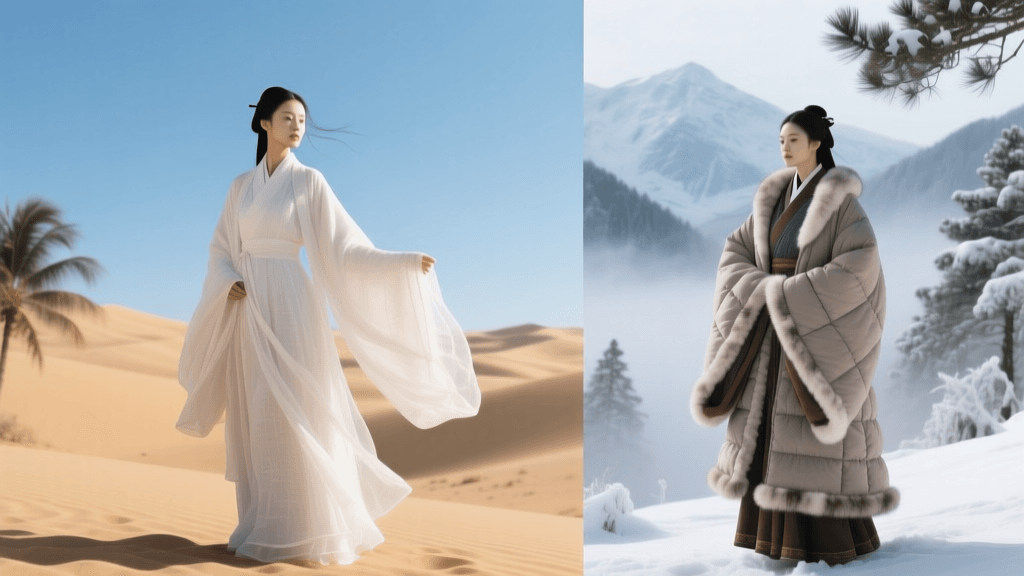
Tropical and desert climates present severe challenges for traditional dress: high UV exposure, extreme humidity, and blistering daytime temperatures. The key to surviving these environments in Hanfu lies in selecting the correct historical weaves and embracing the structural airflow of specific dynastic styles.
The Magic of Ramie and Summer Gauze
For high-humidity tropical regions, cotton and standard silk can quickly become heavy and cling to the skin. The historical solution is Xia Bu (summer cloth), a traditional textile woven from ramie fiber. Ramie is a bast fiber that has been cultivated in Asia for millennia. According to agricultural and textile studies documented by the Food and Agriculture Organization (FAO), ramie is highly absorbent, dries much faster than cotton, and possesses natural anti-bacterial properties, making it the ultimate historical fabric for tropical heat.
In 2026, modern weavers in Jiangxi and Hunan have refined traditional ramie processing, creating ultra-fine yarns that mimic the drape of silk while retaining the cooling properties of linen. Pairing a lightweight ramie Shan (shirt) with a sheer Mamianqun (horse-face skirt) allows for maximum airflow.
Another historical marvel is Luo (gauze) and Sha (crepe gauze). Unlike standard plain weaves, Luo utilizes a complex leno weave structure where warp threads are twisted around each other, creating permanent, microscopic pores in the fabric. As highlighted by the Metropolitan Museum of Art's collection on Chinese Textiles, these intricate gauze weaves were historically reserved for elite summer wardrobes because they allow wind to pass directly through the garment while maintaining a structured, elegant silhouette.
Desert Sun Protection and the Pifeng
Desert environments require protection from intense solar radiation while allowing the body to cool. The Song Dynasty Beizi (a long, open-front jacket) and the Pifeng (cape) are ideal for desert climates. When worn over a thin inner layer, the wide sleeves and open fronts create a bellows effect, pumping cool air against the skin as the wearer walks. In 2026, many desert-dwelling Hanfu enthusiasts opt for UV-blocking Sha fabrics in light, reflective colors like ivory, pale celadon, and moonlight white to deflect the harsh sun.
Surviving Freezing Cold Regions
When the temperature drops below freezing, the structural elegance of Hanfu must be fortified with serious insulation. The Ming Dynasty (1368–1644) provides the most robust historical blueprint for winter wear, characterized by high collars, padded layers, and heavy, wind-resistant textiles.
The Art of the Ao and Winter Layering
The cornerstone of winter Hanfu is the Ao, a lined or padded jacket that falls below the waist or to the mid-thigh. Modern winter Hanfu sets often feature a Pipa-sleeved Ao with a standing collar (Shuling), which protects the neck from biting winds. Beneath the Ao, wearers utilize a Zhongyi (inner garment). In 2026, the Zhongyi has been revolutionized by hidden thermal technology. Rather than bulky historical cotton padding, modern wearers utilize ultra-thin, graphene-infused thermal underlayers that trap body heat without disrupting the sleek, historical lines of the outer garments.
Heavy Silks, Wool, and Brocade
For the outer skirt, the heavy pleats of the wool-blend Mamianqun are not just decorative; the deep, overlapping pleats create pockets of trapped air that act as natural insulation for the legs. For formal winter events, enthusiasts turn to Zhuanghua (woven brocade) and velvet. The prestigious Nanjing Yunjin brocade, recognized by UNESCO for its Intangible Cultural Heritage status, is frequently woven with metallic threads and heavy silk that provide a dense, wind-breaking barrier. Modern 2026 adaptations often line these heavy brocade skirts with ethically sourced thermal fleece or high-tech aerogel linings, offering the opulence of historical winter wear with the warmth of modern arctic gear.
2026 Climate-Specific Hanfu Fabric Guide
To help you build a versatile, climate-appropriate wardrobe, consult the comparison table below detailing the best historical and modern fabric pairings for extreme environments.
| Climate Zone | Recommended Garment Style | Traditional Fabric | 2026 Modern Adaptation | Primary Benefit |
|---|---|---|---|---|
| Tropical / Humid | Song Beizi, Ruqun | Ramie (Xia Bu) | Micro-ramie / Tencel blends | Rapid moisture-wicking and anti-bacterial |
| Arid Desert | Pifeng, Wide-sleeve Shan | Luo (Leno Gauze) | UV-treated Silk Gauze | Solar reflection and structural airflow |
| Mild Winter | Ming Ao, Dahu (Vest) | Heavy Mulberry Silk | Silk-Wool interwoven blends | Wind resistance and core warmth |
| Extreme Cold | Shuling Ao, Lined Mamianqun | Yunjin Brocade, Velvet | Brocade with Aerogel lining | Maximum thermal retention without bulk |
Practical Styling Tips for 2026 Travelers
- Tropical Footwear: Avoid heavy, embroidered cloth boots in the rainforest or humid cities. Opt for traditional woven straw sandals (Caoxie) or modern 2026 hemp-canvas slip-ons that allow the feet to breathe and dry quickly.
- Desert Headwear: The Futou or wide-brimmed bamboo hats draped in sheer silk are historically accurate and provide essential shade for the face and neck in the Gobi or Arabian deserts.
- Cold Weather Hand Muffs: Historical Zhaojun muffs (fur-lined hand warmers worn over the wrists) are making a massive comeback in 2026. Look for versions lined with modern thermal-reflective foils to keep your extremities warm in sub-zero climates.
- Layering the Zhongyi: Always wear a Zhongyi (inner layer). In the heat, a sheer ramie Zhongyi protects your expensive outer silk from sweat. In the cold, a thermal Zhongyi acts as your primary base layer, preserving your body heat.
Conclusion
The beauty of Hanfu lies in its profound adaptability. It is not a static costume, but a living sartorial tradition that has historically weathered every climate the Asian continent has to offer. By respecting the wisdom of ancient textile weavers—who mastered the cooling leno weaves of summer and the dense, wind-breaking brocades of winter—and pairing them with the material science of 2026, you can wear your heritage with pride, comfort, and elegance, no matter where your travels take you.