Extreme Climate Hanfu 2026: Tropical, Desert & Cold Region Styling
The Global Hanfu Renaissance of 2026
The global appreciation for traditional Chinese clothing has evolved dramatically over the last decade. As we navigate through 2026, the Hanfu movement is no longer confined to the temperate, four-season climate of East Asia. Enthusiasts and cultural practitioners are now proudly wearing Hanfu in the sweltering humidity of Southeast Asia, the arid, sun-baked dunes of the Middle East, and the biting, sub-zero winters of Northern Europe and Canada. However, wearing historical garments in extreme environments requires a strategic blend of historical accuracy, modern textile innovation, and intelligent layering.
Historically, Chinese garments were highly adaptable to regional weather variations. According to the extensive archives on historical dress at the Metropolitan Museum of Art, ancient dynasties utilized specific weaving techniques, layering methods, and natural fibers to survive harsh environmental conditions. Today, contemporary heritage brands and smart-textile innovators are reviving these ancient concepts, integrating 2026 fabric technologies to make Hanfu viable for any extreme climate on Earth.
Tropical and Humid Climates: Breathability and Moisture Management
Wearing Hanfu in tropical regions like Singapore, Bangkok, or Miami presents a formidable challenge: high heat combined with oppressive humidity. Traditional heavy silks and dense brocades trap heat and cling uncomfortably to the skin when damp. The solution for 2026 lies in adopting specific historical silhouettes that promote airflow and utilizing specialized tropical fabrics.
Recommended Styles: Song Dynasty Elegance
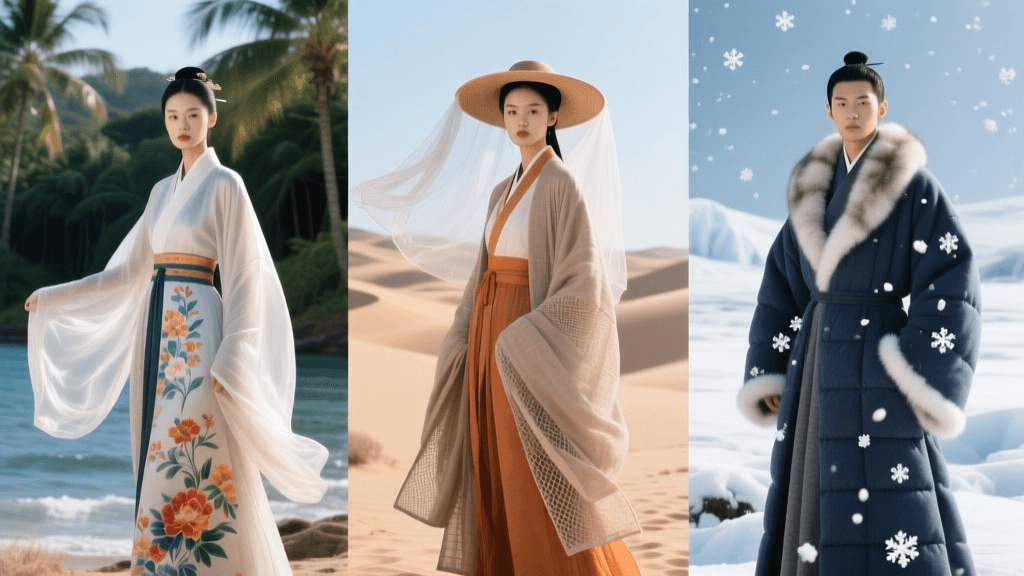
The Song Dynasty (960–1279 AD) is renowned for its minimalist, slender, and highly breathable silhouettes. The Beizi (an open-front, long-sleeved jacket) is the ultimate tropical garment. Worn open over a lightweight Moxiong (tube top) and a flowing, unlined skirt, the Beizi creates a natural chimney effect, allowing body heat to escape while providing elegant, sheer coverage. Another excellent choice is the Qixiong Ruqun (chest-high skirt), which eliminates the need for tight waistbands and allows maximum ventilation around the torso.
2026 Fabric Innovations: Gambiered Silk and Lotus Blends
For tropical Hanfu, material is everything. Xiangyunsha, or gambiered silk, remains a premier choice. Recognized for its profound cultural and historical significance, the traditional methods of silk production and treatment are deeply rooted in Chinese heritage, as highlighted by the UNESCO Intangible Cultural Heritage lists. Gambiered silk is treated with the juice of the Chinese yam and river mud, resulting in a fabric that is naturally water-resistant, quick-drying, and remarkably cool against the skin. In 2026, textile mills have also perfected bio-engineered lotus-silk and hemp-linen blends that mimic the drape of traditional silk while offering the moisture-wicking properties of high-end athletic wear.
Desert and Arid Climates: Sun Protection and Sand Mitigation
Desert environments, such as those found in Dubai, Arizona, and Central Australia, feature extreme diurnal temperature shifts, intense UV radiation, and blowing sand. The goal in these regions is to protect the skin from sunburn while maintaining a microclimate of cool air close to the body.
Recommended Styles: Tang Dynasty Volume
Counterintuitively, covering up entirely is the best defense against desert heat. The Tang Dynasty (618–907 AD) Yuanlingpao (round-collar robe) and wide-sleeved Daxiushan (large-sleeve shirt) are ideal. The voluminous sleeves and wide skirts trap a layer of insulating air that actually keeps the body cooler than tight, modern clothing. To manage the sand and wind, practitioners in 2026 often pair these robes with traditional wide-brimmed Weimao (veiled hats) or modernized sheer face veils that protect the respiratory system and face from abrasive dust storms.
2026 Fabric Innovations: UV-Blocking Organza and Tencel
Modern desert-adapted Hanfu relies heavily on advanced sheer overlays. 2026 market trends show a massive surge in UV-treated silk organza and Tencel-silk blends. These fabrics offer a high Ultraviolet Protection Factor (UPF) while remaining virtually translucent, preserving the ethereal, layered aesthetic of traditional Hanfu. Furthermore, the inner layers are now frequently crafted from micromodal and bamboo-derived viscose, which actively pull sweat away from the body and evaporate it rapidly, creating a natural cooling effect in dry heat.
Cold and Freezing Regions: Insulation Without Sacrificing Silhouette
Wearing Hanfu in the freezing winters of Harbin, Montreal, or Scandinavia requires serious thermal engineering. The historical precedent for winter Hanfu is incredibly robust, favoring dense layering, windproof outer shells, and luxurious insulation.
Recommended Styles: Ming Dynasty Structure and Cloaks
The Ming Dynasty (1368–1644 AD) provides the most comprehensive winter wardrobe in Hanfu history. The Aoqun ensemble, featuring a heavily lined, high-collared jacket (Ao) paired with a thick Mamianqun (horse-face skirt), is structurally designed to trap heat. The stiff, pleated structure of the Mamianqun allows for multiple layers of thermal leggings and wool trousers to be worn underneath without ruining the garment's silhouette. For outerwear, the Doupeng (a sweeping, hooded cloak) and the Pifeng (a fur-trimmed cape) are essential. As noted in the Victoria and Albert Museum's research on Chinese textiles, historical winter garments frequently utilized intricate embroidery and heavy, padded linings to combat the harsh northern winds, a tradition that modern designers are faithfully recreating.
2026 Fabric Innovations: Graphene Linings and Faux Fur
In 2026, the weight of traditional winter Hanfu has been drastically reduced thanks to nanotechnology. Contemporary heritage brands are integrating graphene-infused thermal linings into the Ao and Doupeng. Graphene is incredibly thin, lightweight, and highly conductive, distributing body heat evenly across the garment and eliminating the bulky, restrictive feeling of historical cotton padding. Additionally, ethical, high-pile faux furs made from recycled polymers are being used for collar and cuff trims, providing windproof barriers that look indistinguishable from historical mink or fox fur.
2026 Extreme Climate Hanfu Comparison Chart
| Climate Zone | Primary Challenge | Recommended Historical Style | 2026 Fabric & Tech Innovation |
|---|---|---|---|
| Tropical / Humid | Heat retention, sweat, clinging | Song Dynasty Beizi, Qixiong Ruqun | Gambiered silk (Xiangyunsha), bio-engineered lotus-hemp blends |
| Desert / Arid | Intense UV, blowing sand, dry heat | Tang Dynasty Yuanlingpao, Daxiushan | UPF-rated silk organza, bamboo-viscose inner layers |
| Cold / Freezing | Sub-zero temps, wind chill, bulk | Ming Dynasty Aoqun, Doupeng (cloak) | Graphene thermal linings, recycled polymer faux-fur trims |
Practical Layering and Accessory Tips for 2026
Beyond the primary garments, adapting to extreme climates requires a holistic approach to accessories and base layers:
- Smart Base Layers: In 2026, never wear Hanfu directly against the skin in extreme cold or heat. Use ultra-thin, temperature-regulating merino wool base layers for winter, and sheer, moisture-wicking mesh for summer. Ensure the neckline of the base layer perfectly matches the collar of your Hanfu to remain invisible.
- Modernized Footwear: Traditional Yunxie (cloud shoes) are beautiful but offer zero arch support or weatherproofing. Modern 2026 iterations feature EVA foam soles, waterproof vegan leather uppers, and thermal insulation, allowing you to walk on snow or scorching pavement comfortably.
- Strategic Fastening: In high-wind desert or cold environments, rely on internal ties and modern magnetic clasps hidden beneath traditional ribbon knots to ensure your garments do not blow open and expose your thermal layers.
Conclusion
The beauty of Hanfu lies in its profound versatility and deep connection to the natural world. As the global community of wearers expands in 2026, the integration of historical wisdom with cutting-edge textile science ensures that traditional Chinese garments can be worn with dignity, comfort, and safety in any environment. Whether you are navigating the humid streets of equatorial cities, the sun-drenched sands of the desert, or the snow-covered paths of the far north, there is a historically rooted, technologically advanced Hanfu ensemble perfectly suited for your journey.