Mastering Hanbok Jeogori Zero-Waste Construction in 2026
The Philosophy of Zero-Waste in Traditional Hanbok
As the global fashion industry pivots aggressively toward circularity and sustainable practices in 2026, modern designers are increasingly looking to the past for solutions. Long before the term 'zero-waste' entered the contemporary design lexicon, traditional Asian garment makers were mastering the art of the flat-pattern cut. The Korean hanbok, specifically the upper garment known as the jeogori, stands as a masterclass in zero-waste construction. Unlike Western tailoring, which relies on curved armholes, darts, and complex shaping that leave behind 15% to 20% of fabric as scrap, the traditional jeogori is constructed almost entirely from straight lines and rectangles.
This geometric approach was born out of necessity and respect for the material. Historically, silk and ramie were woven on narrow looms, producing fabric widths of roughly 35 to 40 centimeters. Every single inch of this precious textile was utilized. According to Britannica's comprehensive guide to Hanbok, the structural integrity and aesthetic grace of the garment rely not on the cutting of the fabric, but on the drape, the proportional geometry, and the meticulous hand-stitching that brings the flat pieces to life. Today, as we navigate the 2026 landscape of eco-conscious fashion, understanding and adapting these historic techniques offers a viable blueprint for modern zero-waste pattern making.
Anatomy of the Jeogori: Flat-Pattern Geometry
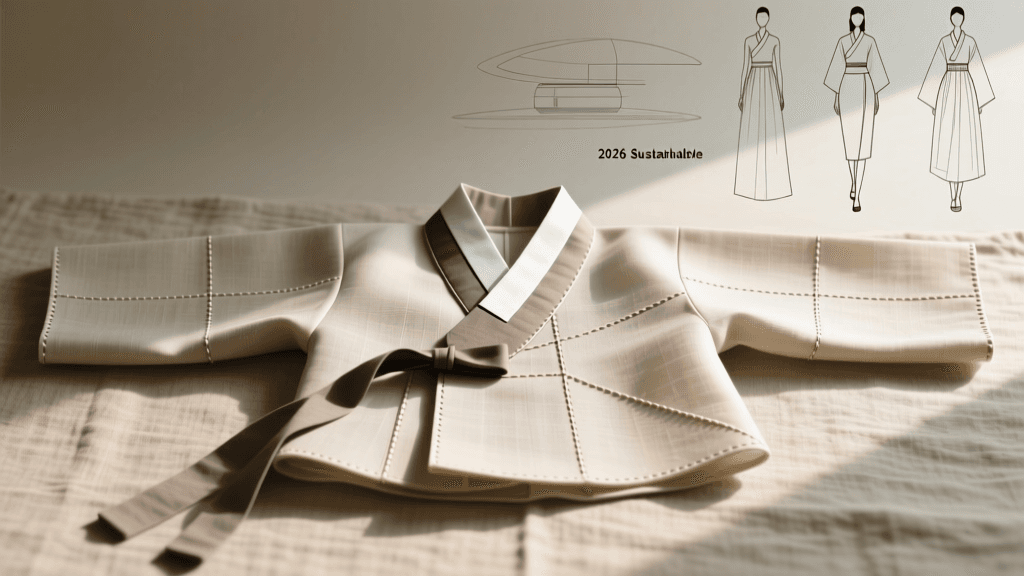
To construct a jeogori using traditional zero-waste methods, one must first understand its fundamental anatomy. The garment is deceptively simple, composed of just a few primary structural elements:
- Gil (Body): The main front and back panels. In traditional construction, this is often a single long rectangle folded over the shoulder, eliminating the shoulder seam entirely and preserving the fabric's continuous warp threads.
- Somae (Sleeves): Rectangular panels attached at a right angle to the body. The defining feature of the hanbok sleeve is the baerae—a subtle, sweeping curve along the bottom edge of the sleeve that mimics the shape of a traditional Korean roof eave, providing both elegance and ease of movement.
- Git (Collar Band): A straight band of fabric that frames the neckline and provides structural support for the detachable white collar.
- Dongjeong (White Collar): A stiff, white, detachable collar that contrasts with the colorful silk of the jacket, drawing attention to the wearer's face and neckline.
- Goreum (Ties): Long, flowing ribbons attached to the right front panel, used to secure the jacket. In 2026, modern interpretations often elongate the goreum for dramatic, contemporary styling.
Key Measurements and Allowances for 2026 Modern Fits
While historical hanbok were designed to be voluminous and conceal the body's natural silhouette, 2026 contemporary adaptations often require a more tailored fit while maintaining the zero-waste ethos. When drafting your pattern, the following measurements and allowances are standard for a modern, sustainable interpretation using 110cm-wide silk crepe or peace silk:
- Bust Circumference: Base measurement + 12cm ease (traditional ease was often 20cm+).
- Nape to Hem: Typically 22cm to 26cm for modern cropped styles, compared to the historical 28cm+.
- Sleeve Length: Measure from the center back neck to the wrist. Because the body panel folds over the shoulder, the sleeve panel only needs to cover the remaining arm length.
- Seam Allowances: A strict 1.5cm allowance is standard for flat-felled seams, ensuring no raw edges are exposed and eliminating the need for synthetic overlocking.
Step-by-Step Construction: The Straight Seam Method
Constructing a jeogori requires a departure from modern industrial sewing habits. The goal is to enclose all raw edges using traditional seam finishes, relying on the fabric's natural properties rather than synthetic interfacings.
Step 1: Layout and Cutting
Lay your 110cm-wide fabric flat. For a true zero-waste layout, the front and back gil panels are cut as a single continuous rectangle, folded precisely at the shoulder line. The sleeves are cut from the remaining width. The only curved cut is the baerae at the underarm/sleeve hem. The small triangular gussets removed from the baerae curve are traditionally saved and pieced together to create the inner collar extensions or the goreum ties, ensuring absolutely zero waste.
Step 2: The Sopyong (Side Seam) and Sleeve Attachment
Begin by sewing the sopyong, the side seams of the body. Use a traditional flat-felled seam (double-stitched and folded) to enclose the raw edges. Next, attach the rectangular somae (sleeves) to the body. Because there is no curved armhole, the sleeve is attached at a 90-degree angle. To accommodate the human shoulder's natural slope, traditional makers use steam and an iron to gently shrink and shape the fabric at the shoulder point, a technique that requires high-quality natural fibers like silk or ramie which respond beautifully to heat manipulation.
Step 3: Constructing the Git and Dongjeong
The git (collar band) is applied to the neckline. Instead of using modern fusible interfacing—which introduces microplastics into the garment—2026 sustainable tailors use gapsa, a lightweight, crisp silk organza, as an underlining to give the collar structure. The dongjeong is constructed separately, heavily stiffened with organic starch, and basted onto the git so it can be removed and washed independently.
Fabric Yield and Zero-Waste Comparison Chart
To understand the efficiency of the hanbok construction method, it is helpful to compare it against standard Western tailoring and contemporary zero-waste patterns. The data below reflects standard yardage for a women's cropped jacket (approx. 24cm hem length) using 110cm-wide fabric.
| Construction Method | Total Fabric Required | Estimated Waste | Primary Waste Source |
|---|---|---|---|
| Standard Western Tailored Jacket | 1.8 meters | 18% - 22% | Curved armholes, neckline cutouts, darts |
| Traditional Hanbok Jeogori (Narrow Loom) | 2.5 meters (35cm width) | < 2% | Baerae sleeve curve (repurposed for ties) |
| 2026 Modern Zero-Waste Jeogori (110cm width) | 1.2 meters | 0% | None (Strategic jigsaw layout, integrated ties) |
As evidenced by the chart, adapting the traditional geometry to modern wider fabric widths allows designers in 2026 to achieve a true zero-waste outcome, utilizing every centimeter of the textile for the garment body, facings, and ties.
Sourcing Sustainable Silk and Ramie in 2026
The success of a flat-pattern garment relies entirely on the quality and drape of the textile. Because the jeogori lacks structural darts, the fabric must do the work of shaping the body through its natural bias and weight. When sourcing materials for your 2026 projects, prioritize heritage textiles that support ethical agriculture and traditional weaving communities.
Hansan Mosi (Ramie): Recognized by UNESCO as an Intangible Cultural Heritage, Hansan mosi is a finely woven ramie fabric from South Korea. It is exceptionally crisp, breathable, and ideal for summer jeogori. In 2026, authentic, hand-woven Hansan mosi retails between $90 and $140 per yard, reflecting the intensive labor required to split and weave the ramie fibers. The Metropolitan Museum of Art's Asian Textile collection frequently highlights historical ramie garments, showcasing the fiber's incredible longevity and structural memory.
Peace Silk (Ahimsa Silk): For designers prioritizing vegan or cruelty-free metrics alongside zero-waste pattern cutting, peace silk is the premier choice for 2026. Unlike conventional silk, peace silk is harvested after the moth has naturally emerged from the cocoon. While it has a slightly more textured, slubbed appearance than cultivated mulberry silk, its matte finish and beautiful drape make it an excellent choice for the flowing goreum ties and the main body of the jeogori. Expect to pay $45 to $75 per yard for high-quality, GOTS-certified peace silk crepe.
Organic Cotton Voile: For everyday, washable interpretations of the jeogori, organic cotton voile provides a lightweight, semi-sheer alternative. When underlined with silk organza, it mimics the structural properties of traditional textiles while remaining accessible and cost-effective for emerging sustainable brands.
Conclusion
The construction of the traditional hanbok jeogori is a testament to the ingenuity of historical garment makers who viewed fabric not as a raw material to be carved away, but as a precious resource to be honored. As the fashion industry in 2026 continues to grapple with the environmental impact of textile waste, the flat-pattern, zero-waste geometry of Asian dress traditions offers more than just historical fascination—it provides a practical, actionable framework for the future of sustainable design. By mastering the straight seam, understanding the drape of natural fibers, and embracing the elegant proportions of the jeogori, modern designers can create garments that are as kind to the earth as they are beautiful to wear. For further reading on the global push for transparent and sustainable supply chains, resources like Fashion Revolution's global transparency initiatives provide excellent context on why these ancient, low-impact construction methods are more relevant today than ever before.