Hanbok Jeogori Construction: Zero-Waste Cutting in 2026
The Philosophy of Flat-Pattern Geometry in Korean Dress
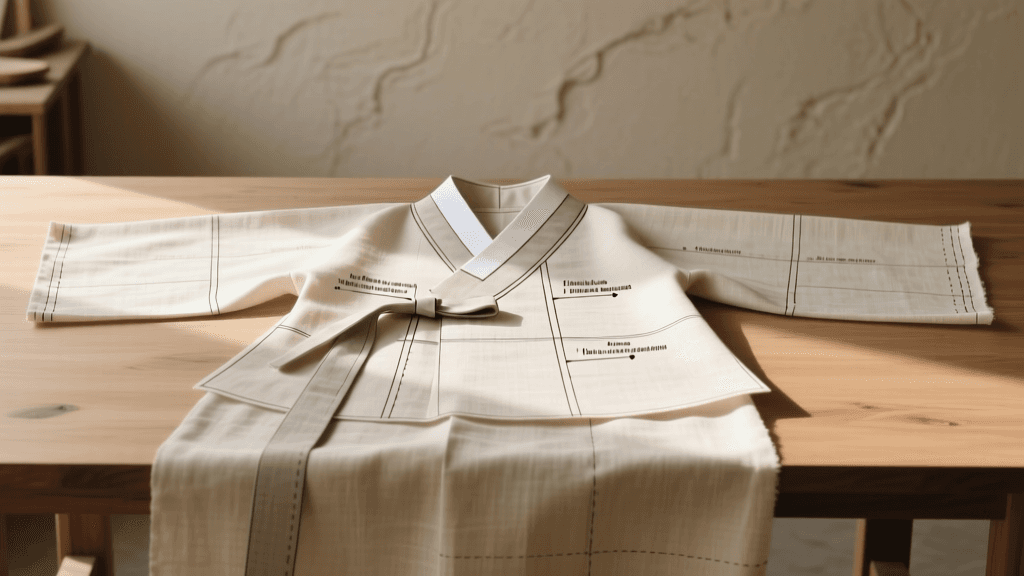
As the global fashion industry faces stringent environmental regulations and a consumer demand for circularity in 2026, traditional Asian garment construction techniques are experiencing a massive renaissance. Among the most revered of these is the flat-pattern cutting method used to create the jeogori, the iconic upper garment of the Korean Hanbok. Unlike Western tailoring, which relies on darts, princess seams, and curved armholes to mold fabric to the three-dimensional human form, traditional Korean dressmaking honors the two-dimensional integrity of the woven textile. This approach, known as straight-grain or flat-pattern cutting, results in a virtually zero-waste construction process that modern makers and sustainable fashion houses are eagerly adopting today.
The fundamental philosophy behind the jeogori is respect for the material. Fabric is viewed not as a malleable clay to be carved away, but as a sacred canvas. By cutting exclusively along the straight warp and weft threads, makers ensure that the natural drape, structural integrity, and longevity of the textile are preserved. When the garment is eventually deconstructed, the remaining fabric can be reused without the awkward, unusable offcuts generated by modern curved pattern drafting. According to the Ellen MacArthur Foundation, zero-waste pattern cutting is a critical pillar of circular fashion, a concept that Korean traditional makers perfected centuries ago.
Deconstructing the Jeogori: Key Structural Elements
To master the construction of the jeogori, one must understand its unique anatomical vocabulary. The garment is composed of several distinct, geometrically simple pieces that come together to create a complex, flowing silhouette. The primary components include:
- Gil (Body): The main front and back panels, cut as simple rectangles that wrap around the torso.
- Somae (Sleeves): Cut as straight, wide rectangles that attach to the body panels without a curved armscye.
- Git (Collar Band): A straight strip of fabric that frames the neckline and extends down the front opening.
- Dongjeong (White Collar): A removable, stiffened white collar that attaches to the git, providing a stark, elegant contrast and protecting the main fabric from skin oils.
- Goreum (Ties): Long, straight ribbons attached to the right side and the collar, used to secure the garment in a distinctive bow.
Historical garments preserved and studied at the National Museum of Korea demonstrate how these straight panels were meticulously pieced together using hidden stitches, allowing the garment to be easily taken apart, washed, and reassembled—a necessity in an era before modern dry cleaning.
2026 Measurement and Cutting Specifications
For contemporary makers adapting the jeogori in 2026, precision in the initial cutting phase is paramount. Because there are no curved seams to ease or stretch, the exactness of the straight lines dictates the final drape. Below is a standardized cutting guide for a modern women's jeogori, utilizing sustainable textile alternatives that have become industry standards this year.
| Component | Traditional Fabric | 2026 Sustainable Alternative | Cutting Dimensions (Standard) | Seam Allowance | Cutting Grain |
|---|---|---|---|---|---|
| Gil (Front/Back) | Silk Damask (Danjeong) | Tencel-Silk Jacquard Blend | Width: 65cm x Length: 75cm (x2) | 1.5 cm | Straight Warp |
| Somae (Sleeves) | Ramie or Silk | Recycled Ramie-Cotton | Width: 115cm x Length: 35cm (x2) | 1.5 cm | Straight Weft |
| Git (Collar) | Silk | Peace Silk (Ahimsa) | Width: 12cm x Length: 80cm | 1.0 cm | Straight Warp |
| Goreum (Ties) | Silk | Cupro-Bemberg | Width: 10cm x Length: 160cm (x2) | 0.5 cm | Straight Warp |
| Mu (Gusset) | Silk | Tencel-Silk Blend | 15cm x 15cm Square | 1.0 cm | Bias (45°) |
The Baerae: Curving Without Cutting
The most remarkable feat of engineering in the jeogori is the baerae—the gentle, sweeping curve of the underarm and sleeve bottom. In Western pattern making, this curve is achieved by cutting a concave shape into the fabric, which inherently creates waste and disrupts the woven grid. In traditional Korean construction, the sleeve and the side panel are cut as perfect, straight rectangles.
The curve is instead created during the sewing process through strategic folding, easing, and gathering. When the straight sleeve is joined to the straight body panel and the square gusset (mu), the maker sews a straight seam but intentionally leaves excess fabric at the underarm junction. This excess is then folded inward and secured with a specialized blind stitch, creating a voluminous, curved pocket of space that allows for freedom of movement while maintaining a smooth exterior line. This technique, known as baerae-japgi, is a masterclass in manipulating 2D geometry to accommodate 3D kinetics without generating a single fabric scrap.
Modern Digital Tools for Traditional Makers
In 2026, the intersection of heritage craftsmanship and digital technology has revolutionized how makers approach the jeogori. Advanced 3D fashion simulation software, such as CLO3D and Marvelous Designer, now features highly accurate physics engines capable of simulating the specific warp-and-weft tension of traditional Korean textiles like moshi (ramie) and myeongju (silk).
Makers can now draft their zero-waste, straight-line patterns digitally and simulate the drape on a customized avatar before cutting into expensive, sustainably sourced peace silk. This digital prototyping allows designers to adjust the exact placement of the baerae folds and the length of the goreum ties to ensure the garment sits perfectly on the body. Furthermore, digital fabrication tools like laser cutters are being used by avant-garde studios to seal the edges of delicate Tencel-silk blends, preventing fraying while maintaining the strict zero-waste mandate of the straight-line cut.
Sewing Techniques: The Hidden Stitches
The construction of the jeogori relies heavily on hand-sewn or meticulously replicated machine stitches that remain invisible from the garment's exterior. The ssamjeong (flat-felled seam) is the workhorse of Hanbok construction. Because the garment is unlined in its summer iterations (sok-jeogori), the interior must be as beautiful and finished as the exterior. The ssamjeong encloses all raw edges within a narrow, perfectly straight channel, providing structural reinforcement and a clean aesthetic.
For the collar (git), makers in 2026 are increasingly utilizing biodegradable, plant-based interfacings derived from cornstarch polymers, replacing the traditional paper or synthetic stiffeners. This ensures that the sharp, clean lines of the neckline hold their shape against the body's heat and moisture, while remaining 100% compostable at the end of the garment's lifecycle.
Sustainable Sourcing in 2026
The zero-waste cutting technique is only as sustainable as the fabric it utilizes. In 2026, the most sought-after textiles for authentic jeogori construction are lab-grown spider silk blends, which offer the tensile strength and luster of traditional mulberry silk with a fraction of the water footprint. Additionally, heritage ramie weavers in the Hansan region have partnered with bio-tech firms to produce naturally dyed, UV-resistant ramie that requires no chemical mordants, perfectly aligning with the eco-conscious ethos of modern Hanbok makers.
By marrying the ancient, zero-waste geometry of the jeogori with the material innovations and digital tools of 2026, contemporary designers are proving that the most sustainable fashion solutions are often those that have been hiding in plain sight for centuries. Mastering these straight-grain techniques is no longer just an exercise in historical preservation; it is a vital, forward-looking skill for the future of ethical garment construction.