Top Hanbok Making Workshops 2026: Seoul & Online Masterclasses
The 2026 Renaissance of Hanbok Construction Workshops
The global fascination with Korean heritage has reached new heights in 2026, moving beyond passive consumption into active, hands-on creation. Traditional garment making, specifically the construction of the Hanbok, has seen a massive surge in educational demand. According to recent cultural heritage reports, enrollment in traditional Korean tailoring seminars has increased by over 40% this year alone. This renaissance is driven by a desire to understand the architectural brilliance of Asian traditional dress, moving away from fast fashion and toward sustainable, historically grounded craftsmanship. For textile enthusiasts, fashion students, and cultural preservationists, 2026 offers an unprecedented array of workshops and masterclasses dedicated to the art of Hanbok making, both in the heart of Seoul and through advanced hybrid online platforms.
The Mathematics of Flat-Pattern Cutting
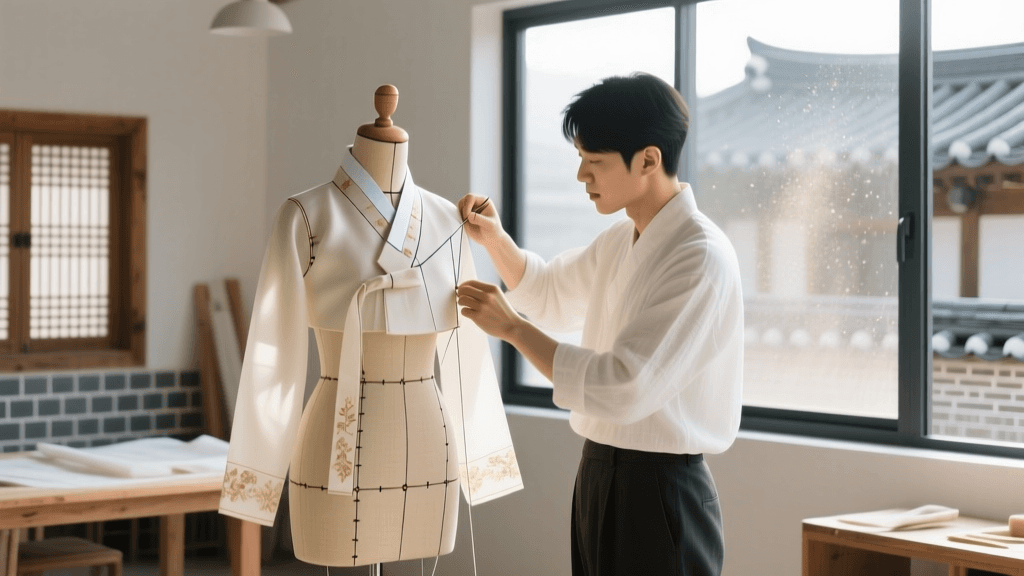
Unlike Western tailoring, which relies heavily on darts, complex curves, and three-dimensional draping to fit the body's contours, traditional Hanbok construction is rooted in two-dimensional, flat-pattern cutting. As detailed in the Metropolitan Museum of Art's Heilbrunn Timeline of Art History, the Joseon Dynasty established a silhouette that prioritized straight lines, geometric precision, and the natural drape of the fabric. In 2026 workshops, students learn that the Jeogori (traditional jacket) is constructed almost entirely from straight-grain rectangles and triangles. The shaping occurs not through cutting away fabric, but through the strategic placement of seams, the gathering of the Chima (skirt), and the structural stiffness of the Dongjeong (white collar). Mastering this zero-waste, geometric approach to pattern drafting is a primary focus of modern seminars, offering fashion designers a completely different paradigm for garment construction.
Top In-Person Masterclasses in Seoul (2026 Cohorts)
For those able to travel to South Korea, Seoul remains the undisputed epicenter of Hanbok education. The 2026 spring and autumn cohorts at premier institutions offer immersive, multi-week intensives.
Seoul Global Cultural Center (SGCC)
Located in the vibrant Myeongdong district, the SGCC offers a highly sought-after 8-week 'Traditional Hanbok Tailoring' seminar. The 2026 curriculum has been updated to include modules on sourcing sustainable, cruelty-free peace silk (Myeongju) from domestic suppliers. Students spend the first three weeks mastering the Jeogori, focusing on the precise mathematical ratios required for the Goreum (the long, flowing chest bow). The final five weeks are dedicated to the Chima, where learners master the traditional knife-pleating techniques using heated wooden blocks. Tuition for the 2026 cohort is approximately 450,000 KRW (around $330 USD), excluding materials.
Korea Traditional Craft and Architecture Museum Workshops
For advanced sewists, the museum's master-apprentice style seminars are unparalleled. These weekend intensives focus on historical replication. In 2026, the spotlight is on the Hwalot (ceremonial bridal robe). Participants learn the intricate embroidery preparation and the complex lining techniques required to give the heavy silk robe its distinctive, structured drape. These seminars are taught by certified Intangible Cultural Heritage practitioners, ensuring the techniques passed down are historically flawless.
Premier Online & Hybrid Hanbok Seminars
Geographical barriers are no longer an excuse to avoid learning traditional Asian garment making. The push for global cultural education, supported by organizations like the Asia Society's traditional arts initiatives, has led to the development of high-definition, multi-camera online workshops.
Global Korean Cultural Center Hybrid Programs
Branches of the Korean Cultural Center worldwide, from New York to London, have rolled out hybrid 2026 programs. Students receive a curated physical kit in the mail containing pre-cut Mosi (ramie fabric), traditional curved rulers, and specialized silk pins. The live-streamed seminars utilize overhead 4K cameras to demonstrate the minute details of hand-stitching the Seop (front overlap panel). The UNESCO Intangible Cultural Heritage registry on Hansan Ramie weaving highlights the delicate, breathable nature of this fabric, making it a challenging but rewarding material for online students to master under the remote guidance of Seoul-based masters.
2026 Workshop Comparison Chart
| Workshop / Institution | Format | Duration | 2026 Est. Cost (USD) | Skill Level |
|---|---|---|---|---|
| Seoul Global Cultural Center | In-Person (Seoul) | 8 Weeks (48 hrs) | $330 + Materials | Beginner to Intermediate |
| Traditional Craft Museum Intensive | In-Person (Seoul) | 3 Weekends (24 hrs) | $500 + Materials | Advanced / Professional |
| Global KCC Hybrid Ramie Course | Online Live + Kit | 6 Weeks (18 hrs) | $275 (Kit included) | Intermediate |
| Domestika: Modern Hanbok Drafting | Pre-recorded Online | Self-Paced (12 hrs) | $45 | Beginner |
Essential Toolkit for the 2026 Hanbok Maker
Attending a seminar requires specific tools that differ vastly from standard Western sewing kits. If you are enrolling in a 2026 masterclass, ensure you have the following:
- Curved Bamboo Rulers: Essential for drafting the subtle, sweeping curves of the Bae-rae (the curved underarm seam of the sleeve). Standard straight rulers cannot achieve this historically accurate slope.
- Traditional 'Gawool' Shears: Heavy-duty, carbon-steel shears designed specifically for cutting through multiple layers of crisp silk and ramie without fraying the edges.
- Silk Pins (Guk-sa-pin): Extra-fine, flexible glass-head pins. Traditional Hanbok silk is densely woven; standard pins will leave permanent holes or snag the delicate threads.
- Beeswax Thread Conditioner: Hand-stitching the Dongjeong (collar) requires incredibly strong, waxed silk thread to maintain the stiff, upright structure of the neckline.
- Wooden Pleating Blocks: For Chima construction, traditional wooden blocks heated over steam are still preferred over modern plastic pleaters to ensure the ramie or silk holds its knife pleats through decades of wear and washing.
Core Techniques Taught in 2026 Seminars
Whether you are learning in a brightly lit Seoul studio or via a hybrid online stream, the curriculum will heavily emphasize three foundational techniques:
1. The Architecture of the Dongjeong (Collar)
The white, detachable collar is the focal point of the Hanbok, framing the face and providing structural contrast to the colorful silk of the Jeogori. Students learn to cut the collar on the bias, apply a stiff interfacing made from traditional mulberry paper (Hanji), and execute the invisible slip-stitching required to attach it flawlessly to the neckline.
2. Drafting the Bae-rae (Curved Sleeve)
The Bae-rae is the defining curve of the Hanbok sleeve, resembling the gentle slope of a traditional Korean roof. Mastering the ratio between the shoulder drop and the wrist width is a rigorous mathematical exercise taught in the first week of any reputable seminar. A poorly drafted Bae-rae will cause the garment to bunch uncomfortably at the armpit when the arms are lowered.
3. Tying the Goreum (Chest Bow)
Far from a simple knot, the Goreum is a complex structural tie that holds the jacket closed while creating a visually balanced, asymmetrical bow. Workshops dedicate entire sessions to the physics of the knot, teaching students how to press and fold the wide silk ribbons so that they hang with the correct tension and angle, reflecting the wearer's social grace and attention to detail.
How to Prepare for Your First Seminar
Before stepping into a 2026 Hanbok workshop, it is crucial to prepare your foundational skills. While you do not need to be a master tailor, you should be completely comfortable with basic hand-sewing stitches, particularly the running stitch and the backstitch, as much of the internal structure and collar work is done by hand to maintain historical accuracy. Familiarize yourself with the behavior of natural fibers; practice cutting and sewing 100% silk organza or lightweight linen to understand how natural fabrics shift and fray. Finally, approach the seminar with a mindset of cultural respect and patience. Traditional Asian garment making is not about speed or mass production; it is a meditative practice of precision, geometry, and deep respect for the materials. By enrolling in these specialized 2026 masterclasses, you are not just learning to sew a garment; you are participating in the living preservation of Asian cultural heritage.