Haida Woolen Button Blanket Design Coding And Loom Construction
The Haida Button Blanket: A Living Archive of Coast Salish and Haida Cosmology
Woven on the mist-shrouded archipelago of Haida Gwaii—formerly the Queen Charlotte Islands—button blankets are not mere garments but portable crests, legal documents, and kinship maps rendered in wool and shell. Though often associated broadly with Northwest Coast peoples, the button blanket tradition is most rigorously codified among the Haida Nation, whose ancestral territory spans over 17,000 km² of islands and coastal rainforest. These blankets measure precisely 137 cm wide by 213 cm long—the standard ceremonial size used for potlatches held at the Old Massett Village Council longhouse. Each blanket begins as undyed Chilkat-style mountain goat wool spun by hand, then dyed using traditional methods: hemlock bark yields deep russet (requiring a 72-hour soak), while lichen produces ochre tones through fermentation lasting up to 14 days.
Design Coding: The Grammar of Crest Imagery
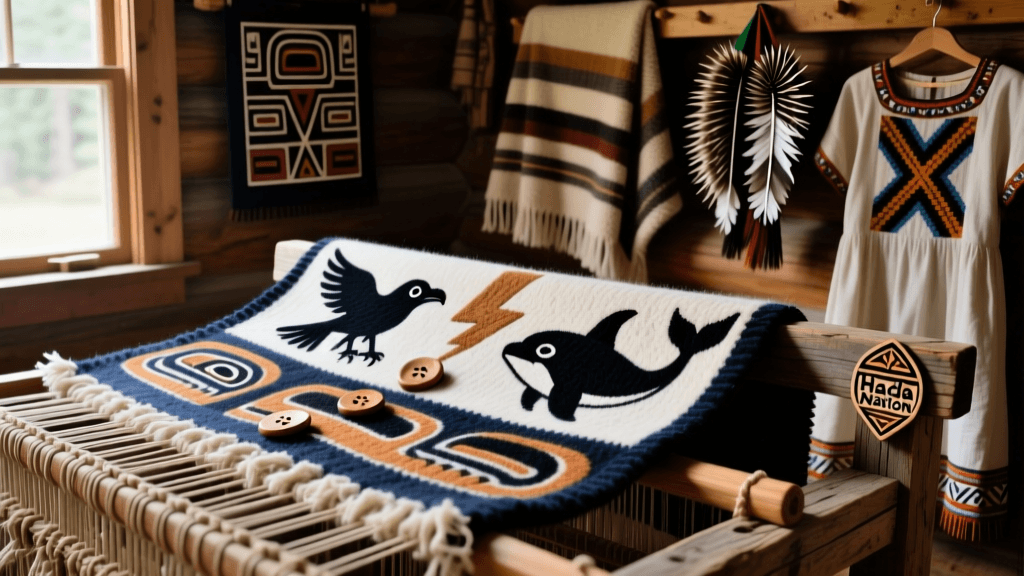
Every element of a Haida button blanket follows strict hereditary protocols governed by matrilineal house groups. The central crest—often a Raven, Eagle, Killer Whale, or Bear—is never improvised. Its placement, orientation, and proportional relationships adhere to rules passed down through generations of master weavers like Florence Davidson and Delores Churchill. The black field represents the primordial sea; the red border symbolises life force and bloodline continuity; and the white background evokes cedar bark, the foundational material of Haida basketry and architecture.
Button Placement as Kinship Syntax
Abalone and mother-of-pearl buttons—sourced from Pacific coast shells—are not decorative accents but grammatical markers. Their count and arrangement encode lineage rank and house affiliation. For example:
- A full-length blanket worn by a hereditary chief displays exactly 144 buttons arranged in 12 vertical columns of 12
- Each column corresponds to one of the 12 founding lineages of the Kaigani Haida in Alaska
- Buttons placed within 5 cm of the crest’s eye denote direct descent from the crest’s original bearer
Crest Proportions and Symbolic Geometry
The crest occupies exactly 60% of the blanket’s total height. Within that space, the head fills 38% of the crest area, the body 42%, and appendages 20%. This ratio appears consistently across blankets held in museum collections dating back to 1885, confirming its adherence to inherited design logic rather than aesthetic preference.
Loom Construction: From Cedar Frame to Tension Precision
Haida weavers construct upright looms from western redcedar, selecting straight-grained saplings aged between 40–60 years for optimal flexibility and tensile strength. The frame stands 220 cm tall and 150 cm wide, with warp beams spaced precisely 115 cm apart to maintain even tension across the 1,200-thread warp. Traditional looms lack mechanical tensioning devices; instead, weavers use cedar pegs driven into the ground at exact 12° angles to anchor the lower beam—angles verified using cedar compasses calibrated against true north via Polaris observation.
Warp Preparation and Threading Protocols
Warp threads are hand-spun from mountain goat wool blended with stinging nettle fibre (Urtica dioica) at a ratio of 70:30 to increase durability. Each thread is measured to 240 cm before mounting—a length allowing for 15 cm of take-up during weaving and 10 cm of fringe. Weavers follow the “three-pass rule”: every third warp thread must be threaded through a heddle rod carved from yew wood, ensuring consistent shed formation. This method produces the distinctive “stepped” edge visible along the blanket’s red border.
Ceremonial Significance and Contemporary Reclamation
Button blankets are activated only during formal potlatches, naming ceremonies, and memorial feasts. They are never worn casually or displayed outside sanctioned events. At the 2019 G̱aaw Village Potlatch in Skidegate, 17 new blankets were unveiled—each representing a distinct lineage from the three major Haida villages: Skidegate, Old Massett, and Hydaburg. The event was co-organised by the Council of the Haida Nation and the Haida Gwaii Museum at Kay Llnagaay, which maintains a digital archive of 214 historic blanket photographs taken between 1910 and 1987.
The revival of button blanket weaving is deeply tied to language reclamation. As noted by the Haida Language Authority (2021), “The verbs for ‘to weave a crest’ and ‘to assert sovereignty’ share the same root morpheme tl’áa. To weave is to govern.” This linguistic link underscores how textile practice functions as embodied law. In 2023, the Skidegate Band Council approved Ordinance No. 2023-07, mandating that all ceremonial blankets gifted to visiting dignitaries must include a woven label bearing the Haida name of the originating house group and the year of creation—replacing English-only museum tags used since the 1950s.
Institutional Stewardship and Ethical Curation
The Royal British Columbia Museum in Victoria holds 89 documented Haida button blankets, 42 of which were repatriated between 2015 and 2022 under the Haida Repatriation Protocol signed by the museum and the Council of the Haida Nation. Similarly, the Canadian Museum of History in Gatineau returned 17 blankets in 2018, including a 1894 Raven crest blanket measuring 138 cm × 214 cm—just 1 cm outside standard dimensions, indicating it was woven for a specific individual of exceptional stature.
“We do not ask museums to ‘display our culture.’ We ask them to return the physical anchors of our laws so we may continue to live them—not as relics, but as obligations.” — Kii’iljus Barbara Wilson, Haida artist and cultural advisor, Council of the Haida Nation (2020)
Contemporary Practice and Technical Continuity
Today’s weavers maintain exacting technical standards. Delores Churchill, a Haida elder and master weaver based in Hydaburg, Alaska, teaches apprentices to spin wool at a consistent 8–10 twists per inch using spindle whorls carved from argillite—a black slate found only on Haida Gwaii. Her students must complete 200 hours of warp preparation before threading their first loom. The Haida Gwaii Higher Education Society offers a certified 1,200-hour Indigenous Weaving Diploma, with curriculum approved by the Council of the Haida Nation Education Department. Graduates must demonstrate mastery of five core techniques: cedar-bark warp substitution, abalone inlay binding, crest symmetry verification using mirrored water reflection, ceremonial fringe knotting (exactly 27 knots per side), and post-weaving steaming at 92°C for 4 minutes to set dyes.
Measurements are non-negotiable: the red border must be exactly 12.7 cm wide (½ inch in imperial, preserved from pre-contact trade cloth standards); abalone buttons must be cut to 1.2 cm diameter with no more than 0.3 mm variance; and the final blanket weight must fall between 1,850 g and 1,920 g—verified using scales calibrated annually at the Haida Gwaii Museum conservation lab.
The button blanket remains inseparable from Haida governance. When the Council of the Haida Nation ratified its Constitution in 2007, the signing ceremony took place beneath a 1921 Eagle crest blanket woven by Margaret S. Edenshaw—now housed at the Museum of Anthropology at UBC. That blanket measures 137.2 cm × 213.4 cm and contains 142 abalone buttons, each polished with sharkskin and fixed using sinew from Sitka black-tailed deer. Its continued presence at constitutional proceedings affirms that law, land, and loom remain interwoven.
| Feature | Traditional Standard | Contemporary Verification Method |
|---|---|---|
| Warp thread count | 1,200 ± 12 threads | Counted under 10× magnification at Haida Gwaii Museum lab |
| Button diameter variance | ≤ 0.3 mm | Measured with Mitutoyo digital calipers (certified annually) |
| Final blanket weight | 1,850–1,920 g | Weighed on Mettler Toledo scale calibrated to NRC Canada standards |
At the heart of this tradition lies an unbroken chain of responsibility: to ancestors who first stretched wool across cedar frames, to living relatives who hold crest rights, and to future generations who will inherit both the loom and the law. Every stitch asserts continuity—not as nostalgia, but as daily practice grounded in place, protocol, and precision.
The Haida Gwaii Museum at Kay Llnagaay, the Old Massett Village Council, and the Council of the Haida Nation jointly administer the Haida Weaving Certification Program, ensuring that technical fidelity serves cultural sovereignty—not the reverse. This is not craft preservation; it is jurisdiction enacted through fibre.
When a young Haida weaver in Skidegate finishes her first full-length blanket, she does not sign it. She presents it to her grandmother, who inspects the tension, counts the buttons, and traces the crest’s outline with her fingertips—confirming that the pattern breathes with the same rhythm as the tides off Tanu Island. Only then does the blanket receive its Haida name, spoken aloud for the first time in the longhouse. That moment is not an ending—it is the first public utterance of a covenant renewed.
These blankets do not hang on walls. They move with people. They wrap shoulders at funerals. They drape over canoes during launching rites. They cover newborns during naming. Their geometry is not static; it pulses with the heartbeat of Haida law, measured in centimetres, grams, and generations.
The loom is not a tool. It is a threshold.